聖ニコラウスのお祭り
ヤン・ステーン · 1660s
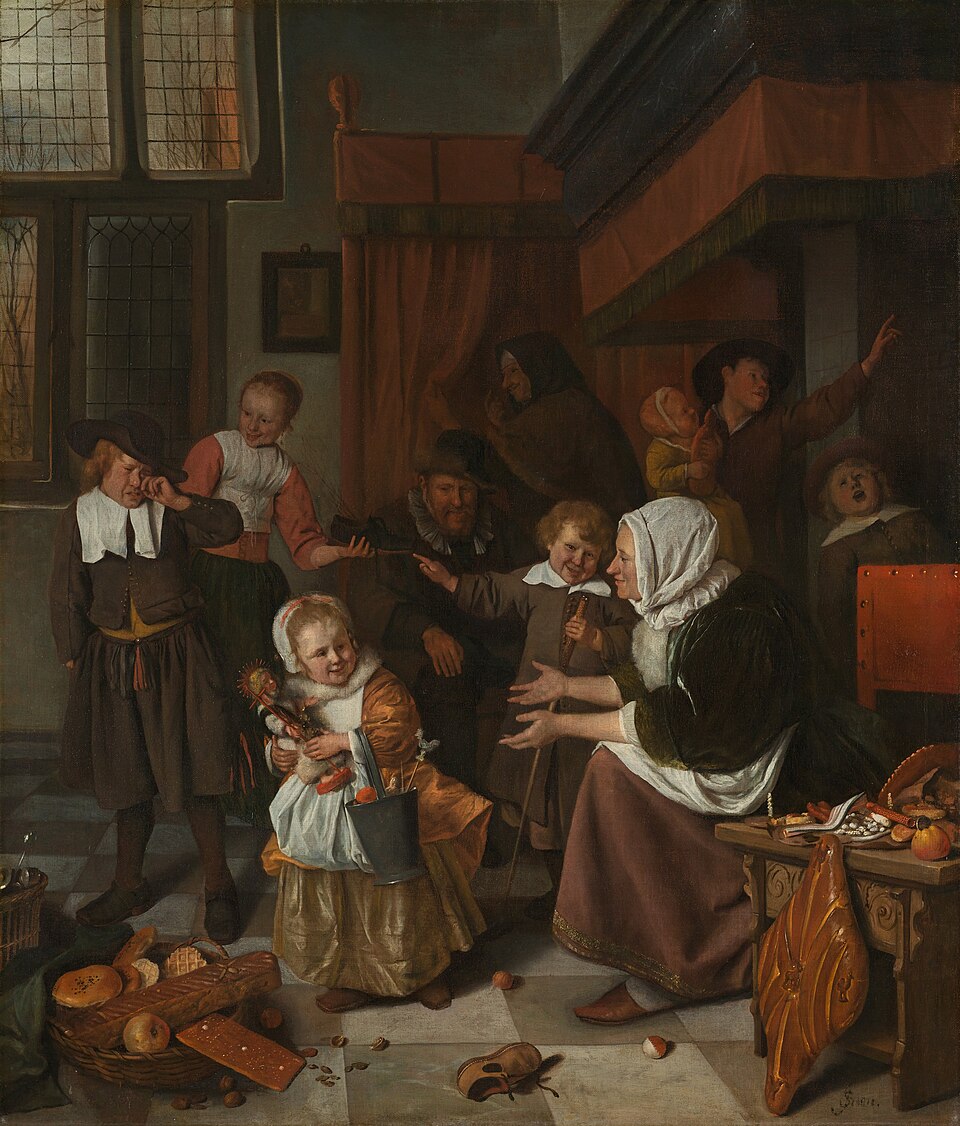
On the night of Saint Nicholas, a little girl in gold hugs her presents while her brother sobs over an empty shoe. Jan Steen filled one Dutch living room with every joy and disappointment of the holiday.
The story behind the painting
Jan Steen painted The Feast of Saint Nicholas around 1665 to 1668. It shows a family at home on 5 December, the night celebrated in the Netherlands as the Feast of Saint Nicholas, or Sinterklaas. In Steen's time the Dutch economy was thriving and a wealthy merchant middle class was growing. These new patrons favoured scenes of household life over the traditional religious and historical subjects, and painters such as Steen and Vermeer answered with pictures of domestic comfort. Steen's version, however, is lively and chaotic, in what has become known as the Jan Steen style.
What to look for
The focal point is the youngest daughter, dressed in a golden smock with golden curls. Saint Nicholas has filled her shoe with treats and a doll, which she holds in her bucket. Her elder brother sobs, while another brother laughs; his shoe, held up by an older sister, is empty. Half hidden by the curtains, the grandmother seems to beckon him, perhaps with a gift. In the background a boy shows a small child the chimney the saint came down, and another sings. A basket of honey cake, gingerbread, waffles, nuts and apples forms a small still life, each strand of wicker finely painted, and a diamond shaped duivekater cake leans against the table.
Meaning and intent
The details carry meaning. The girl's doll appears to be John the Baptist, with a camel hair shirt and a long cross; since he is the patron saint of epilepsy, her firm grip may hint that she suffered childhood convulsions, though this is only a suggestion. The apple and coin recall the custom of giving hidden apples and coins as presents. A child near the chimney holds a gingerbread Saint Nicholas, a reminder of tension between Catholics and Protestants: such saint shaped treats were seen as Catholic saint worship, and in 1655 Utrecht banned the baking of likenesses in bread or cake. Unlike Vermeer's calm interiors, Steen's chosen disorder is a gentle commentary on society.
Legacy
Dutch painters of the Golden Age pursued extreme detail and realism and mastered how light falls on different surfaces, and this picture is a fine example, from the glistening sweets to the crying child's face. Through such humour and realism Steen pointed to the flaws of his society, and the source sees him paving the way for later artists like William Hogarth, whose Marriage A-la-Mode series used painting for satire. The canvas, 82 by 70.5 cm, now hangs in the Rijksmuseum in Amsterdam, where the Sinterklaas tradition it shows is still celebrated every December.
豆知識
- Painted around 1665 to 1668.
- Shows a Dutch family on 5 December, Sinterklaas night.
- Includes a gingerbread saint, a treat banned in Utrecht in 1655.
- Now in the Rijksmuseum, Amsterdam.
画家について
ヤン・ステーン (1626-1679)
風俗美術 · オランダ黄金時代の絵画 · アムステルダム国立美術館
同じ画家の作品: ヤン・ステーン
 牡蠣を食べる少女 - Jan Steen (1658)
 アドルフ・クルーゼルとその娘カタリナ・クルーゼル - Jan Steen (1655)
 贅沢に気をつけよ - Jan Steen (1663)
 親に倣って子も歌う - Jan Steen (1665)
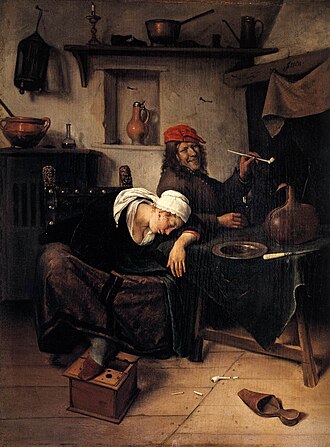 怠け者 - Jan Steen (1660s)
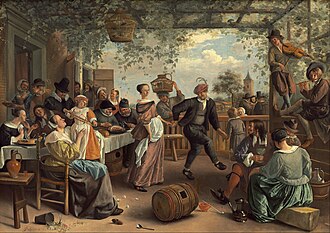 踊るカップル - Jan Steen (1663)
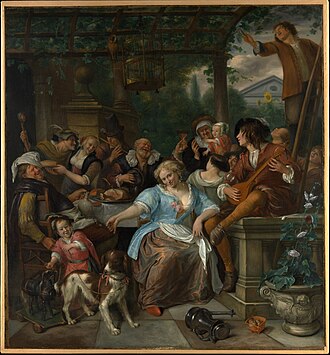 テラスの浮かれ騒ぎ - Jan Steen (1670)
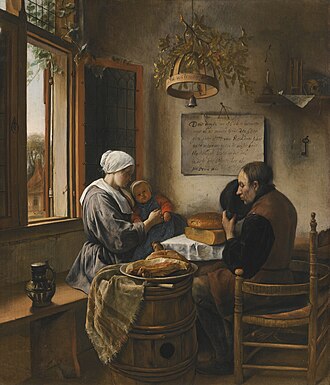 The prayer before the meal - Jan Steen (1660)
関連する画家の作品
 夜警 - Rembrandt van Rijn (1642)
 自画像 - Rembrandt van Rijn (1659)
 真珠の耳飾りの少女 - Johannes Vermeer (1665)
 牛乳を注ぐ女 - Johannes Vermeer (c. 1658)
 陽気な酒飲み - Frans Hals (1620s)
 微笑む騎士 - Frans Hals (1624)
 ウェイク・ベイ・ドゥールステーデの風車 - Jacob van Ruisdael (1670)
 The Jewish Cemetery - Jacob van Ruisdael (1650s)
 デルフトの家の中庭 - Pieter de Hooch (1658)
 リンゴの皮を剥く女性 - Pieter de Hooch (1663)