贅沢に気をつけよ
ヤン・ステーン · 1663
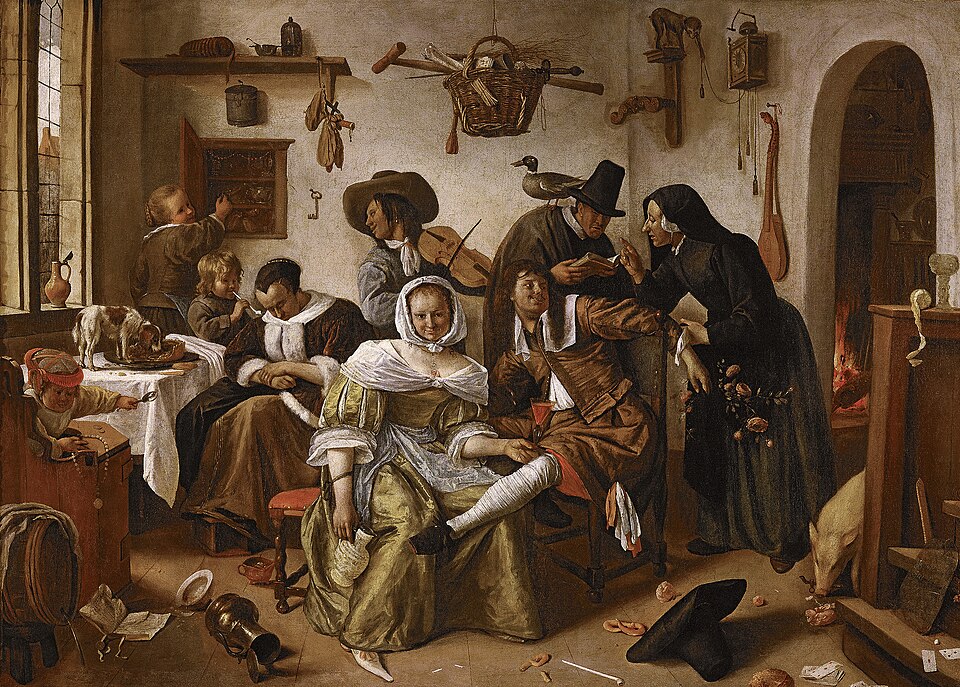
The mother has dozed off, and the whole house has gone wild: a pig steals the tap, a dog eats the pie, a monkey stops the clock. Jan Steen painted the chaos, and himself grinning in the middle of it.
The story behind the painting
Jan Steen painted Beware of Luxury in 1663; it is also known as The Upside-Down World. In the Dutch Republic of the 17th century, trade brought new wealth and class mobility, and families liked portraits showing off their new comforts. Steen painted some of these newly rich people himself, and he was known for humorous scenes of dissolute households that mocked the excesses of the rising Dutch middle class. Here he turns the proud family portrait inside out, twisting the calm domestic scenes of painters like Pieter de Hooch into a warning.
What to look for
The canvas, 105 by 145.5 cm, arranges the merrymakers in an inverted triangle. The lady of the house sleeps, perhaps drunk. Her husband flirts with a young woman who holds a glass of red wine between his legs, laughing off a nun or beguine. A man plays the violin, a worried Quaker reads his Bible. One child reaches into the glassware, a boy blows on a pipe, the youngest plays with pearls and a silver spoon. Food, dishes and cards cover the floor, a pig has run off with the spigot of a leaking barrel, a duck sits on a man's shoulder, a monkey holds the clock's string. Above it all hangs a basket of tools and weapons. Look bottom left for a slate with the proverb.
Meaning and intent
The slate reads In weelde siet toe, beware of luxury, or in good times beware the consequences. The dog stealing meat stands for greed, the cards for gambling, the wine for erotic desire. The basket threatens a crutch, a sword and the clappers that signalled illness like leprosy. A pig nuzzling a rose recalls throwing roses before swine; the monkey and clock recall that time is forgotten in folly. The half-peeled lemon, sweet to look at but sour, adds temptation. The family's plain clothes and modest house mark them as middle class, yet they play at aristocratic leisure. The painting works as an ironic eulogy, seeming to praise vice while hiding a lesson.
Legacy
Steen often used himself and his family as models. Here he is the grinning man in the brown jacket, and the woman in the centre is his first wife, Margriet van Goyen. Since many paintings were sold face to face, his own face in a farce was part of the joke. Later biographers mistook such comic self-portraits for real life, which helped create the image of Steen as a drunken good-for-nothing. One biographer says Margriet disliked being shown as a loose woman, though she modelled for many such pictures. The painting is now in the Kunsthistorisches Museum in Vienna.
豆知識
- Painted by Jan Steen in 1663.
- The proverb In weelde siet toe is written on a slate.
- Steen and his wife Margriet van Goyen appear in it.
- Now in the Kunsthistorisches Museum, Vienna.
画家について
ヤン・ステーン (1626-1679)
風俗美術 · オランダ黄金時代の絵画 · 美術史美術館
同じ画家の作品: ヤン・ステーン
 聖ニコラウスのお祭り - Jan Steen (1660s)
 牡蠣を食べる少女 - Jan Steen (1658)
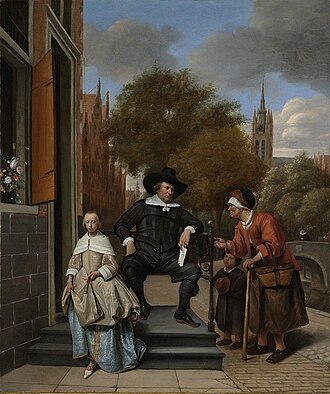 アドルフ・クルーゼルとその娘カタリナ・クルーゼル - Jan Steen (1655)
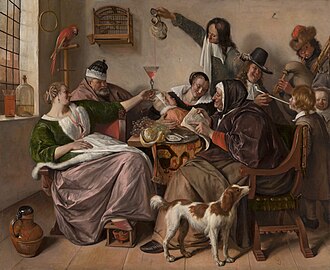 親に倣って子も歌う - Jan Steen (1665)
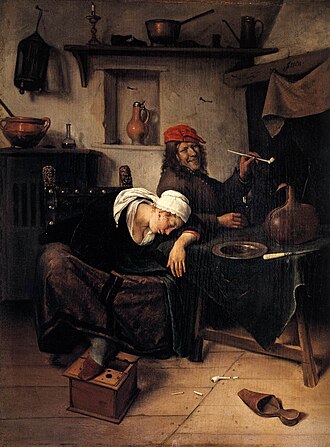 怠け者 - Jan Steen (1660s)
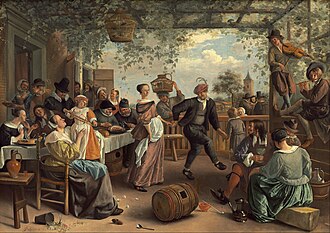 踊るカップル - Jan Steen (1663)
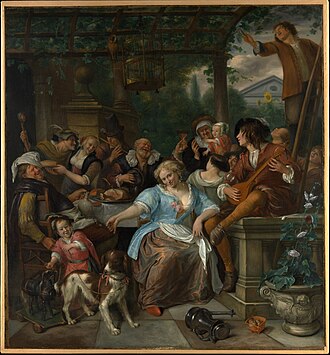 テラスの浮かれ騒ぎ - Jan Steen (1670)
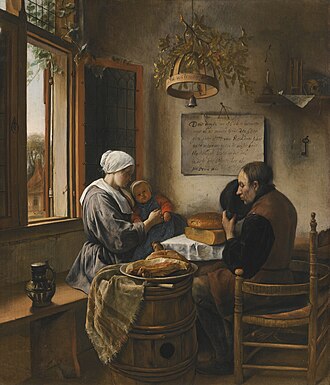 The prayer before the meal - Jan Steen (1660)
関連する画家の作品
 夜警 - Rembrandt van Rijn (1642)
 自画像 - Rembrandt van Rijn (1659)
 真珠の耳飾りの少女 - Johannes Vermeer (1665)
 牛乳を注ぐ女 - Johannes Vermeer (c. 1658)
 陽気な酒飲み - Frans Hals (1620s)
 微笑む騎士 - Frans Hals (1624)
 ウェイク・ベイ・ドゥールステーデの風車 - Jacob van Ruisdael (1670)
 The Jewish Cemetery - Jacob van Ruisdael (1650s)
 デルフトの家の中庭 - Pieter de Hooch (1658)
 リンゴの皮を剥く女性 - Pieter de Hooch (1663)