牡蠣を食べる少女
ヤン・ステーン · 1658
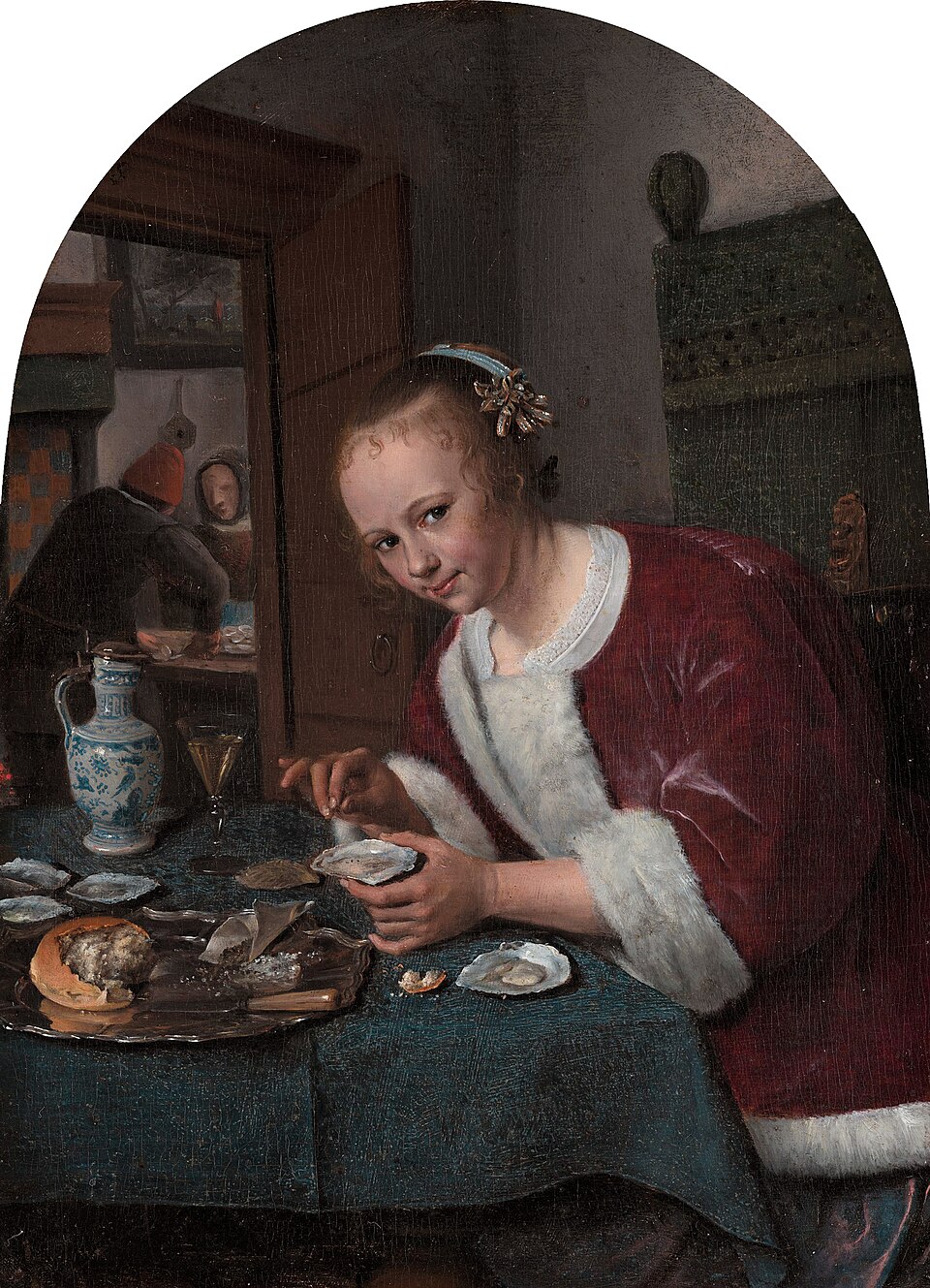
A young woman salts an oyster and looks straight at us, as if the oyster were meant for the viewer. Jan Steen packed a whole flirtation into a panel only about 20 by 15 cm.
The story behind the painting
Jan Steen painted this small oil on panel around 1658 to 1660; Wikidata gives 1658. In Dutch it is called Het oestereetstertje, and it is also known as Girl Offering Oysters. Where it was before 1783 is unknown. That September, Pieter Locquet sold it to Pieter van Winter in Amsterdam, and it then passed down through his daughter Lucretia Johanna van Winter and the Six family, including Professor Jan Six, until the 1920s. In 1936 Sir Henri Deterding gave it to the Mauritshuis in The Hague, where it has been ever since.
What to look for
The girl salts the oysters while looking directly at you, with a flirtatious expression that suggests they are being prepared for the viewer. Steen frames her with the vertical and horizontal lines of a door frame, bed curtains and the edge of the table, and the arched top of the panel echoes the curve of her head and left shoulder. Objects such as the oyster point the eye into a back room where men are seen. This view through a doorway, called doorsien in Dutch, adds depth and balances the men behind against the young woman in front.
Meaning and intent
Here the oysters carry an erotic meaning. They were thought to be an aphrodisiac, and since antiquity they had been linked with Aphrodite, goddess of love and pleasure. Empty shells or half-eaten food beside them could also hint at how brief earthly pleasures are, a theme often repeated in Dutch art. After 1658, when the Dutch took control of pearl fisheries in Indian waters, oyster scenes moved from noisy merry companies into private interiors that suggested a romantic meeting. Steen liked to show love's passion and folly with humour, and he used oysters as a symbol of lust in other works too.
Legacy
The painting shows how close Steen could come to the refined style of Frans van Mieris the Elder. The arched top, the small size and the extreme care given to every tiny detail recall Gerrit Dou, the great master of fine painting in Leiden and the teacher of Van Mieris. It also shows two sides of Steen at once: the polished craftsman and the storyteller of earthy humour who painted homes, families and moral lessons, sometimes with a satirical edge. It is a classic example of his intricate style and his love of domestic settings.
豆知識
- Small oil on panel, about 20.5 by 14.5 cm.
- Dated about 1658-1660; Wikidata gives 1658.
- In the Mauritshuis since a gift by Sir Henri Deterding in 1936.
- Oysters here symbolise earthly lust.
画家について
ヤン・ステーン (1626-1679)
女性 · 風俗美術 · オランダ黄金時代の絵画 · テーブル · マウリッツハイス美術館 · パン · テーブルクロス · 毛皮 · 食事
同じ画家の作品: ヤン・ステーン
 聖ニコラウスのお祭り - Jan Steen (1660s)
 アドルフ・クルーゼルとその娘カタリナ・クルーゼル - Jan Steen (1655)
 贅沢に気をつけよ - Jan Steen (1663)
 親に倣って子も歌う - Jan Steen (1665)
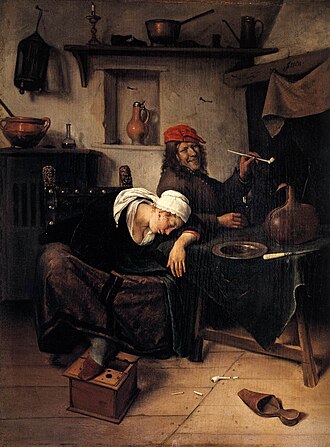 怠け者 - Jan Steen (1660s)
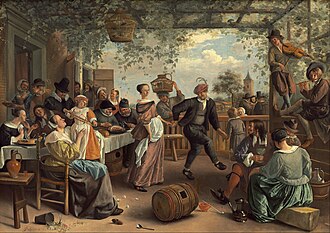 踊るカップル - Jan Steen (1663)
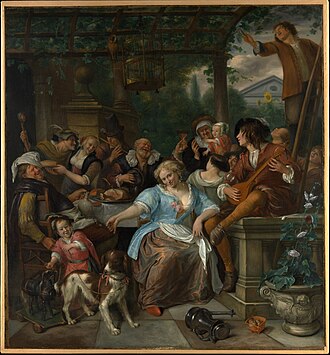 テラスの浮かれ騒ぎ - Jan Steen (1670)
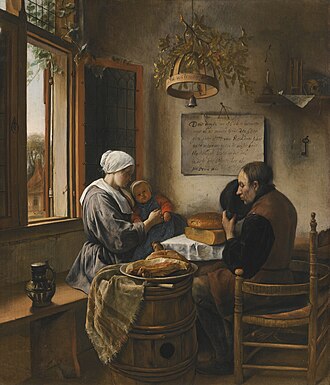 The prayer before the meal - Jan Steen (1660)
関連する画家の作品
 夜警 - Rembrandt van Rijn (1642)
 自画像 - Rembrandt van Rijn (1659)
 真珠の耳飾りの少女 - Johannes Vermeer (1665)
 牛乳を注ぐ女 - Johannes Vermeer (c. 1658)
 陽気な酒飲み - Frans Hals (1620s)
 微笑む騎士 - Frans Hals (1624)
 ウェイク・ベイ・ドゥールステーデの風車 - Jacob van Ruisdael (1670)
 The Jewish Cemetery - Jacob van Ruisdael (1650s)
 デルフトの家の中庭 - Pieter de Hooch (1658)
 リンゴの皮を剥く女性 - Pieter de Hooch (1663)