Paul Gauguin
1848-1903
Paul Gauguin was a Paris stockbroker who gave up a comfortable life to paint, and whose bold, unnatural colour and Symbolist dreams, carried from Brittany to Tahiti, opened a door through which Picasso and Matisse would walk.
Origins
Gauguin was born in Paris on 7 June 1848, in a year of revolution across Europe. His father, Clovis, was a liberal journalist forced to flee France when his newspaper was suppressed; his mother, Aline Chazal, was the daughter of Flora Tristan, an author and early socialist activist whom Paul idolised all his life, keeping her books with him to the end. In 1850 the family sailed for Peru, but Clovis died on the voyage. Aline arrived a widow with her small children and was welcomed by powerful relatives; until the age of six Paul lived a privileged childhood among nursemaids and servants, leaving impressions of Peru that haunted him forever. Political upheaval ended that idyll in 1854, and the family returned to France, to Orléans and then Paris. After boarding school and naval preparatory studies, he served in the merchant marine and the French navy. His art education was largely self-taught, shaped by friendships rather than academies.
Life and turning points
In 1871 a family friend, Gustave Arosa, found him a job at the Paris Bourse, and for eleven years Gauguin was a successful stockbroker. In 1873 he married the Dane Mette-Sophie Gad, with whom he had five children, and began painting in his spare time. Camille Pissarro became his mentor; Gauguin painted in his garden on Sundays and showed with the Impressionists in 1881 and 1882. The stock market crash of 1882 changed everything. In 1883 he resolved to live by painting at all costs. Rouen and then Copenhagen, where he failed as a tarpaulin salesman, brought only hardship, and his marriage gave way; he returned to Paris in 1885 to real poverty. From 1886 he found a following among young artists at Pont-Aven in Brittany, travelled to Panama and Martinique, and in the 1890s went to Tahiti, then a French colony, seeking refuge from Western civilisation. His final years there and in the Marquesas were marked by illness and money troubles. He died on 8 May 1903.
Style and technique
Gauguin began in the Impressionist manner but soon broke away, developing a style of bolder colour and less traditional subjects that came to be called Synthetism and linked with Post-Impressionism and Symbolism. Disappointed with Impressionism, he felt European painting had become too imitative and lacked symbolic depth, and he looked to the art of Africa and Asia, full, as he saw it, of mystic symbolism and vigour. At Pont-Aven his Four Breton Women marked a clear departure, borrowing the naive quality of the English illustrator Randolph Caldecott and exaggerating features almost to caricature. Together with Émile Bernard, Charles Laval and others he forged what is now called the Pont-Aven School, defined by pure colour and Symbolist themes. His Tahitian paintings, with their vivid colour, explore the relationships between people, nature and the spiritual world. He was also a sculptor, ceramist and writer, and an influential pioneer of wood engraving and the woodcut as art forms.
Stories and anecdotes
Gauguin's life was full of sharp turns. When his mother died in 1867 he did not learn of it for months, until a letter from his sister Marie reached him in India. Before he painted seriously he was a collector, buying the work of emerging artists, and a sculpture of his son Émile was the only sculpture at the fourth Impressionist exhibition of 1879. In Copenhagen he could not speak Danish, and, as the source dryly notes, the Danes did not want French tarpaulins. At Pont-Aven he was an accomplished boxer and fencer, remembered as much for his outlandish appearance as for his art. He scornfully rejected Seurat's Pointillist technique in 1886 and broke with Pissarro, his old mentor. His friendship with Vincent and Theo van Gogh remains one of the best-known relationships in the history of modern art. His time in Tahiti, then a French colony, is today also examined critically alongside his art.
Legacy
Gauguin was only moderately successful in his lifetime, and his family life paid a heavy price for his choices. Recognition came after his death, helped by the dealer Ambroise Vollard, who organised exhibitions late in his career and two important posthumous shows in Paris. His experimental colour and Synthetist style, so distinct from Impressionism, influenced the French avant-garde and many modern artists, notably Pablo Picasso and Henri Matisse, while his woodcuts helped renew printmaking as an art in its own right. Early works once dismissed, such as The Market Gardens of Vaugirard, are now highly regarded. Today his paintings of Brittany and Polynesia are among the most recognisable images of Post-Impressionism, inviting viewers into a world of colour and myth, and also into honest questions about the place from which he looked at it.
豆知識
- Gauguin's grandmother, Flora Tristan, was a well-known author and early socialist activist.
- He spent his first years in Peru, memories that stayed with him all his life.
- For eleven years he was a successful stockbroker at the Paris Bourse.
- He was an accomplished boxer and fencer.
関連する画家
Vincent van Gogh · Pierre-Auguste Renoir
Paul Gauguinの作品
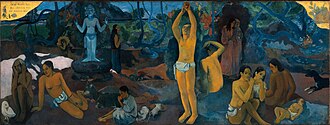 我々はどこから来たのか 我々は何者か 我々はどこへ行くのか - Paul Gauguin (1897-1898)
%201889.jpg) 黄色いキリスト - Paul Gauguin (1889)
黄色いキリスト - Paul Gauguin (1889)%201892%2C%20oil%20on%20canvas%2C%20101%20x%2077%20cm.jpg) いつ結婚するの - Paul Gauguin (1892)
いつ結婚するの - Paul Gauguin (1892)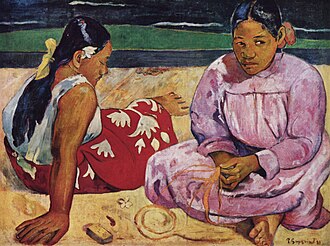 タヒチの女たち - Paul Gauguin (1890)
.jpg) 説教の後の幻影 - Paul Gauguin (1888)
説教の後の幻影 - Paul Gauguin (1888)死霊が見ている - Paul Gauguin (1892)
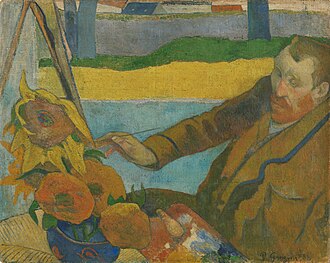 Vincent van Gogh Painting Sunflowers - Paul Gauguin (1888)
%20-%201926.198%20-%20Art%20Institute%20of%20Chicago.jpg) マハナ・ノ・アトゥア - Paul Gauguin (1894)
マハナ・ノ・アトゥア - Paul Gauguin (1894)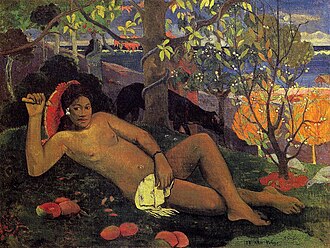 テ・アリイ・ヴァヒネ - Paul Gauguin (1896)
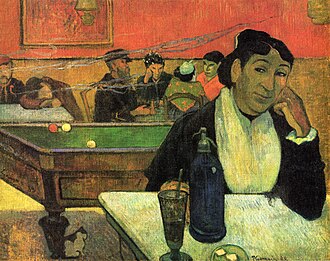 The Night Café in Arles - Paul Gauguin (1888)
%2C%20oil%20on%20canvas%2C%2073.2%20x%2091.5%20cm%2C%20Kunstmuseum%20Basel.jpg) We Shall Not Go to the Market Today - Paul Gauguin (1892)
We Shall Not Go to the Market Today - Paul Gauguin (1892)