テ・アリイ・ヴァヒネ
Paul Gauguin · 1896
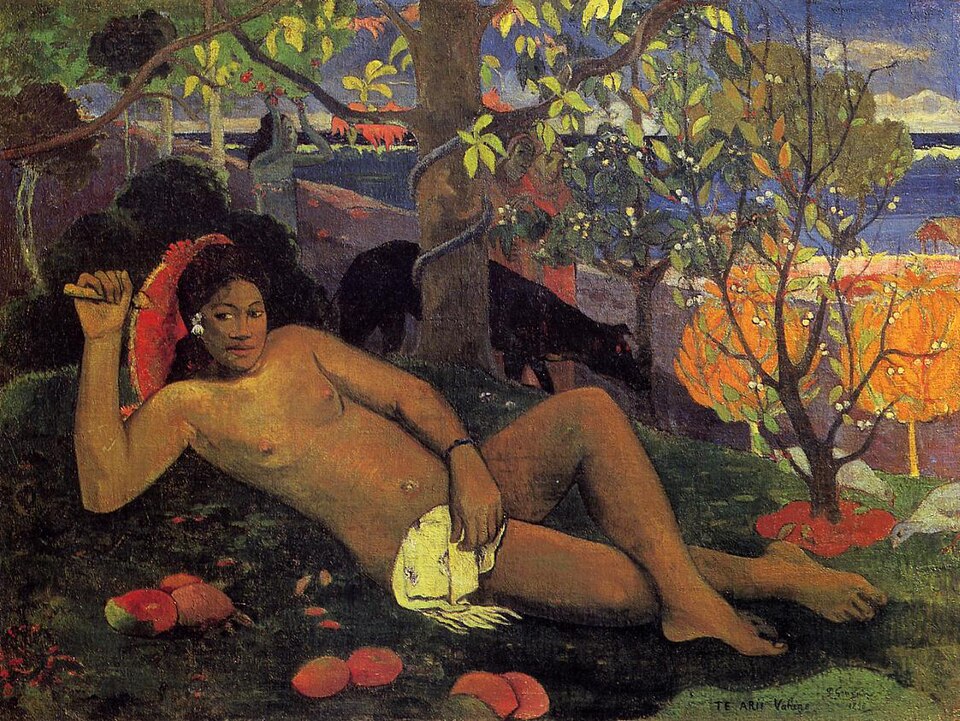
A woman reclines on green, trees in bloom behind her, a dog on guard and two doves cooing. Gauguin believed he had never made colour sound so solemn.
The story behind the painting
The King's Wife, also called The Queen, Woman with Mango Fruits, Woman under a Mango Tree, or Te arii vahine, the Tahitian title painted at the lower right, was made on Tahiti in early 1896. In April that year Gauguin wrote to his friend Daniel Monfreud that he had just finished a painting he considered much more successful than the one before. He sent it to Monfreud, though he wondered aloud whether there was any point when so many other paintings were unsold and caused an outcry; this one, he wrote, would cause an even louder one.
What to look for
Gauguin himself described the picture in that letter: a naked queen lies on a green carpet, a servant picks fruit, and two old men near a larger tree discuss the tree of knowledge, with the sea coast in the depths. The trees are in bloom, a dog keeps watch, and on the right two doves are cooing. The canvas is wide, 97 by 130 centimetres according to Wikidata, giving room for the reclining figure to stretch across it. Gauguin was proudest of the colour, writing that he had never created anything with such a strong, solemn sonority.
Meaning and intent
The painting was heavily influenced by Edouard Manet's Olympia. Gauguin had made a copy of Olympia and took a reproduction of it with him to Tahiti, so the famous reclining nude of Paris travelled with him into his work in the Pacific. Gauguin's own words, a queen, a servant, elders speaking of the tree of knowledge, suggest he meant the scene to carry the weight of an old story about knowledge and paradise, told in the setting of the island where he lived. Visitors can let his letter guide the eye from figure to tree to coast.
Legacy
Monfreud kept the painting until August 1903, when it was bought by Gustave Fayet. Gauguin had died in April 1903, but the news had not yet reached Monfreud, who wrote to tell him the painting had sold; the letter came back unopened, marked deceased. It is a quietly moving moment in the picture's history. Fayet, Gauguin and Monfreud all considered it one of the artist's best works. Today it belongs to the Pushkin Museum of Fine Arts in Moscow.
豆知識
- Painted on Tahiti in early 1896.
- Also known as Te arii vahine, the Tahitian title at lower right.
- Influenced by Manet's Olympia, which Gauguin had copied.
- Now in the Pushkin Museum, Moscow.
画家について
Paul Gauguin (1848-1903)
同じ画家の作品: Paul Gauguin
 我々はどこから来たのか 我々は何者か 我々はどこへ行くのか - Paul Gauguin (1897-1898)
%201889.jpg) 黄色いキリスト - Paul Gauguin (1889)
黄色いキリスト - Paul Gauguin (1889)%201892%2C%20oil%20on%20canvas%2C%20101%20x%2077%20cm.jpg) いつ結婚するの - Paul Gauguin (1892)
いつ結婚するの - Paul Gauguin (1892) タヒチの女たち - Paul Gauguin (1890)
.jpg) 説教の後の幻影 - Paul Gauguin (1888)
説教の後の幻影 - Paul Gauguin (1888)死霊が見ている - Paul Gauguin (1892)
 Vincent van Gogh Painting Sunflowers - Paul Gauguin (1888)
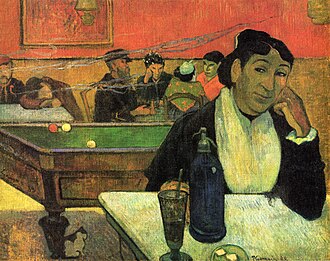 The Night Café in Arles - Paul Gauguin (1888)
関連する画家の作品
 星月夜 - Vincent van Gogh (1889)
.jpg) 夜のカフェテラス - Vincent van Gogh (1888)
夜のカフェテラス - Vincent van Gogh (1888) ムーラン・ド・ラ・ギャレットの舞踏会 - Pierre-Auguste Renoir (1876)
 舟遊びの昼食 - Pierre-Auguste Renoir (1881)