The Night Café in Arles
Paul Gauguin · 1888
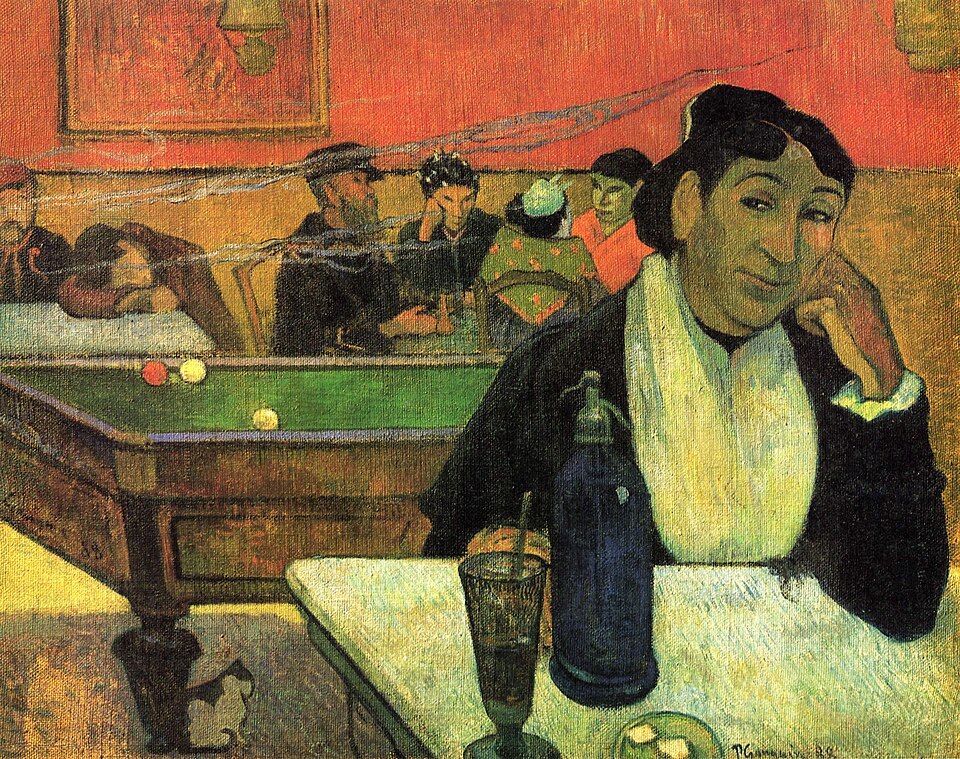
A woman leans her elbows on a café table in the foreground, while behind her a smoky room drifts toward sleep. Gauguin painted this night scene in Arles at the end of 1888.
The story behind the painting
The Night Café in Arles, known in French as Cafe a Arles or Le Cafe de nuit a Arles, was painted by Paul Gauguin at the end of 1888 in Arles, in the south of France. According to the English Wikipedia article on the painter, Gauguin spent nine weeks that year painting alongside Vincent van Gogh at Vincent's Yellow House in Arles, at the instigation of Vincent's brother Theo. The relationship proved fraught, and after a crisis on the evening of 23 December 1888 Gauguin left Arles. The two never saw each other again, though they continued to write. This canvas belongs to those few weeks.
What to look for
The picture is a genre scene showing the smoky interior of a night café. In the foreground on the right, a woman rests her elbows on a table: she is the proprietor, Madame Ginoux. Behind her to the left, beyond a billiard table with a cat beneath it, various customers sit, one slumped in sleep, another identifiable as Joseph Roulin. Wikidata also notes her Arlesian costume, a stemmed glass, a soda siphon and sugar on the table. The canvas measures 72 by 92 centimetres, a horizontal format that lets the room recede behind the calm, close figure of the woman.
Meaning and intent
The composition sets two worlds side by side. Close to us sits a single, composed figure, the woman who runs the café, steady and watchful. Behind her lies the late-night life of the room: the billiard table, the sleeping drinker, the cat in the shadows, the regulars. It is a quiet portrait of a place and of the people who keep it going, seen at the hour when talk fades and only the patient remain. The sources say little more about Gauguin's intentions, so we leave the rest to the viewer's own eye.
Legacy
Today the painting belongs to the Pushkin Museum of Fine Arts in Moscow, which presents it under the English title Cafe at Arles. Its significance lies partly in its moment: it comes from the short, intense period in late 1888 when Gauguin and Van Gogh worked side by side in Arles, before their partnership ended and Gauguin left the town. The sources available do not describe how the painting reached Moscow, so we do not tell that part of the story here. Wikidata places the work within Post-impressionism.
豆知識
- Painted in Arles at the end of 1888 (French Wikipedia).
- Foreground figure: Madame Ginoux, the proprietor; Joseph Roulin among the customers.
- Oil on canvas, 72 x 92 cm (Wikidata).
- Now in the Pushkin Museum, Moscow.
Wikipedia · Wikipedia (Paul Gauguin) · Wikidata
画家について
Paul Gauguin (1848-1903)
女性 · 風俗美術 · ポスト印象派 · 座法 · テーブル · プーシキン美術館
同じ画家の作品: Paul Gauguin
 我々はどこから来たのか 我々は何者か 我々はどこへ行くのか - Paul Gauguin (1897-1898)
%201889.jpg) 黄色いキリスト - Paul Gauguin (1889)
黄色いキリスト - Paul Gauguin (1889)%201892%2C%20oil%20on%20canvas%2C%20101%20x%2077%20cm.jpg) いつ結婚するの - Paul Gauguin (1892)
いつ結婚するの - Paul Gauguin (1892) タヒチの女たち - Paul Gauguin (1890)
.jpg) 説教の後の幻影 - Paul Gauguin (1888)
説教の後の幻影 - Paul Gauguin (1888)死霊が見ている - Paul Gauguin (1892)
 Vincent van Gogh Painting Sunflowers - Paul Gauguin (1888)
%20-%201926.198%20-%20Art%20Institute%20of%20Chicago.jpg) マハナ・ノ・アトゥア - Paul Gauguin (1894)
マハナ・ノ・アトゥア - Paul Gauguin (1894)
関連する画家の作品
 星月夜 - Vincent van Gogh (1889)
.jpg) 夜のカフェテラス - Vincent van Gogh (1888)
夜のカフェテラス - Vincent van Gogh (1888) ムーラン・ド・ラ・ギャレットの舞踏会 - Pierre-Auguste Renoir (1876)
 舟遊びの昼食 - Pierre-Auguste Renoir (1881)