Four Breton Women
Paul Gauguin · 1886
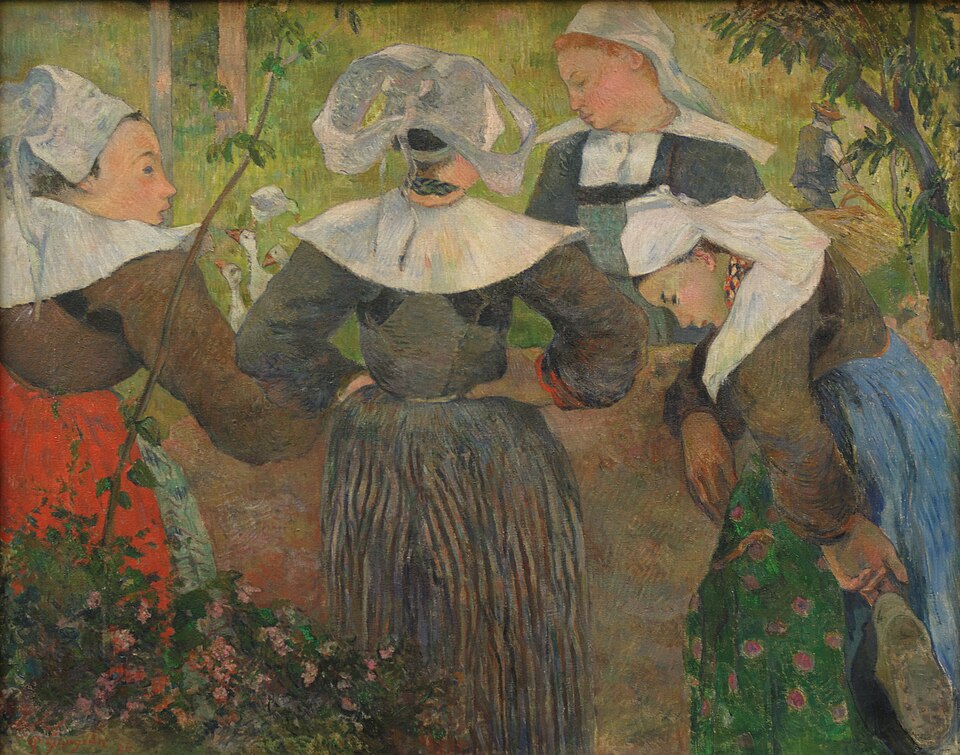
Four women in white Pont-Aven caps lean together by a fence while a man ploughs behind them. Are they dancing or just talking? Even the catalogues have changed their minds, and the picture marks Gauguin's first steps away from Impressionism.
The story behind the painting
The painting is inscribed P. Gauguin 86 in the lower left corner. Gauguin made several preliminary sketches at the end of his first stay in Brittany, from June to September 1886, including pencil studies of each of the four figures. It is not known whether he painted the canvas in Pont-Aven or in Paris at the end of that year, and it has even been suggested it dates from his second stay in Brittany in 1888. After being shown at the Diot gallery on rue Laffitte, it was sold in October 1888 by his dealer Theo van Gogh to the French collector Dupuis.
What to look for
Four peasant women in traditional dress and the typical caps of Pont-Aven talk beside a fence, three in front and the fourth behind it. In the background a man ploughs the land and geese graze. The figures are flat, without relief or perspective, and the group fills almost the whole space for a monumental effect. Notice the flat area of red in the skirt on the left and the sober white of the caps and collars. Outlines are drawn around the figures, especially the faces, an early sign of what would be called cloisonnism, after the look of stained glass.
Meaning and intent
The placement of the women recalls Degas' dancers, and the Wildenstein catalogue of 1964 called the work Dance of Four Breton Women. That reading has been much disputed: it only works if the space between the women is read as ground rather than a fence. The woman on the right may be moving, or half crouching with one arm on the fence and her left hand holding the heel of her clog. Daniel Wildenstein's revised catalogue of 2001 changed the title to Breton Women Chatting. The four geese beside four women may recall the French phrase oie blanche, used for a naive, prudishly raised girl.
Legacy
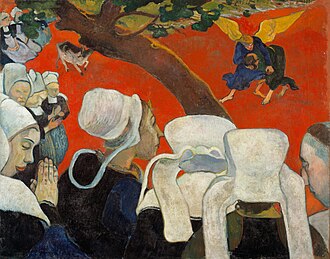
The painting is considered one of the key works in Gauguin's development in Brittany, a path that culminated in The Vision After the Sermon. Its colours and brushwork still recall Pissarro's Impressionism, but static balance outweighs Impressionist movement, pointing the way towards Synthetism and Symbolism. The supposed dance has often led to confusion with The Breton Girls Dancing of 1888. Today it belongs to the Bavarian State Painting Collections and is on deposit in the Neue Pinakothek in Munich. It is listed as W.201 in Wildenstein's 1964 catalogue and W.237 in the 2001 edition.
豆知識
- Inscribed P. Gauguin 86; painted after his first stay in Pont-Aven.
- Titled a dance in 1964, renamed Breton Women Chatting in 2001.
- Sold in 1888 by Theo van Gogh.
- Held by the Bavarian State Painting Collections, Neue Pinakothek, Munich.
画家について
Paul Gauguin (1848-1903)
同じ画家の作品: Paul Gauguin
 我々はどこから来たのか 我々は何者か 我々はどこへ行くのか - Paul Gauguin (1897-1898)
 黄色いキリスト - Paul Gauguin (1889)
 いつ結婚するの - Paul Gauguin (1892)
 タヒチの女たち - Paul Gauguin (1890)
 説教の後の幻影 - Paul Gauguin (1888)
死霊が見ている - Paul Gauguin (1892)
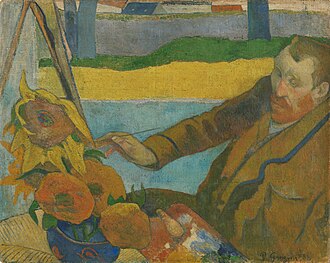 Vincent van Gogh Painting Sunflowers - Paul Gauguin (1888)
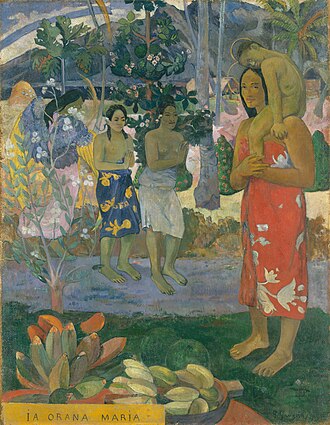 イア・オラナ・マリア - Paul Gauguin (1891)
関連する画家の作品
 星月夜 - Vincent van Gogh (1889)
 夜のカフェテラス - Vincent van Gogh (1888)
 Walk on the mountain - Joaquín Sorolla (1909)
 Sad Inheritance - Joaquín Sorolla (1898)
 大水浴図 - Paul Cézanne (1900s)
 赤いチョッキの少年 - Paul Cézanne
 ムーラン・ド・ラ・ギャレットの舞踏会 - Pierre-Auguste Renoir (1876)
 舟遊びの昼食 - Pierre-Auguste Renoir (1881)
 ムーラン・ルージュ - Henri de Toulouse-Lautrec (1892)
 La Toilette - Henri de Toulouse-Lautrec (1896)