アンリ・ド・トゥールーズ=ロートレック
1864-1901
Born a count, Henri de Toulouse-Lautrec spent almost twenty years in Montmartre drawing its dancers, singers and night people. In a career of less than two decades he left more than 700 paintings, hundreds of posters and prints, and over 5,000 drawings.
Origins
He was born on 24 November 1864 in Albi, in the south of France, the first child of Count Alphonse de Toulouse-Lautrec Montfa and Adele Tapie de Celeyran, who were first cousins. His younger brother died as a baby, and his parents then separated. At eight he lived with his mother in Paris, filling his exercise books with sketches and caricatures, and his father's friend Rene Princeteau, a painter of horses, gave him informal lessons. At 13 he broke his right thigh bone and at 14 his left; neither healed properly. Modern physicians think of an unknown genetic disorder. His legs stopped growing, and he reached 1.52 m.
Life and turning points
Impressed by his progress, Princeteau persuaded his parents to let him study in Paris with the portrait painter Leon Bonnat, and he returned there in 1882. He then moved to the studio of Fernand Cormon, where he met Emile Bernard and Vincent van Gogh and formed lifelong friendships. Montmartre became the area he rarely left for the next 20 years. In 1888 he showed eleven works with Les XX in Brussels, and from 1889 to 1894 he exhibited regularly at the Salon des Independants. When the Moulin Rouge opened in 1889 he was commissioned to make posters; the cabaret kept a seat for him. Alcoholism and syphilis wore him down. In 1899 he spent three months in a sanatorium, and he died at his mother's estate, Chateau Malrome, on 9 September 1901, aged 36.
Style and technique
His debt to the more figurative Impressionists, especially Manet and Degas, is clear, and he was also influenced by Japanese woodblock prints, popular in Paris at the time. He excelled at showing people in their working places, keeping the colour and movement of nightlife but stripping away the glamour. He painted crowd scenes in which each figure is strongly individual. Other artists looked down on poster work, but he ignored them, and his posters of Aristide Bruant, La Goulue and Jane Avril became famous images of the Belle Epoque.
Stories and anecdotes
At an 1890 banquet in Brussels he challenged the artist Henry de Groux to a duel for insulting Van Gogh's work; De Groux apologised and the duel never happened. In London he befriended Oscar Wilde and spoke up for him when Wilde faced prison. He was also a serious cook, called Henri the cook by his cousins; at a famous party in February 1895 he served as sole chef and bartender for three hundred guests. During his months in the sanatorium he drew 39 circus pictures from memory. His reported last words, to his father, were the old fool.
Legacy
After his death his mother and his dealer Maurice Joyant kept promoting his work, and his mother helped fund a museum in Albi, his birthplace. The Musee Toulouse-Lautrec there holds the largest collection of his works. He is counted among the Post-Impressionists, with Cezanne, Van Gogh, Gauguin and Seurat. His pictures remain a vivid, close record of bohemian Paris in the late 19th century, seen from a seat inside it.
豆知識
- He first exhibited in Toulouse in 1887 under the pseudonym Treclau, a reversal of Lautrec.
- He painted several portraits of Suzanne Valadon and supported her ambition to be an artist.
- Joyant later published his recipes as a cookbook, described by Charles Stuckey as the first ever published by an artist.
- He is buried at Verdelais, a few kilometres from Chateau Malrome.
関連する画家
Vincent van Gogh · Paul Gauguin · Pierre-Auguste Renoir
アンリ・ド・トゥールーズ=ロートレックの作品
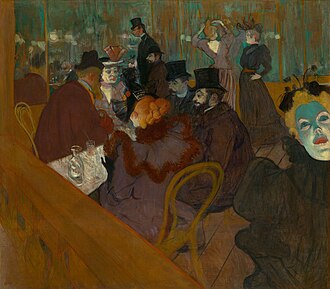 ムーラン・ルージュ - Henri de Toulouse-Lautrec (1892)
%20Rousse%20(La%20Toilette)%20-%201889%20-%20Henri%20de%20Toulouse-Lautrec%20-%20Mus%C3%A9e%20d'Orsay%2C%20Paris.jpg) La Toilette - Henri de Toulouse-Lautrec (1896)
La Toilette - Henri de Toulouse-Lautrec (1896)%2C%201887-1889%20color%20corrected.jpg) The Hangover - Henri de Toulouse-Lautrec (1889)
The Hangover - Henri de Toulouse-Lautrec (1889)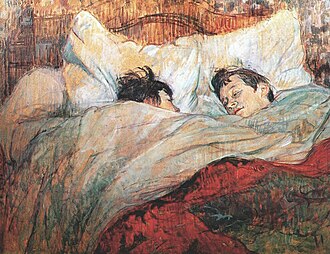 Le Lit - Henri de Toulouse-Lautrec (1890s)
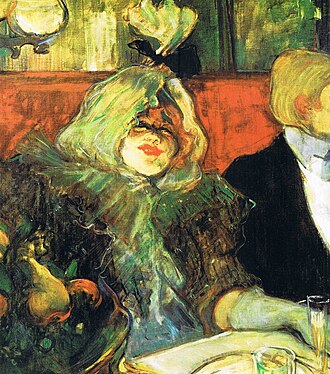 In a Private Dining Room - Henri de Toulouse-Lautrec (1899)
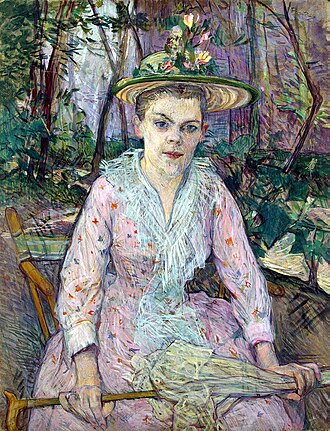 Woman with a parasol - Henri de Toulouse-Lautrec (1889)
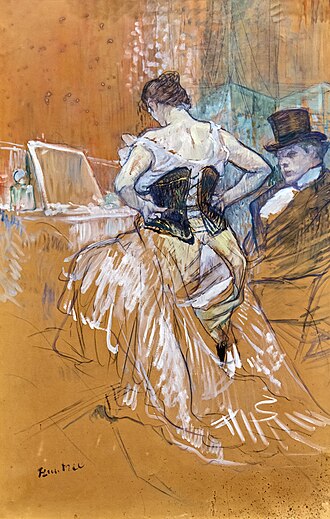 Conquête de passage - Henri de Toulouse-Lautrec (1896)
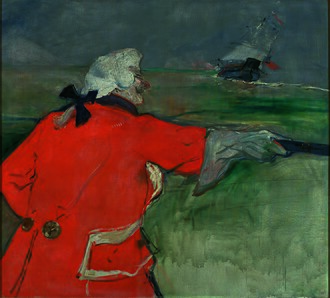 Paul Viaud em almirante do século XVIII - Henri de Toulouse-Lautrec (1901)
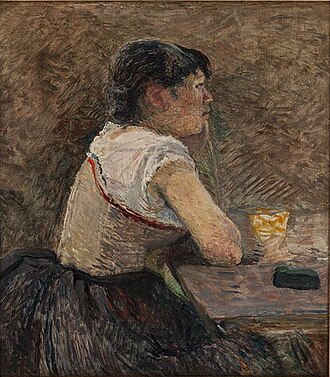 At Grenelle, Absinthe Drinker - Henri de Toulouse-Lautrec (1886)
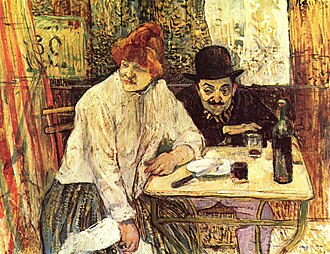 カフェにて - Henri de Toulouse-Lautrec (1891)
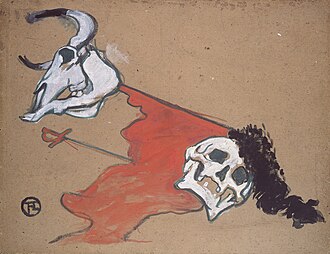 La Tauromachie - Henri de Toulouse-Lautrec (1894)
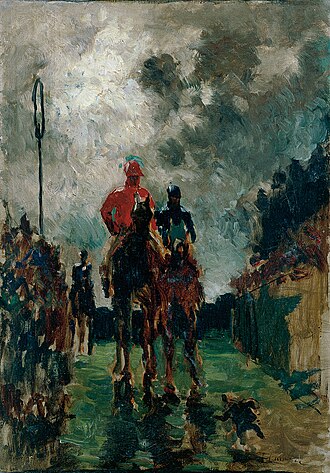 The Jockeys - Henri de Toulouse-Lautrec (1882)