Et l'or de leur corps
Paul Gauguin · 1901
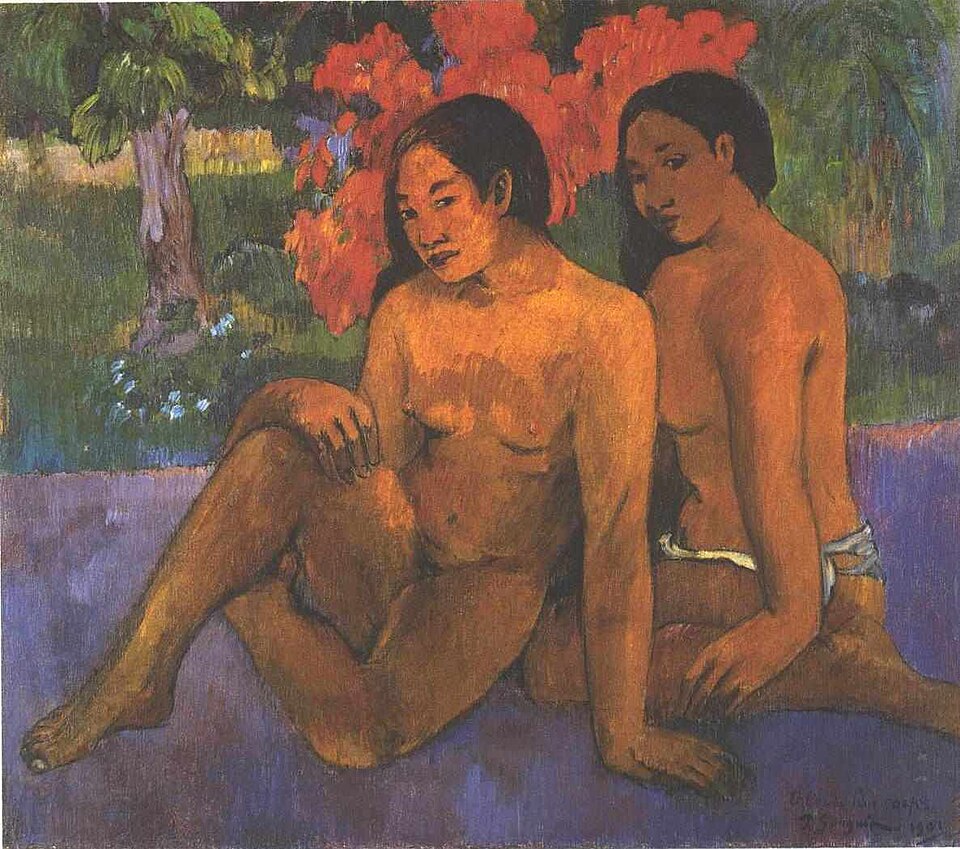
Two women sit on violet ground in front of red, green and yellow leaves, looking straight at us. Gauguin gave the picture its own poetic title, And the Gold of Their Bodies, in the last years of his life in the Marquesas.
The story behind the painting
Gauguin painted this canvas in 1901 on the Marquesas Islands in French Polynesia, where he chose to live at the end of his life. In his catalogue raisonné, Georges Wildenstein lists it as the second picture Gauguin painted that year, under number W. 596. The title is Gauguin's own: he wrote it on the canvas with his signature and the date, Et l'or de leur corps, P. Gauguin 1901. Writing about the islands where he had just settled, he said that here poetry arises by itself, and one only has to let go to suggest it.
What to look for
Two Polynesian women sit one behind the other, crouching on violet ground before lush green and red vegetation, and both look out at the viewer. The woman on the left is completely nude, the other half nude. Gauguin builds the picture on chords of green, violet and pink, and the art historian Jean-Jacques Lévêque called his brushwork here sensual and illuminated. According to Wildenstein, the poses repeat the composition of Gauguin's 1893 painting Eiaha Ohipa, and the left figure can be compared, reversed, with Ahe oe feii. Wildenstein and B. Dorival also suggest the influence of a relief from the temple of Borobudur on Java.
Meaning and intent
The title alone has a poetic ring, evoking the golden skin of the women, along with dream, promise and nonchalance. For Lévêque the painting is above all about desire and pleasure: Gauguin paints desire more than the body, pleasure more than love, and a nature found again at its origins more than the landscape before his eyes. In this reading the picture takes on a magical, almost religious sense. Analysts agree that it evokes the promise of pleasure more than the female bodies themselves. The poet Victor Segalen found a photograph of the Borobudur temple in Gauguin's hut, which supports the link to Java.
Legacy
The painting was shown in Paris in 1903, at the gallery of the dealer Ambroise Vollard and at the Salon d'Automne in the Petit Palais. It then entered the collection of the politician and art lover Olivier Sainsère, and in 1944 the Louvre acquired it from his widow. In 1947 it was assigned to the Jeu de Paume, and in 1986, when the Musée d'Orsay opened, it moved there, where it is still kept today. It remains one of the late works in which Gauguin's search for a paradise of tropical colour is most openly declared.
豆知識
- Painted in 1901 on the Marquesas Islands.
- The title was written on the canvas by Gauguin himself.
- Catalogued by Wildenstein as W. 596.
- At the Musée d'Orsay since 1986.
画家について
Paul Gauguin (1848-1903)
女性 · オルセー美術館 · 座法 · 裸 · 木 · 花 · 人物画
同じ画家の作品: Paul Gauguin
 我々はどこから来たのか 我々は何者か 我々はどこへ行くのか - Paul Gauguin (1897-1898)
 黄色いキリスト - Paul Gauguin (1889)
 いつ結婚するの - Paul Gauguin (1892)
 タヒチの女たち - Paul Gauguin (1890)
 説教の後の幻影 - Paul Gauguin (1888)
死霊が見ている - Paul Gauguin (1892)
 Vincent van Gogh Painting Sunflowers - Paul Gauguin (1888)
 イア・オラナ・マリア - Paul Gauguin (1891)
関連する画家の作品
 星月夜 - Vincent van Gogh (1889)
 夜のカフェテラス - Vincent van Gogh (1888)
 Walk on the mountain - Joaquín Sorolla (1909)
 Sad Inheritance - Joaquín Sorolla (1898)
 大水浴図 - Paul Cézanne (1900s)
 赤いチョッキの少年 - Paul Cézanne
 ムーラン・ド・ラ・ギャレットの舞踏会 - Pierre-Auguste Renoir (1876)
 舟遊びの昼食 - Pierre-Auguste Renoir (1881)
 ムーラン・ルージュ - Henri de Toulouse-Lautrec (1892)
 La Toilette - Henri de Toulouse-Lautrec (1896)