Vincent van Gogh Painting Sunflowers
Paul Gauguin · 1888
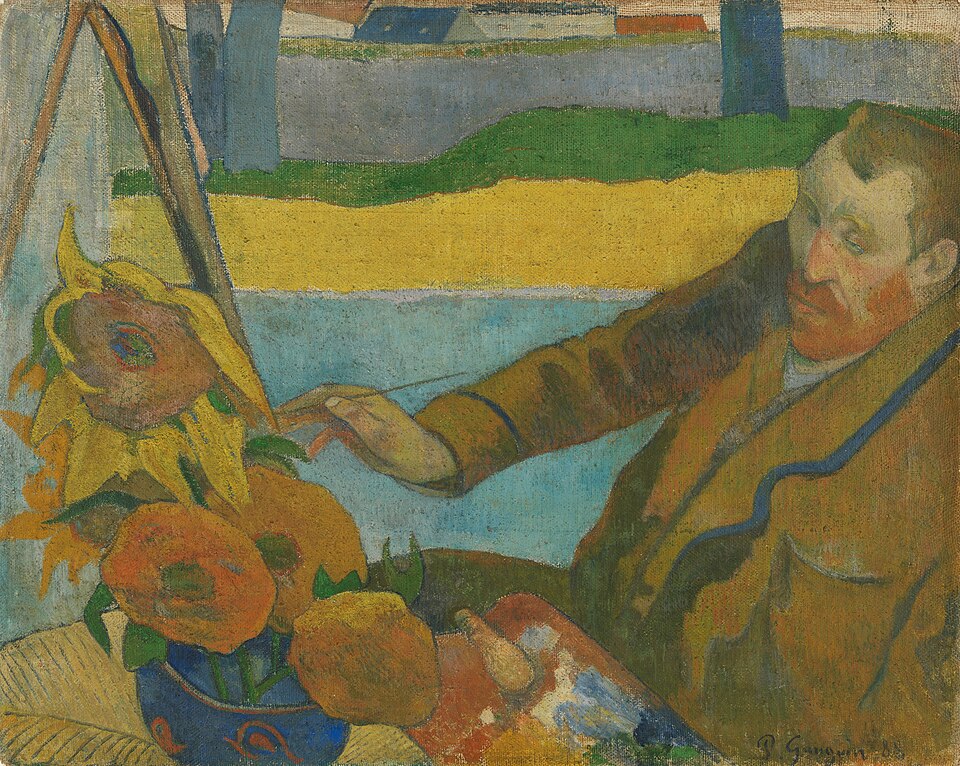
One friend paints another at his easel, brush raised toward a vase of sunflowers: Gauguin's portrait of Van Gogh was made in Arles in December 1888, just days before their shared dream fell apart.
The story behind the painting
In October 1888 Paul Gauguin finally agreed to join Vincent van Gogh in Arles, where Van Gogh hoped to found an artists' colony he called the Studio of the South. Gauguin's stay was supported by Vincent's brother Theo, who paid him 150 francs a month in exchange for one painting. The two artists lived together until December, often at odds over artistic expression and freedom of representation. Gauguin painted this portrait during that time, and it was shipped to Theo on 20 December 1888. Days later, on 23 December, a disagreement was followed by Van Gogh cutting his own left ear. Gauguin soon returned to Paris.
What to look for
Van Gogh sits in the Yellow House before his easel, seen from slightly above, sunk into his chair with his eyes half closed. Some details echo his own works: the blue walls recall his Bedroom in Arles, and the chair is likely the one in Van Gogh's Chair. Behind him hangs an enlarged section of a Gauguin painting, closest to his Blue Trees. Although painted in winter, the scene shows summer sunflowers, so Gauguin probably worked largely from memory. Technical study shows a coarse jute canvas and pure lead-based pigments, with the paint built up most thickly in the figure, the wall and the sunflowers.
Meaning and intent
Gauguin admitted the portrait was not a perfect likeness, but believed it captured his friend's inner character. Van Gogh's first reaction was famous: "It is certainly I, but I gone mad." Later he softened, describing himself as he had been then, very tired and charged with electricity. Art historians note that the head appears distorted, sloping and flattened, and some suggest Gauguin was showing his friend's troubled state of mind rather than his true appearance. It is a portrait of a friendship under strain, made by one painter watching another at work.
Legacy
The painting stayed with Theo van Gogh from 1888 until his death in 1891, then passed down through his family before going to the Van Gogh Foundation in 1962. It has been in the Van Gogh Museum in Amsterdam since the museum opened in 1973. The work belongs to Gauguin's Arles period, when his style moved beyond Impressionism toward a more personal, Post-Impressionist manner. Today it offers a rare view of Van Gogh through another artist's eyes, painted in the very house where their brief partnership unfolded.
豆知識
- Painted in Arles in December 1888; shipped to Theo van Gogh on 20 December.
- Canvas 73 x 91 cm, in the Van Gogh Museum, Amsterdam, since 1973.
- Van Gogh's first reaction: "It is certainly I, but I gone mad."
- Painted on coarse jute, likely largely from memory.
画家について
Paul Gauguin (1848-1903)
肖像 · ポスト印象派 · ファン・ゴッホ美術館 · フィンセント・ファン・ゴッホ · 画家 · 花瓶
同じ画家の作品: Paul Gauguin
 我々はどこから来たのか 我々は何者か 我々はどこへ行くのか - Paul Gauguin (1897-1898)
%201889.jpg) 黄色いキリスト - Paul Gauguin (1889)
黄色いキリスト - Paul Gauguin (1889)%201892%2C%20oil%20on%20canvas%2C%20101%20x%2077%20cm.jpg) いつ結婚するの - Paul Gauguin (1892)
いつ結婚するの - Paul Gauguin (1892) タヒチの女たち - Paul Gauguin (1890)
.jpg) 説教の後の幻影 - Paul Gauguin (1888)
説教の後の幻影 - Paul Gauguin (1888)死霊が見ている - Paul Gauguin (1892)
 The Night Café in Arles - Paul Gauguin (1888)
%20-%201926.198%20-%20Art%20Institute%20of%20Chicago.jpg) マハナ・ノ・アトゥア - Paul Gauguin (1894)
マハナ・ノ・アトゥア - Paul Gauguin (1894)
関連する画家の作品
 星月夜 - Vincent van Gogh (1889)
.jpg) 夜のカフェテラス - Vincent van Gogh (1888)
夜のカフェテラス - Vincent van Gogh (1888) ムーラン・ド・ラ・ギャレットの舞踏会 - Pierre-Auguste Renoir (1876)
 舟遊びの昼食 - Pierre-Auguste Renoir (1881)