ファタタ・テ・ミティ
Paul Gauguin · 1892
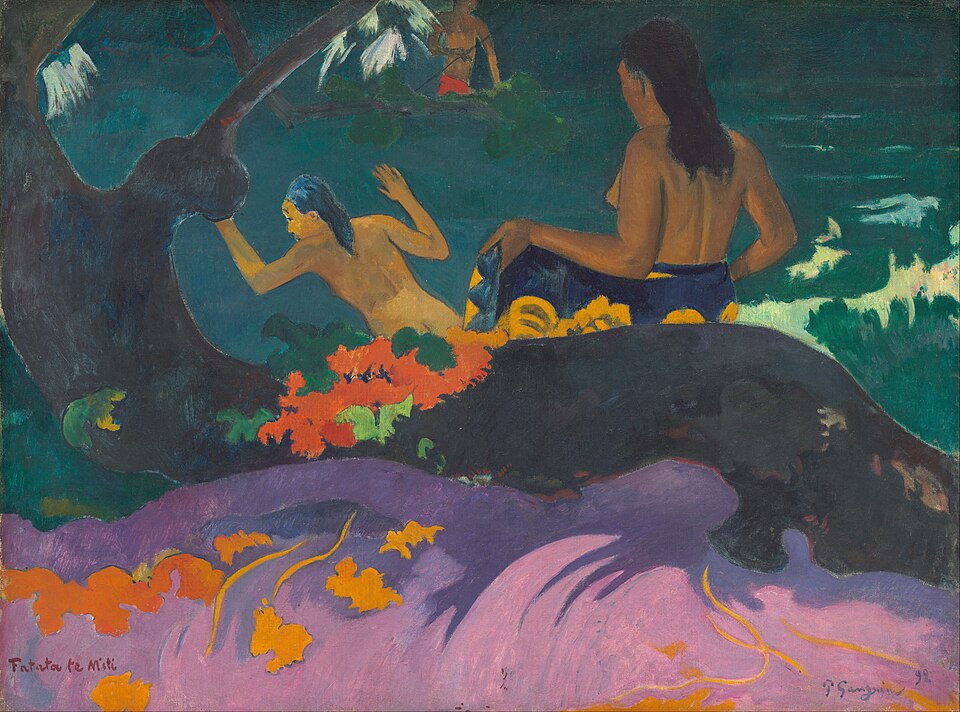
Two women, seen from behind, leap into a sea of pink and violet sand and bright water, while a fisherman raises his spear beyond them. Gauguin painted By the Sea in 1892 as the paradise he hoped to find on Tahiti.
The story behind the painting
Looking for a society simpler than that of France, Gauguin auctioned thirty of his paintings and used the money to travel to Tahiti, where he stayed from 1891 to 1893. He painted Fatata te Miti, By the Sea, in 1892, after setting up his studio in a native bamboo hut at Mataiea. Like Vahine no te vi, painted at the same time, it is one of the relatively few straightforward genre scenes he made then. Yet, as his biographer Nancy Mowll Mathews points out, neither picture shows what he actually saw: both turn ordinary life into an exoticised view of the island.
What to look for
Two Tahitian women, seen from behind, are jumping into the sea, having taken off their pareos, apparently untroubled by the fisherman with a spear in the background. A tree divides the picture into two zones, the same tree that appears in Parau na te Varua ino. The sand is pink and purple, although the real beaches were a drab volcanic brown. Gauguin lays pure, unmixed colour in bold flat shapes outlined in dark contours, a method developed in Brittany and called cloisonnism. To heighten the luminosity and give a jewel like effect, he coated his early Tahitian paintings with a thin layer of clear wax.
Meaning and intent
The painting sums up the romantic view of Tahitians made famous by Pierre Loti's novel Le Mariage de Loti, where the bride's pursuits are reverie and, above all, bathing. It is the uninhibited tropical paradise Gauguin had hoped for, though in reality western missionaries and colonial rule had already transformed Polynesian culture. Nymphs in the waves were a Golden Age theme painted by Titian, Courbet and Degas, and Gauguin had used it before, in Women Bathing of 1885 and Ondine of 1889. The historian Eisenman reads the side by side shapes of related colours as a sign of Gauguin's belief that opposites could be reconciled.
Legacy
A pendant, Arearea no varua ino, painted soon after Gauguin returned to Paris, seems to share the same setting, but adds symbolist elements, showing how he moved beyond simple genre painting. His travel book Noa Noa, meaning The Fragrant Isle, was meant to give context to his 1893 Paris exhibition, though it was published only in 1901. Fatata te Miti later belonged to the collector Chester Dale, who left his collection to the National Gallery of Art in Washington in 1962, where it now hangs.
豆知識
- Painted on Tahiti in 1892, during Gauguin's first stay.
- Pink and purple sand replaces the real brown volcanic beaches.
- Coated with clear wax for a jewel like glow.
- Given to the National Gallery of Art by Chester Dale in 1962.
画家について
Paul Gauguin (1848-1903)
女性 · 風俗美術 · 裸 · ナショナル・ギャラリー・オブ・アート · 木 · 海 · 波
同じ画家の作品: Paul Gauguin
 我々はどこから来たのか 我々は何者か 我々はどこへ行くのか - Paul Gauguin (1897-1898)
 黄色いキリスト - Paul Gauguin (1889)
 いつ結婚するの - Paul Gauguin (1892)
 タヒチの女たち - Paul Gauguin (1890)
 説教の後の幻影 - Paul Gauguin (1888)
死霊が見ている - Paul Gauguin (1892)
 Vincent van Gogh Painting Sunflowers - Paul Gauguin (1888)
 イア・オラナ・マリア - Paul Gauguin (1891)
関連する画家の作品
 星月夜 - Vincent van Gogh (1889)
 夜のカフェテラス - Vincent van Gogh (1888)
 Walk on the mountain - Joaquín Sorolla (1909)
 Sad Inheritance - Joaquín Sorolla (1898)
 大水浴図 - Paul Cézanne (1900s)
 赤いチョッキの少年 - Paul Cézanne
 ムーラン・ド・ラ・ギャレットの舞踏会 - Pierre-Auguste Renoir (1876)
 舟遊びの昼食 - Pierre-Auguste Renoir (1881)
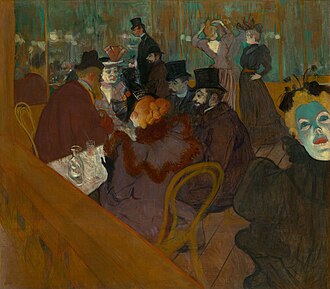 ムーラン・ルージュ - Henri de Toulouse-Lautrec (1892)
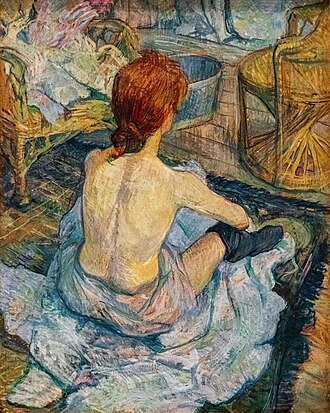 La Toilette - Henri de Toulouse-Lautrec (1896)