The Temptations of Saint Anthony
ヒエロニムス・ボス · 1510s
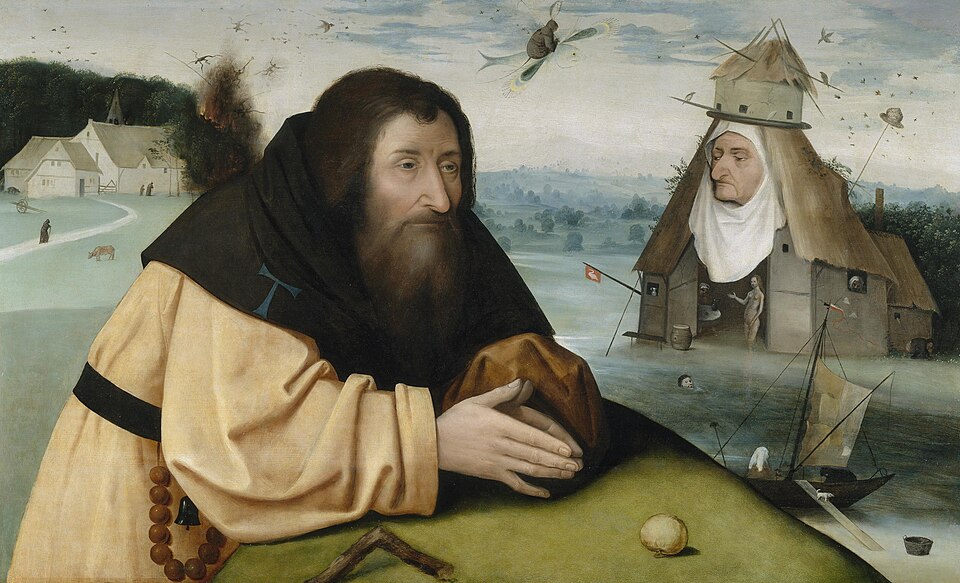
Saint Anthony prays with folded hands while a monastery burns and a strange house beckons with wine and a naked woman. This Prado panel carries Bosch's world, but whose hand painted it is still debated.
The story behind the painting
This sixteenth century painting in the Museo del Prado is attributed to a follower or to the workshop of Hieronymus Bosch. Dendrochronology of the oak panel sets the earliest possible date at 1486, and the painting was probably made around 1510 to 1515, during Bosch's lifetime. Yet its composition and technique differ noticeably from the master's known works. Gustav Glück and Jacques Combe saw such versions as copies of a lost original. Others, including Jan Victor Lucien Brans, Carmen Garrido, Roger van Schoute and Monique Verboomen, saw a pastiche by a later follower. The title, artist and dating therefore remain open questions.
What to look for
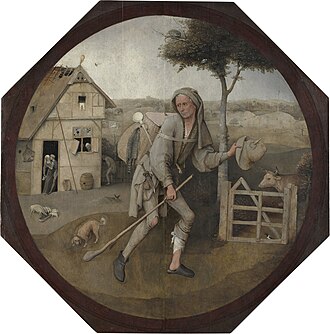
Anthony, set off centre to the left and shown half length, is recognisable by the Tau on his hood. He prays with joined hands on a mossy rock or small hill. Behind him on the left, flying demons attack and burn a monastery. Before him lies a fruit, and on the right, at the door of a strange house, a naked woman and a jug of wine on a table. The house is topped by a giant old woman's head wearing a dovecote. Its swan sign, the woman at the window and the barrel at the door recall the brothel in Bosch's Wayfarer in Rotterdam, and a man defecates by its wall.
Meaning and intent
The saint seems untouched by everything around him, the fire and the attack as much as the temptations of the fruit, the woman and the wine. That calm is the heart of the picture: the more the world crowds in with noise and desire, the more still the praying figure becomes. Further right, in a vague stretch of water, a man seems to swim or drown, while a small sailing boat with a woman aboard lies at the near shore. In the air, a monk riding a winged fish recalls similar motifs on the inner wings of Bosch's Lisbon Temptation triptych, tying this scene to the master's own imagery.
Legacy
Two other versions exist. One, in the Rijksmuseum in Amsterdam, is of lower quality and bears the signature Jheronimus bosch, contradicted by dendrochronology: its tree was felled between 1543 and 1554, at least twenty seven years after Bosch's death. In the copy at El Escorial, the brothel is replaced by a crucifix. The Prado panel belonged to a Spanish convent or church in the early nineteenth century, was seized around 1836, shown at the Museo de la Trinidad from 1838 and joined the Prado collections in 1872. It was lent to San Francisco el Grande, hung at the Foreign Ministry in 1930, and returned to the Prado in 1948.
豆知識
- Attributed to a follower or the workshop of Bosch.
- Oil on oak, 70 by 115 cm, probably painted around 1510-1515.
- Other versions are in the Rijksmuseum and at El Escorial.
- Returned to the Prado for good in 1948.
画家について
ヒエロニムス・ボス (1450-1516)
同じ画家の作品: ヒエロニムス・ボス
 快楽の園 - Hieronymus Bosch
 愚者の船 - Hieronymus Bosch (1500s)
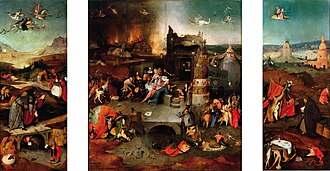 聖アントニウスの誘惑の三連祭壇画 - Hieronymus Bosch (1501)
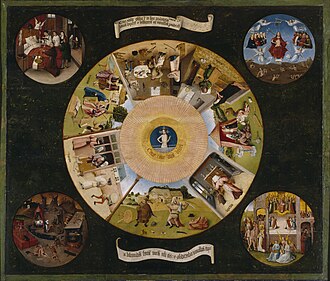 七つの大罪と四終 - Hieronymus Bosch (1500)
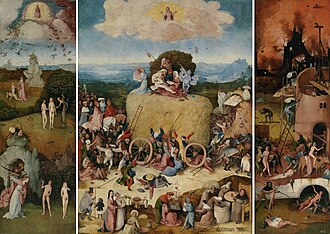 乾草車の三連祭壇画 - Hieronymus Bosch (1510s)
 十字架を担うキリスト - Hieronymus Bosch (1510s)
 放浪者 - Hieronymus Bosch (1500)
 守銭奴の死 - Hieronymus Bosch (1500s)
関連する画家の作品
 十字架降架 - Rogier van der Weyden (1440s)
 女性の肖像 - Rogier van der Weyden (1460)
 アルノルフィーニ夫妻像 - Jan van Eyck (1434)
 ヘントの祭壇画 - Jan van Eyck (1432)
 受胎告知 - Hans Memling (1480s)
 キリストの受難の場面 - Hans Memling (1470)
 雪中の狩人 - Pieter Bruegel the Elder (1565)
 ネーデルラントの諺 - Pieter Bruegel the Elder (1551)