十字架を担うキリスト
ヒエロニムス・ボス · 1500s
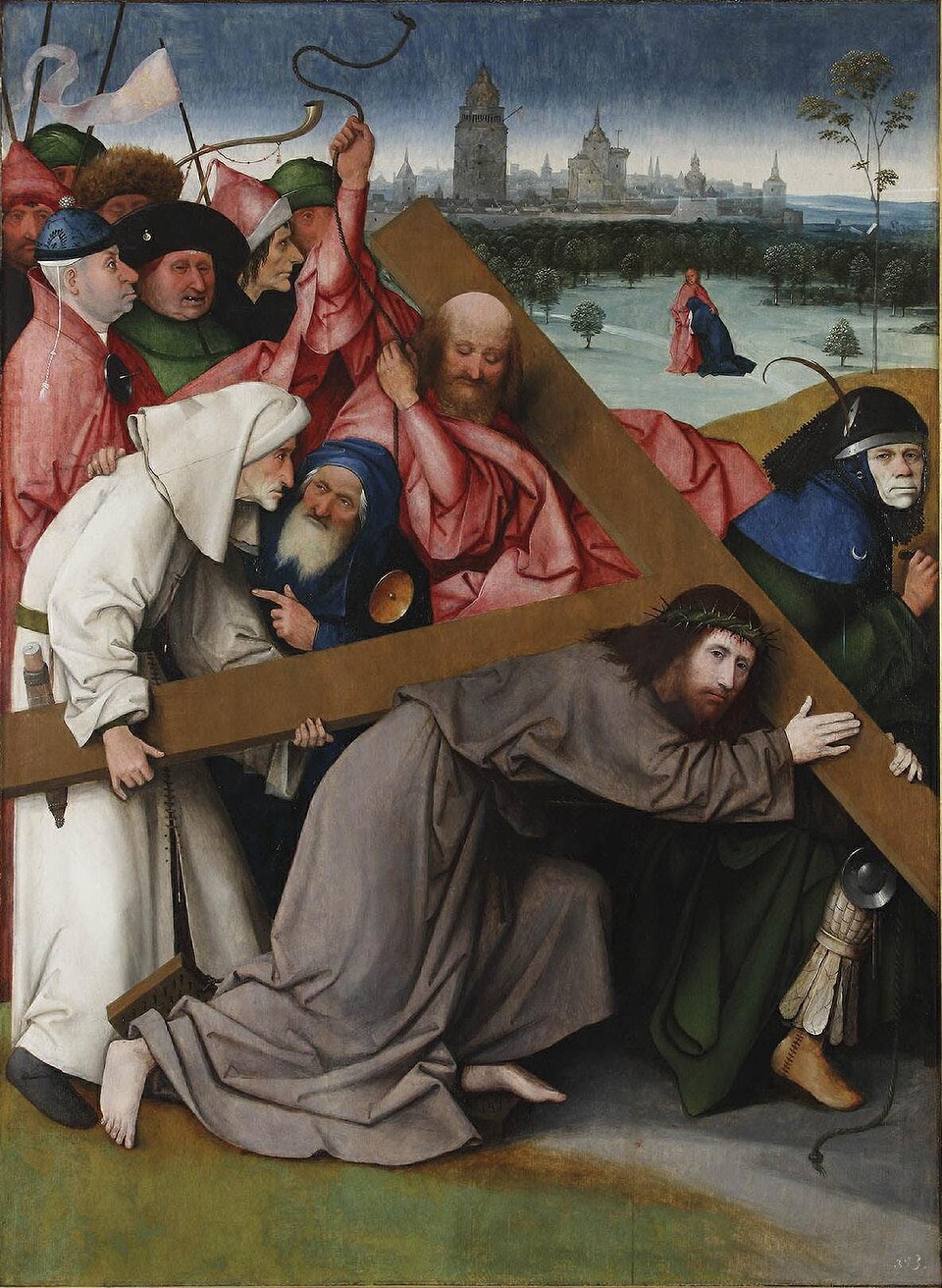
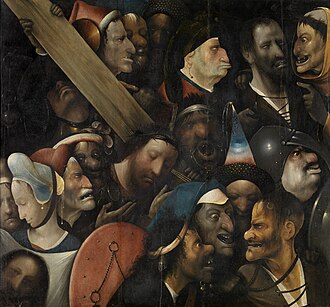
Christ has just fallen to one knee, crowned with thorns, whipped with a rope, yet his face stays calm. Behind the noisy crowd, Bosch painted a quiet landscape where Mary weeps beside Saint John.
The story behind the painting
Hieronymus Bosch painted this Christ Carrying the Cross around 1505, and it is kept at the Royal Monastery of San Lorenzo de El Escorial in Spain. Dendrochronology showed that the oak panel could have been painted in 1498 at the earliest. The art historian Frédéric Elsig places it around 1504 to 1505 and suggests it may have been meant for the chapel of the Brotherhood of Our Lady in the church of Saint John in 's-Hertogenbosch, Bosch's home town. The label at El Escorial gives a slightly later date, around 1505 to 1507.
What to look for
The panel, about 142 by 104 cm, is made of two boards of Baltic oak. In front, Christ carries a Tau-shaped cross. Thorns make his forehead bleed, boards studded with nails hang near his bare feet, and a tormentor whips him with a rope as he goes down on one knee. His plain grey tunic stands out against the red, blue and green clothes of soldiers and onlookers, and against the white garment of old Simon of Cyrene, who helps him. A soldier leading the group wears a hood with a small crescent moon.
Meaning and intent
Despite the cruelty around him, Christ's face is stoic. Some faces, especially the three men behind Simon, are close to caricature, though less deformed than in the version in Ghent. The crescent on the soldier's hood may allude to the Ottoman Turks, the main enemies of Christendom after the fall of Constantinople. Far behind, in a landscape worthy of an illuminated manuscript, the Virgin Mary weeps beside Saint John, recognisable by his beardless face. The walls and towers of Jerusalem seem freely inspired by the Gothic architecture of 's-Hertogenbosch.
Legacy
Some scholars wondered how much of the work was done by Bosch's workshop, but changes of mind visible in infrared reflectography seem to prove it is by his own hand. Christ, Simon and the bald, bearded man with the rope appear in very similar poses on the Vienna Christ Carrying the Cross, but the El Escorial panel is broader and more monumental, which may point to a later date. King Philip II, the greatest collector of Bosch, had it hung at El Escorial from 1574. In the twentieth century it was shown for years at the Royal Palace of Madrid and was restored.
豆知識
- Painted around 1505 on Baltic oak, at the earliest from 1498.
- About 142 x 104 cm.
- Hung at El Escorial by Philip II from 1574.
- Elsig dates it 1504-1505, the El Escorial label 1505-1507.
画家について
ヒエロニムス・ボス (1450-1516)
宗教美術 · 男性 · イエス・キリスト · 初期フランドル派 · エル・エスコリアル修道院 · 王宮
同じ画家の作品: ヒエロニムス・ボス
 快楽の園 - Hieronymus Bosch
 愚者の船 - Hieronymus Bosch (1500s)
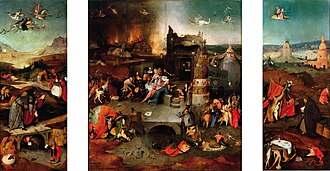 聖アントニウスの誘惑の三連祭壇画 - Hieronymus Bosch (1501)
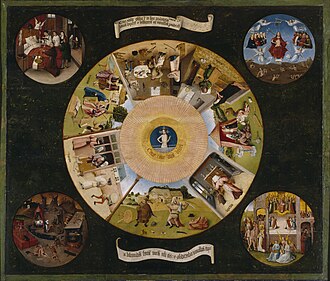 七つの大罪と四終 - Hieronymus Bosch (1500)
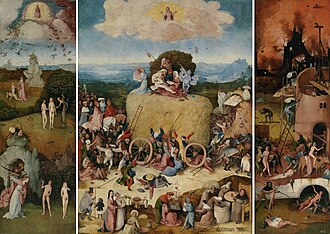 乾草車の三連祭壇画 - Hieronymus Bosch (1510s)
 十字架を担うキリスト - Hieronymus Bosch (1510s)
 放浪者 - Hieronymus Bosch (1500)
 守銭奴の死 - Hieronymus Bosch (1500s)
関連する画家の作品
 十字架降架 - Rogier van der Weyden (1440s)
 女性の肖像 - Rogier van der Weyden (1460)
 アルノルフィーニ夫妻像 - Jan van Eyck (1434)
 ヘントの祭壇画 - Jan van Eyck (1432)
 受胎告知 - Hans Memling (1480s)
 キリストの受難の場面 - Hans Memling (1470)
 雪中の狩人 - Pieter Bruegel the Elder (1565)
 ネーデルラントの諺 - Pieter Bruegel the Elder (1551)