Édouard Manet
1832-1883
Édouard Manet turned his brush on the Paris around him and shocked the city twice, with The Luncheon on the Grass and Olympia. A reluctant rebel who still longed for the Salon, he opened the door to Impressionism and to modern art.
Origins
Manet was born in Paris on 23 January 1832, in the family mansion on the Rue des Petits Augustins, now Rue Bonaparte. He had two younger brothers, Eugène and Gustave. His mother, Eugénie-Desirée Fournier, was a diplomat's daughter and goddaughter of the Swedish crown prince Charles Bernadotte; his father, Auguste, was a judge who expected his son to study law. It was an uncle, Edmond Fournier, who encouraged the boy to paint and took him to the Louvre. Unhappy and unremarkable at the Collège Rollin, he joined a drawing course in 1845 and met Antonin Proust, his lifelong friend. In 1848 he sailed on a training ship to Rio de Janeiro, but after failing the naval examination twice he was allowed to study art. From 1850 to 1856 he worked under the academic painter Thomas Couture, while copying Velázquez and Titian in the Louvre.
Life and turning points
Between 1853 and 1856 Manet travelled to Germany, Italy and the Netherlands, absorbing Frans Hals, Velázquez and Goya. In 1856 he opened his own studio. Two canvases were accepted at the Salon of 1861, and The Spanish Singer won admirers. In 1862 he showed Music in the Tuileries, which provoked fury but made his name known across Paris. A year later The Luncheon on the Grass, rejected by the Salon, appeared at the Salon des Refusés and became one of its most discussed works. In 1863 he married Suzanne Leenhoff, a Dutch-born piano teacher he had loved for about ten years. Olympia caused an even greater scandal at the Salon of 1865. When he was excluded from the International Exhibition of 1867, he staged his own show. From 1868 his friendship with Berthe Morisot drew him close to Degas, Monet, Renoir and their circle. He died on 30 April 1883.
Style and technique
From the start Manet's manner looked different: loose brushstrokes, simplified details and the suppression of transitional tones between light and dark. Next to the polished surfaces of other Salon paintings his work seemed slapdash to some, and one critic said The Luncheon looked as if painted with a floor mop. Yet his compositions were steeped in the old masters. The Luncheon borrows its main figures from an engraving after Raphael, and Olympia takes its pose from Titian's Venus of Urbino, while its flatness owes something to Japanese woodblock prints. He chose modern subjects: cafés, beggars, singers, bullfights and the leisure of Parisians outdoors. Under the influence of Monet and Morisot, after the early 1870s he lightened his palette and used fewer dark backgrounds, though he kept his distinctive black, something the Impressionists avoided. He painted outdoors, but always returned to what he saw as the serious work of the studio.
Stories and anecdotes
Music in the Tuileries filled a garden with Manet's own circle, including the poet Charles Baudelaire, the composer Jacques Offenbach and the painter himself. Some visitors threatened to destroy it, and one of its few defenders was Eugène Delacroix, one of Manet's idols. When Olympia was shown, Antonin Proust recalled that only precautions by the administration saved the canvas from being torn. Émile Zola was so moved by The Luncheon that he later based the painting at the heart of his novel L'Œuvre on it. Berthe Morisot persuaded Manet to try painting in the open air, and in 1874 she became his sister-in-law by marrying his brother Eugène. His friend the composer Emmanuel Chabrier owned fourteen of his paintings. His wife's son, Léon Leenhoff, posed for him eighteen times, most famously in Boy Blowing Bubbles.
Legacy
Manet stands at the hinge between Realism and Impressionism, and The Luncheon on the Grass and Olympia are widely seen as watershed paintings marking the start of modern art. What critics mocked, younger artists embraced. Gustave Courbet, Paul Cézanne, Claude Monet and later Paul Gauguin recognised Olympia's importance, and The Spanish Singer, in the words of a contemporary, made painters' eyes open and their jaws drop. Curiously, he never exhibited with the Impressionists, partly because he did not want to stand for a group and partly because he believed modern artists should fight their battles at the Salon. His only formal student was Eva Gonzalès. His simple and direct style became a major influence on the painters who followed. To look at his pictures today is to see the moment when painting turned to face its own time.
豆知識
- Manet twice failed the examination to join the French navy before his father let him study art.
- His friend Antonin Proust later became Minister of Fine Arts.
- The Luncheon on the Grass was originally titled Le Bain.
- Méry Laurent posed for seven of his pastel portraits.
関連する画家
Claude Monet · Pierre-Auguste Renoir · Vincent van Gogh
Édouard Manetの作品
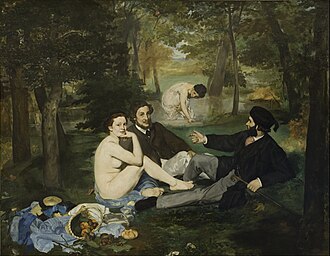 草上の昼食 - Édouard Manet (1863)
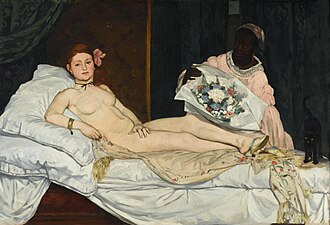 オランピア - Édouard Manet (1863)
%20(33539037428).jpg) フォリー・ベルジェールのバー - Édouard Manet (1882)
フォリー・ベルジェールのバー - Édouard Manet (1882)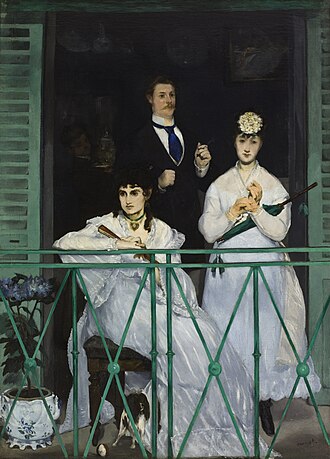 バルコニー - Édouard Manet (1868)
.jpg) テュイルリー公園の音楽会 - Édouard Manet (1862)
テュイルリー公園の音楽会 - Édouard Manet (1862).jpg) 笛を吹く少年 - Édouard Manet (1866)
笛を吹く少年 - Édouard Manet (1866)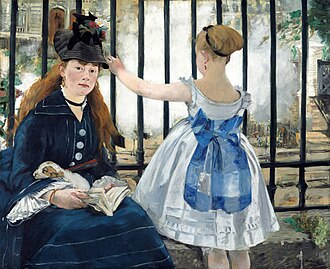 鉄道 - Édouard Manet (1873)
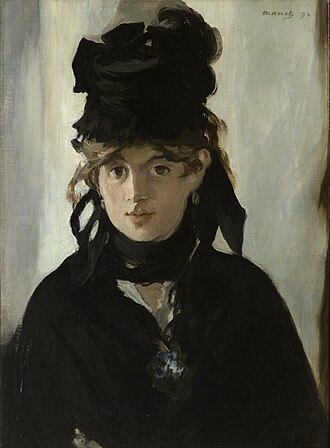 すみれの花束をつけたベルト・モリゾ - Édouard Manet (1872)
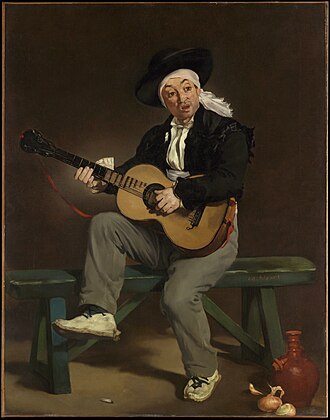 スペインの歌手 - Édouard Manet (1860)
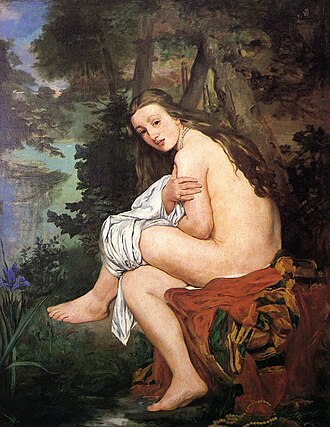 驚くニンフ - Édouard Manet (1860)