Portrait of Zacharie Astruc
Édouard Manet · 1866
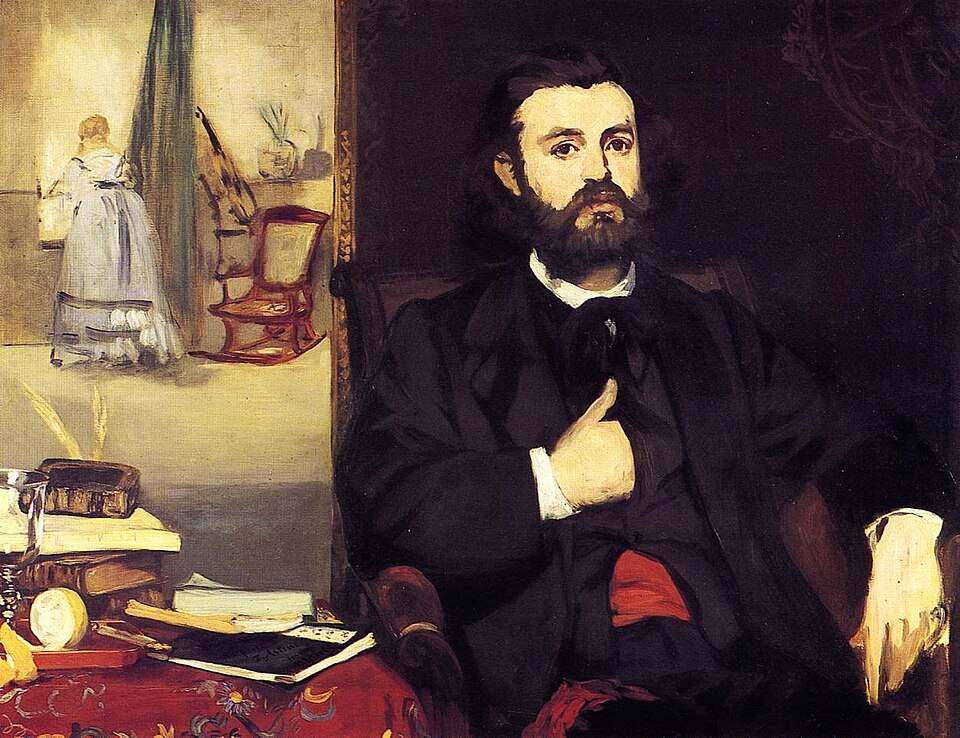
On the right, a poet in black sits against a dark wall, one hand tucked into his waistcoat. On the left, a bright still life and a sunlit room with a woman at a window. Manet painted his friend Zacharie Astruc in 1866 and dedicated a book in the picture to him.
The story behind the painting
The portrait belongs to a series of portraits of men of letters that Manet painted in the 1860s, works that bear witness to mutual admiration and friendship. Painter and sitter shared an interest in Japanese art and Spanish painting, and many objects in the picture point to both. The models for the portrait have been traced to Titian and to Flemish painting. Manet chose a landscape format, about 90 by 116 cm, although even in the 19th century portraits were normally upright. The painting is now in the Kunsthalle Bremen.
What to look for
The portrait itself fills roughly the right two thirds: Astruc sits in an armchair before a dark wall, wide-eyed, with a full dark beard, in a black suit, white shirt and loose black bow, a bright red cloth like a cummerbund at his waist. Like Napoleon, his right hand is tucked into his waistcoat, thumb up, while the left, painted far more sketchily, hangs from the chair. On the left, on a red flowered tablecloth, sit a red Japanese lacquer tray, a water glass cut by the edge, a half peeled lemon, a knife, old leather books, yellow and green new ones and two light quills. A green covered book, identified as Yanagawa Shigenobu's 1823 Ehon Fujibakama, bears the dedication: au poète Z. Astruc son ami Manet 1866. Above, a woman in grey leans at a window beside a rocking chair, a guitar and a vase of flowers.
Meaning and intent
The sketchy left hand has been read in many ways. Gotthard Jedlicka saw it acting like a direction arrow; Petra Buschhoff-Leineweber said its unfinished state makes the composition rhythmic; Françoise Cachin saw a provocative negligence that keeps attention on the face, and rejected the old idea that Manet could not paint hands. The room at upper left has three readings: a view into another room, which the table seems to block; a mirror, though Cachin notes the reflections are missing; or a picture within the picture, which Cachin thinks a fiction by Manet. Whether the woman is Astruc's wife, as Adolphe Tabarant suspected, is not certain. The guitar may evoke the two men's shared love of Spain.
Legacy
Critics have long admired how the halves hold together. Colours link them: the red tablecloth echoes Astruc's red sash, the brown books and rocking chair echo the dark wall, and the bright books and room answer the light face and hands. In 1913 Karl Scheffler wondered at how two pictures had become one. Werner Hofmann called Manet's montage as bold as it is puzzling, with foreground and background balanced as unequal yet linked weights. The painter Curt Stoermer praised the seemingly spontaneous shift from simplified to finely worked passages, and Étienne Moreau-Nélaton wrote that an enchanting brush had touched this portrait.
豆知識
- Painted by Manet in 1866, in landscape format.
- A book in the still life carries Manet's dedication to Astruc.
- The bright room at left may be a view, a mirror or a picture within the picture.
- In the Kunsthalle Bremen.
画家について
Édouard Manet (1832-1883)
同じ画家の作品: Édouard Manet
 草上の昼食 - Édouard Manet (1863)
 オランピア - Édouard Manet (1863)
 フォリー・ベルジェールのバー - Édouard Manet (1882)
 バルコニー - Édouard Manet (1868)
 テュイルリー公園の音楽会 - Édouard Manet (1862)
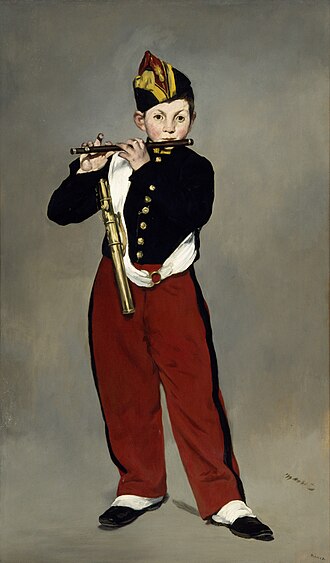 笛を吹く少年 - Édouard Manet (1866)
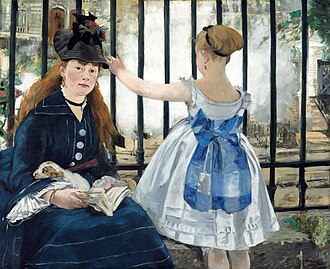 鉄道 - Édouard Manet (1873)
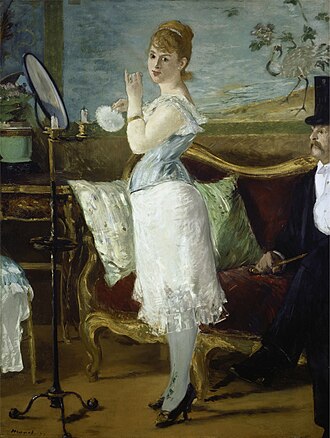 ナナ - Édouard Manet (1877)
関連する画家の作品
 印象・日の出 - Claude Monet (1872)
 睡蓮 - Claude Monet (1906)
 ムーラン・ド・ラ・ギャレットの舞踏会 - Pierre-Auguste Renoir (1876)
 舟遊びの昼食 - Pierre-Auguste Renoir (1881)
 ゆりかご - Berthe Morisot (1872)
 Summer's Day - Berthe Morisot (1879)
 アブサントを飲む人 - Edgar Degas (1875)
 The Bellelli Family - Edgar Degas (1858)
 The Canal du Loing at Moret - Alfred Sisley (1892)
 The Watering Pond at Marly with Hoarfrost - Alfred Sisley (1876)
 パリの通り、雨 - Gustave Caillebotte (1877)
 床削り - Gustave Caillebotte (1875)