鉄道
Édouard Manet · 1873
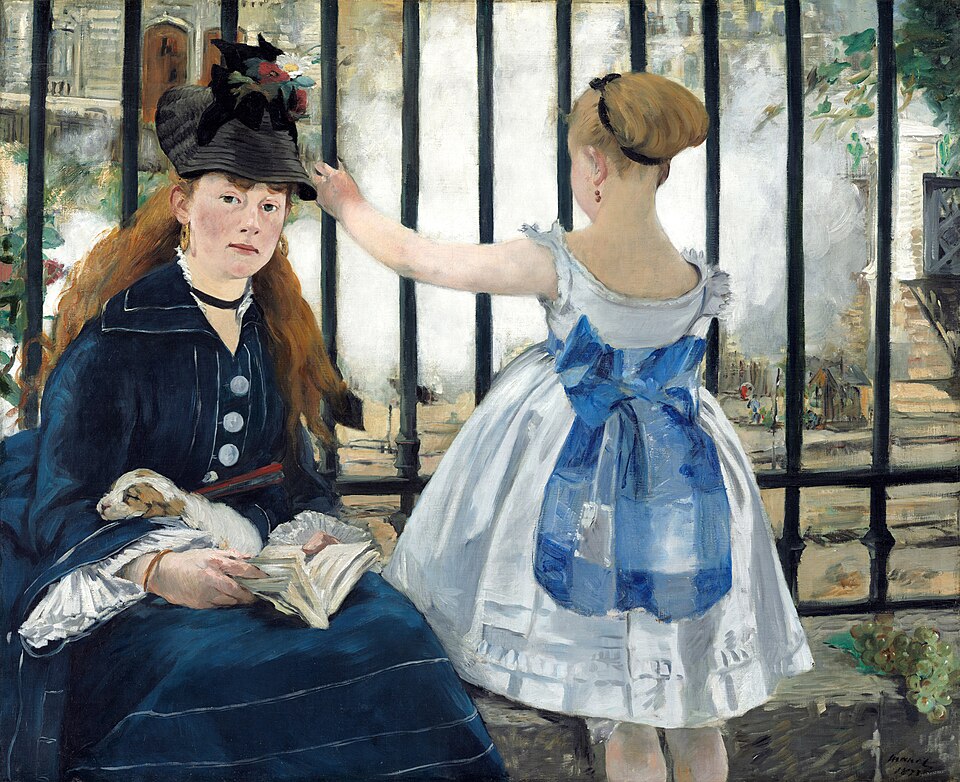
A woman looks up from her book, a little girl stares through iron railings, and the train itself is nothing but a cloud of white steam. Manet's The Railway of 1873 baffled the Salon and later came to stand for modern life.
The story behind the painting
Édouard Manet painted The Railway, widely known as Gare Saint-Lazare, in 1873. Since July 1872 he had rented a studio on the Rue de Saint-Pétersbourg near the Place de l'Europe, and that very house appears in the background of the picture. For the seated woman he turned once more to Victorine Meurent, a fellow painter and his favourite model, who had posed for Olympia and the Luncheon on the Grass. This would be his last painting of her. The little girl beside her was modelled by the daughter of his neighbour Alphonse Hirsch. A bunch of grapes on a parapet at the right may hint that the picture was made in autumn. Manet showed the finished canvas at the Paris Salon of 1874.
What to look for
Meurent sits at the left in front of an iron fence, in a dark hat and a deep blue dress with white details. She looks straight at us, while a sleeping puppy, a fan and an open book rest in her lap. Beside her, the little girl in a white dress with a large blue bow stands with her back to us, watching through the railings as a train passes below. Notice the small rhymes: the black band in the girl's hair echoes the black band at the woman's neck. Instead of a natural view, Manet lets the iron grating stretch across the canvas, pressing the foreground into a narrow strip and ignoring deep space. Beyond it you can find white steam, apartment buildings, a signal box and the Pont de l'Europe.
Meaning and intent
The only sign of the train is its steam, and that absence is part of the point. The art historian T. J. Clark read the scene as a moment of interception: for the girl watching, time stands still, while the woman keeps her place in her book with a finger, waiting for our brief glance to pass before she returns to her novel. He contrasted that fleeting moment with the solid, permanent presence oil paint gives to things, the pages, the puppy, the bracelet, the fan, the ribbon. The puppy may also be a nod to Titian's Venus of Urbino, which Manet had already echoed in Olympia. Two figures, two directions of looking, one turned to us and one to the new city.
Legacy
At the Salon of 1874, according to historian Isabelle Dervaux, visitors and critics found the subject baffling, the composition incoherent and the handling sketchy, and caricaturists mocked it; only a few recognised the symbol of modernity it has since become. The painting went first to the baritone Jean-Baptiste Faure, then to the dealer Paul Durand-Ruel, who gave it several titles, including Gare St. Lazare. In 1898 it was bought by the American Henry Osborne Havemeyer. Louisine Havemeyer later divided a small group of works, including this one, among her children, and on the death of her son Horace it was donated in 1956 to the National Gallery of Art in Washington, D.C., where it hangs today.
豆知識
- Painted 1873; shown at the Paris Salon of 1874
- Manet's last painting of Victorine Meurent
- Background shows Manet's own studio building
- Donated to the National Gallery of Art, Washington, in 1956
画家について
Édouard Manet (1832-1883)
女性 · 肖像 · ナショナル・ギャラリー・オブ・アート · 少女
同じ画家の作品: Édouard Manet
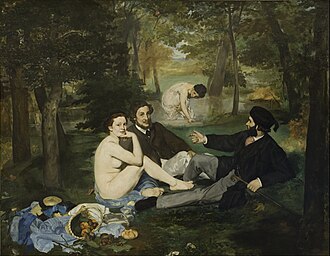 草上の昼食 - Édouard Manet (1863)
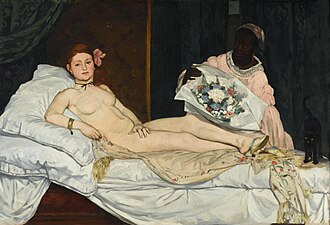 オランピア - Édouard Manet (1863)
%20(33539037428).jpg) フォリー・ベルジェールのバー - Édouard Manet (1882)
フォリー・ベルジェールのバー - Édouard Manet (1882)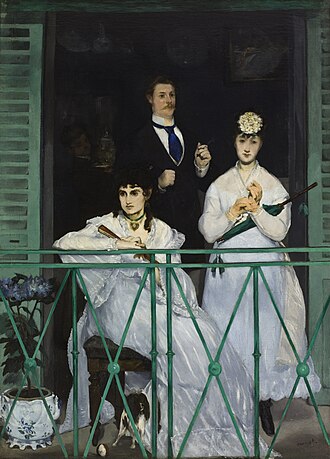 バルコニー - Édouard Manet (1868)
.jpg) テュイルリー公園の音楽会 - Édouard Manet (1862)
テュイルリー公園の音楽会 - Édouard Manet (1862).jpg) 笛を吹く少年 - Édouard Manet (1866)
笛を吹く少年 - Édouard Manet (1866)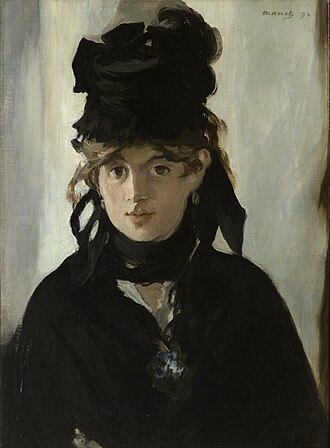 すみれの花束をつけたベルト・モリゾ - Édouard Manet (1872)
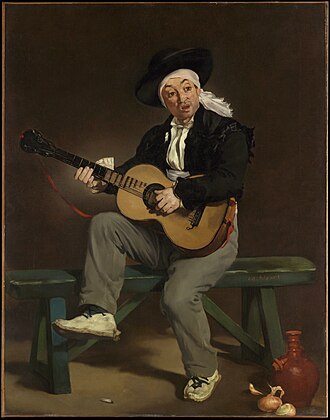 スペインの歌手 - Édouard Manet (1860)
 印象・日の出
 睡蓮
睡蓮 ムーラン・ド・ラ・ギャレットの舞踏会
 舟遊びの昼食
 星月夜
星月夜.jpg) 夜のカフェテラス
夜のカフェテラス