驚くニンフ
Édouard Manet · 1860
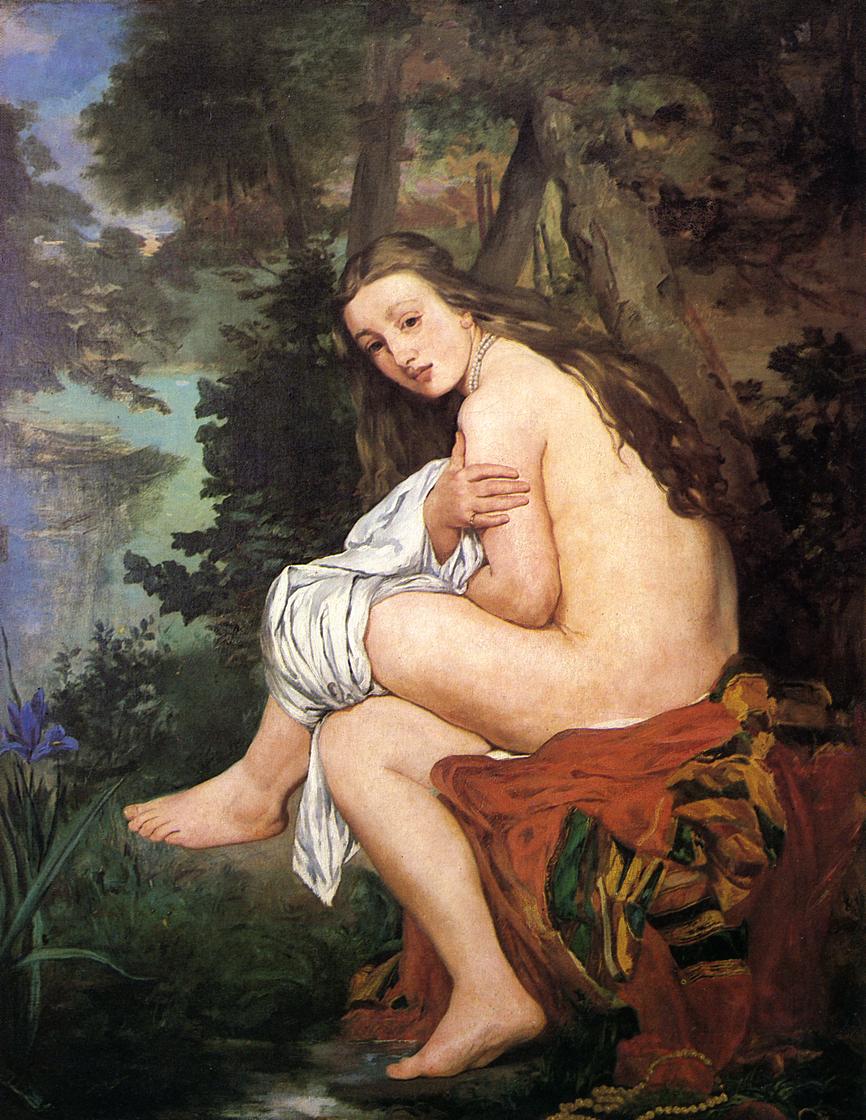
A young woman by a lake turns, startled, as if she has just caught you looking. The model was the pianist Manet loved in secret and later married.
The story behind the painting
La Nymphe surprise, the Surprised Nymph, is a painting by Édouard Manet. Wikidata dates it to 1860, while the Wikipedia article gives 1861. The model was Suzanne Leenhoff, a Dutch pianist three years older than Manet, who had been engaged in 1849 to teach piano to Édouard and his brother Eugène in their parents' house. The two began a secret affair, hidden from his family. They married in 1863, the year after Manet's father died and two years after this painting was completed, and they stayed together until Manet's death in 1883.
What to look for
A young woman sits in a wooded landscape beside a lake, her chestnut hair falling down her back, and looks out at us in surprise. She wears nothing except white pearls around her neck and a ring on her little finger. Near her left foot grows a blue iris. Notice her glance: it is not bold or challenging but shy and startled, as though she has discovered someone watching her and invading her privacy. The canvas is large, about 144.5 by 112.5 cm, so the figure feels close to life size.
Meaning and intent
Nymphs were female nature spirits of Greek mythology, often imagined as young women living in woods and by springs and rivers. Several writers have linked Manet's picture to Rembrandt's Susanna and the Elders, noting that the model was named Suzanne, was Dutch, and holds the same pose. Françoise Cachin instead suggests that Manet was inspired by Jean-Baptiste Santerre's 1704 painting of the same subject, pointing to the arm and the handling of the material. So beneath the mythological title lies both art history and a private love story.
Legacy
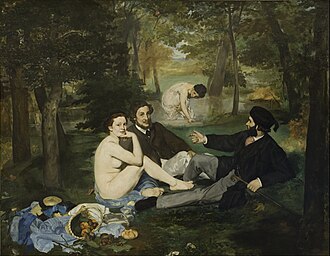
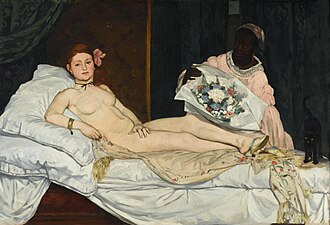
The work is described as a key painting in Manet's career, marking the start of a new period for him and for modernism in French painting. It came two years before Le Déjeuner sur l'herbe and Olympia, and it was shown at the Salon in 1865. Manet kept it in his studio his entire life, and there is evidence he counted it among his most important works. It is now in the National Museum of Fine Arts in Buenos Aires, where it is considered one of the highlights of the collection.
豆知識
- Model: Suzanne Leenhoff, whom Manet married in 1863.
- Dated 1860 by Wikidata and 1861 by Wikipedia.
- Exhibited at the Salon in 1865.
- Now in the National Museum of Fine Arts, Buenos Aires.
画家について
Édouard Manet (1832-1883)
同じ画家の作品: Édouard Manet
 草上の昼食 - Édouard Manet (1863)
 オランピア - Édouard Manet (1863)
%20(33539037428).jpg) フォリー・ベルジェールのバー - Édouard Manet (1882)
フォリー・ベルジェールのバー - Édouard Manet (1882) バルコニー - Édouard Manet (1868)
.jpg) テュイルリー公園の音楽会 - Édouard Manet (1862)
テュイルリー公園の音楽会 - Édouard Manet (1862).jpg) 笛を吹く少年 - Édouard Manet (1866)
笛を吹く少年 - Édouard Manet (1866) 鉄道 - Édouard Manet (1873)
 すみれの花束をつけたベルト・モリゾ - Édouard Manet (1872)
 印象・日の出
 睡蓮
睡蓮 ムーラン・ド・ラ・ギャレットの舞踏会
 舟遊びの昼食
 星月夜
星月夜.jpg) 夜のカフェテラス
夜のカフェテラス