ブリュネ夫人の肖像
Édouard Manet · 1863
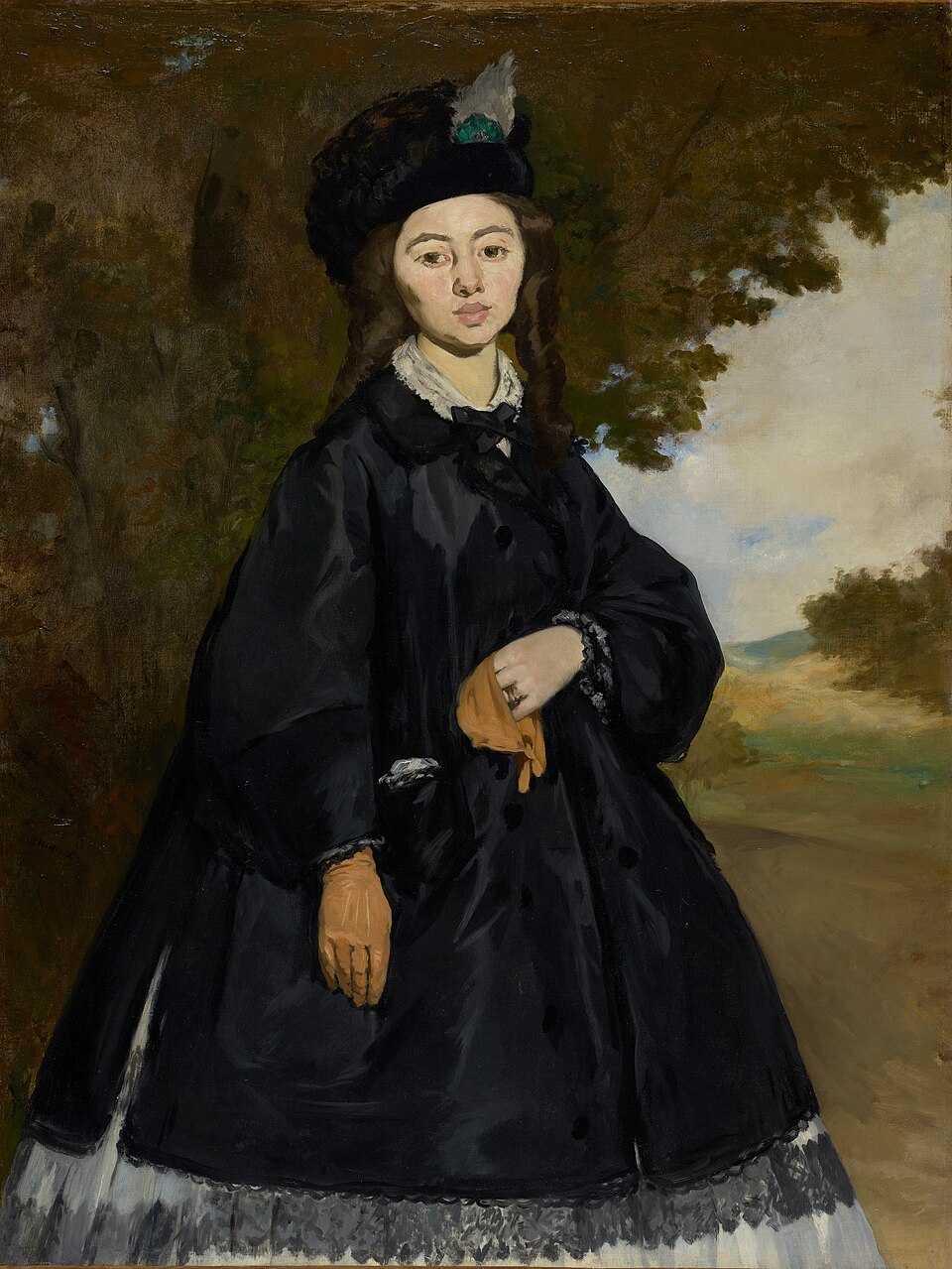
Manet painted a young Parisian in black with a glove, flattering her, and she burst into tears when she saw it. Mocked by the press and refused by its sitter, the portrait stayed in his studio for years, and he even cut away its lower part.
The story behind the painting
Manet began the painting in 1861 and finished it in 1863. The sitter is Caroline de Pène, wife of the sculptor Eugène Cyrille Brunet. According to Théodore Duret she was not beautiful, and although Manet flattered her, she burst into tears when she first saw the picture. The work was mocked by the popular press and refused by its subject, and it remained in Manet's studio for a long time. It originally showed her full-length, but by 1867 Manet had cut away the bottom section. Wikidata gives the present size as 132.4 by 100 cm.
What to look for
The tonality, with its strong emphasis on black, shows the influence of Spanish painting and of Diego Velázquez in particular. Velázquez's Philip IV as a Hunter has been suggested as a likely inspiration for the landscape behind her, so the woman stands, like a Spanish king, against an open outdoor background. One title used for the work, Woman with a Glove, points to the glove that is part of her elegant costume. Look at how the black dress dominates the picture, setting off her face and the landscape behind.
Meaning and intent
The painting's many names show how uncertain its identity was. When Manet first exhibited it in 1867 he called it Portrait of Madame B. At that exhibition Moreau-Nélaton referred to it as La Parisienne de 1862, The Parisian Woman of 1862. Tabarant named the sitter as Madame Brunet, née Penne, and called the work Woman with a Glove. In Manet's inventory it was number 14, Woman with a Glove, Fashion of 1850, and at the 1884 sale it became Young Woman of 1860; in 1902 Duret retitled it Young Woman in 1860. The changing titles turn a rejected portrait of a person into an image of a type, the Parisian woman of her time.
Legacy
Just after the 1884 sale of Manet's works, Durand-Ruel sold the painting to Jacques-Émile Blanche, who sold it around 1930 to the Knoedler gallery in Paris. It was then acquired by Mrs Charles S. Payson, née Joan Whitney, and it later formed part of the private Payne Whitney collection in New York, largely built up by Gertrude Vanderbilt Whitney. In 2011 the J. Paul Getty Museum in Los Angeles acquired it, and it is there today.
豆知識
- Begun in 1861 and completed in 1863.
- The sitter, Caroline de Pène, wife of sculptor Eugène Brunet, wept on seeing it.
- Manet cut away the lower part by 1867.
- Acquired by the J. Paul Getty Museum in 2011.
画家について
Édouard Manet (1832-1883)
同じ画家の作品: Édouard Manet
 草上の昼食 - Édouard Manet (1863)
 オランピア - Édouard Manet (1863)
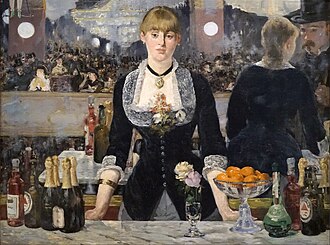 フォリー・ベルジェールのバー - Édouard Manet (1882)
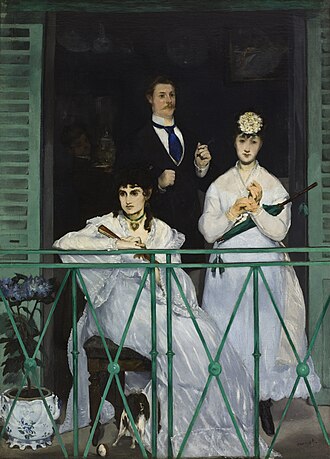 バルコニー - Édouard Manet (1868)
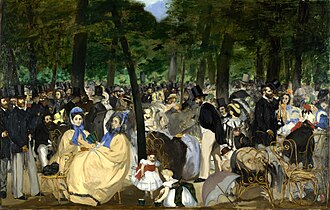 テュイルリー公園の音楽会 - Édouard Manet (1862)
 笛を吹く少年 - Édouard Manet (1866)
 鉄道 - Édouard Manet (1873)
 ナナ - Édouard Manet (1877)
関連する画家の作品
 印象・日の出 - Claude Monet (1872)
 睡蓮 - Claude Monet (1906)
 ムーラン・ド・ラ・ギャレットの舞踏会 - Pierre-Auguste Renoir (1876)
 舟遊びの昼食 - Pierre-Auguste Renoir (1881)
 ゆりかご - Berthe Morisot (1872)
 Summer's Day - Berthe Morisot (1879)
 アブサントを飲む人 - Edgar Degas (1875)
 The Bellelli Family - Edgar Degas (1858)
 The Canal du Loing at Moret - Alfred Sisley (1892)
 The Watering Pond at Marly with Hoarfrost - Alfred Sisley (1876)
 パリの通り、雨 - Gustave Caillebotte (1877)
 床削り - Gustave Caillebotte (1875)