カミーユ・ピサロ
1830-1903
Camille Pissarro, born on a Caribbean island, became the steady heart of Impressionism: the only painter in all eight of its exhibitions and a father figure to Cézanne, Gauguin and more. He painted village roads and working people as they were, without artifice or grandeur.
Origins
Jacob Abraham Camille Pissarro was born on 10 July 1830 at Charlotte Amalie on Saint Thomas, then in the Danish West Indies. His father, of Portuguese Jewish descent with French nationality, had come from France to run the hardware store of a deceased uncle and married the uncle's widow, Rachel Manzano-Pomié. Because Jewish law forbade a man to marry his aunt, the marriage caused a stir, and the children were barred from the local Jewish school and sent instead to an all-black primary school. At twelve Camille went to boarding school at Passy near Paris, where Monsieur Savary gave him a strong grounding in drawing and told him to draw from nature at home. Back on the island at sixteen or seventeen, he worked as a port clerk and drew in every break. At twenty-one the Danish painter Fritz Melbye encouraged him to paint full time, and the two spent two years working in Venezuela.
Life and turning points
In 1855, at twenty-five, Pissarro moved to Paris, assisting Fritz's brother Anton Melbye and finding the teaching at the École des Beaux-Arts and Académie Suisse stifling. He sought guidance from Corot instead, and in 1859 his first painting was accepted at the Salon. At the Académie Suisse he befriended Monet, Guillaumin and Cézanne. In 1871 in Croydon he married Julie Vellay, a vineyard grower's daughter who had been his mother's maid; they had seven children. During the Franco-Prussian War he took his family to Norwood near London, where he met the dealer Paul Durand-Ruel, who sold his work for most of his life. He lived at Pontoise from 1872 to 1884 and then at Éragny-sur-Epte for the rest of his life. In 1873 he helped found the society of artists that became the Impressionists, and at fifty-four he took up Neo-Impressionism. He died on 13 November 1903.
Style and technique
From Corot Pissarro learned to paint outdoors, but unlike Corot, who revised his pictures in the studio, he preferred to finish on the spot, often in one sitting. He painted what he saw, rutted roads and untidy bushes included, and some critics called it vulgar. His own advice to a student sums up the method: work on sky, water, branches and ground all at once, paint generously and without hesitation, and never lose the first impression. One writer said he painted the smell of the earth. In London, looking at Constable and Turner with Monet, he loosened his brushwork and added impasto. He was fascinated by Japanese prints, admiring their calm and subdued radiance. Later, beside Georges Seurat and Paul Signac, he took up the Neo-Impressionist style. Throughout, he insisted on showing ordinary people in natural settings, which Renoir called revolutionary.
Stories and anecdotes
When Cézanne's work was mocked by others at the Académie Suisse, Pissarro encouraged him, and Cézanne never forgot it, later saying that Pissarro was a father to him and a little like the good Lord. In 1868 Pissarro stopped listing his teachers in the Salon catalogue, quietly declaring his independence, and Émile Zola wrote that he was one of the three or four true painters of the day. Even when the hanging committee skied his views of Pontoise near the ceiling, the critic Castagnary noted that art lovers had seen their quality. Stranded in England in 1870 with only Danish nationality, he wrote to Théodore Duret that his painting did not catch on at all. A committed anarchist, he made an album of thirty satirical drawings, Turpitudes sociales, in 1889 as a gift for his niece. Six of his children became painters.
Legacy
Pissarro is the only artist who showed work in all eight Paris Impressionist exhibitions, from 1874 to 1886. The art historian John Rewald called him the dean of the Impressionist painters, not only because he was the oldest, but for his wisdom and his balanced, kind and warmhearted personality. He was the pivotal figure who held the group together, and he acted as a father figure to all four major Post-Impressionists: Cézanne, Seurat, Gauguin and Van Gogh. His paintings of Upper Norwood and Sydenham record south London just after the railways arrived and before suburbia spread, and The Avenue, Sydenham hangs in the National Gallery in London. His importance lies in his part in both Impressionism and Post-Impressionism, and in a quiet conviction that a muddy lane and a person at work deserved to be painted with care.
豆知識
- As a child he was sent to an all-black primary school on Saint Thomas.
- He is the only artist to have shown at all eight Impressionist exhibitions.
- He took up Neo-Impressionism at the age of 54.
- Six of his seven children became painters.
関連する画家
Claude Monet · Édouard Manet · Pierre-Auguste Renoir · エドガー・ドガ · ギュスターヴ・カイユボット · ホアキン・ソローリャ · Vincent van Gogh · J. M. W. Turner
カミーユ・ピサロの作品
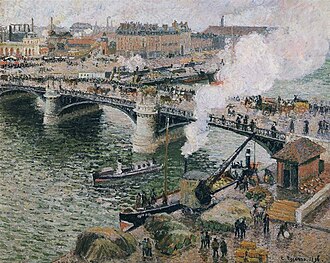 Pont Boieldieu in Rouen, Rainy Weather - Camille Pissarro (1896)
.jpg) Boulevard Montmartre, Mardi Gras - Camille Pissarro (1897)
Boulevard Montmartre, Mardi Gras - Camille Pissarro (1897)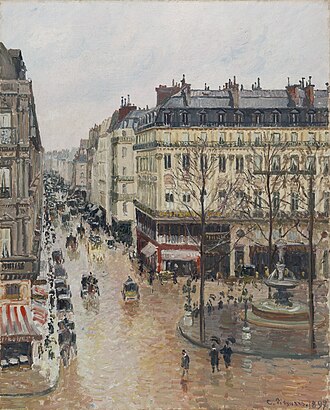 Rue Saint-Honoré in the Afternoon. Effect of Rain - Camille Pissarro (1897)
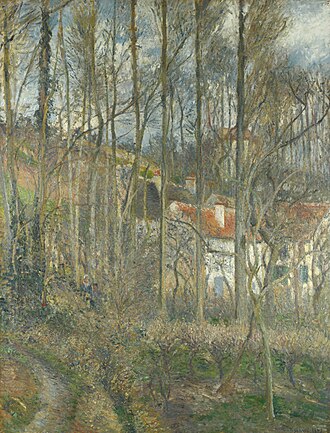 The Côte des Bœufs, Pontoise - Camille Pissarro (1877)
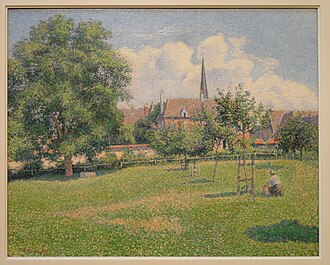 The House of the Deaf Woman and the Belfry at Eragny - Camille Pissarro (1886)
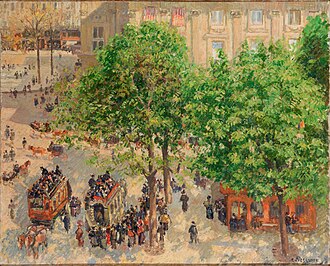 Place du Theatre-Francais in Spring - Camille Pissarro (1898)
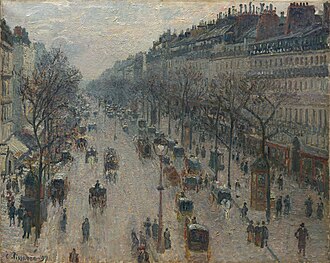 The Boulevard Montmartre on a Winter Morning - Camille Pissarro (1897)
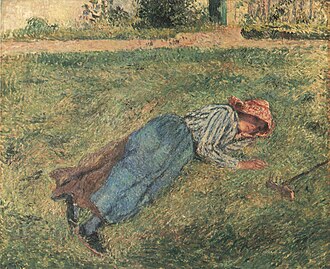 The Nap, Peasant Woman Lying in the Grass, Pontoise - Camille Pissarro (1882)
.jpg) The Quai Malaquais and the Institute - Camille Pissarro (1903)
The Quai Malaquais and the Institute - Camille Pissarro (1903)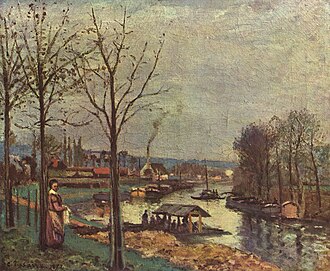 The Seine at Port-Marly, the Wash-House - Camille Pissarro (1872)