The Origin of the Milky Way
Peter Paul Rubens · 1630s
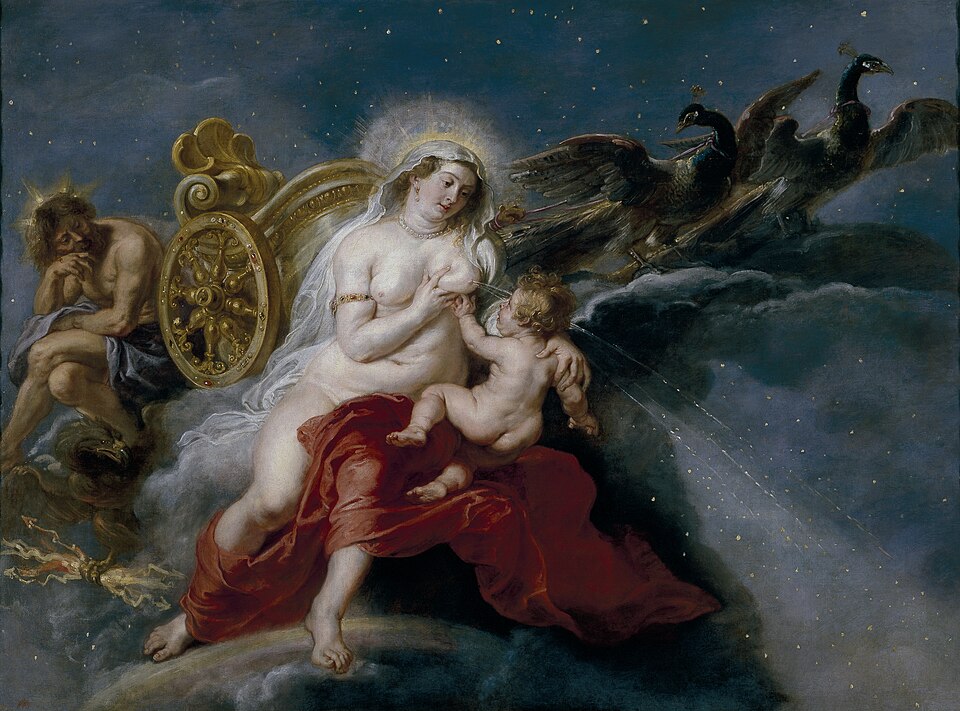
A goddess sits on a cloud in a starry sky, and milk from her breast streams out to become the Milky Way. Rubens painted this myth himself for the hunting lodge of Philip IV, and gave the goddess the face of his wife.
The story behind the painting
In 1636 Philip IV of Spain commissioned Rubens to decorate the newly remodelled Torre de la Parada, his hunting lodge on Monte de El Pardo, with a huge series of mythological and hunting scenes based largely on Ovid's Metamorphoses. The order went through the king's brother, Cardinal Ferdinand of Austria, governor of the Spanish Netherlands. Because the deadline was short, Rubens made sketches and handed most of the paintings to former pupils such as Jacob Jordaens and Jan Boeckhorst. Only about 15 works, this one among them, are believed to be by his own hand. The finished set was shipped to Madrid in 1638. The source counts the commission as 112 paintings in one place and as 63 mythological plus 50 hunting scenes in another.
What to look for
Hera sits on a cloud among the stars, wearing a pearl necklace, jewelled bracelets and a white veil. The infant reaches toward her left breast but has not yet taken it, and milk gushes out across the sky, forming the Milky Way. Behind her stands a gleaming golden chariot drawn by two peacocks, her sacred birds. Further back Zeus rests on his right elbow and watches, identified by the eagle beneath him, which holds his thunderbolt in its talons. Hera's face is modelled on Rubens's second wife, Hélène Fourment. Sketches in the Royal Museums of Fine Arts of Belgium show that Rubens later changed the goddess's legs and added Zeus and the eagle.
Meaning and intent
Ovid says little about the birth of the Milky Way, so Rubens probably drew on other writers such as Hyginus. The ancient versions differ: in one, Hera unknowingly nurses Hermes and pushes him away; in another, Hercules is brought to her while she sleeps; in a third, the hungry baby spills the milk himself. Diodorus Siculus tells how Athena found the abandoned Hercules and asked Hera to feed him. Rubens shows no pushing away, which looks like his own retelling. Because Zeus is present, the art historian Cecil Gould read the child as Hermes rather than Hercules, a view Svetlana Alpers adopted, though the painting is usually described as showing Hercules.
Legacy
The painting was recorded at the Torre de la Parada in 1701. After the lodge burned during the War of the Spanish Succession, it moved to the Royal Palace of Madrid, where inventories list it in 1772, 1794 and from 1814 to 1818. After the death of King Ferdinand VII it entered the Museo del Prado in 1834. It hangs there today in room 79, inventory number P01668, a canvas 181 by 244 cm. Wikipedia dates it 1636 to 1638, while Wikidata gives only the 1630s.
Did you know?
- Part of Philip IV's commission for the Torre de la Parada, begun in 1636.
- One of about 15 works in the series painted by Rubens himself.
- Hera's face is modelled on Hélène Fourment.
- In the Museo del Prado since 1834.
About the artist
Peter Paul Rubens (1577-1640)
Museo del Prado · mythological painting · Zeus · Jupiter · Heracles
More by Peter Paul Rubens
.jpg) The Elevation of the Cross - Peter Paul Rubens (1609)
The Elevation of the Cross - Peter Paul Rubens (1609) The Rape of the Daughters of Leucippus - Peter Paul Rubens (1618)
 Rubens and Isabella Brant in the honeysuckle bower - Peter Paul Rubens (1600s)
 Samson and Delilah - Peter Paul Rubens (1600s)
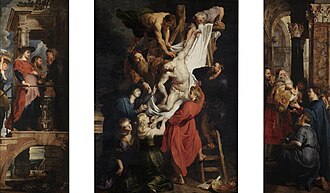 The Descent from the Cross - Peter Paul Rubens (1611)
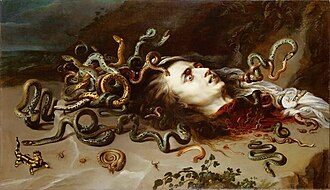 Head of Medusa - Peter Paul Rubens (1618)
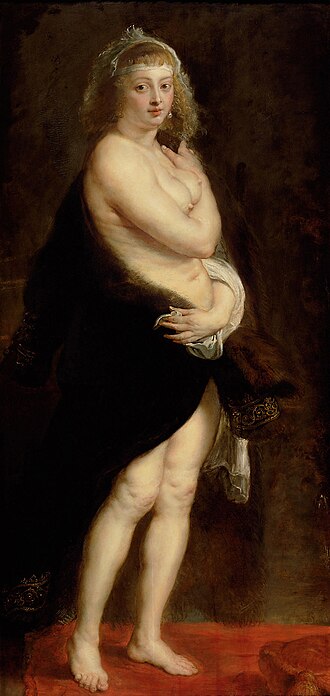 Helena Fourment in a Fur Robe - Peter Paul Rubens (1638)
.jpg) The Garden of Love - Peter Paul Rubens (1632)
The Garden of Love - Peter Paul Rubens (1632)
Paintings by related artists
 The Starry Night - Vincent van Gogh (1889)
.jpg) Café Terrace at Night - Vincent van Gogh (1888)
Café Terrace at Night - Vincent van Gogh (1888) Supper at Emmaus - Caravaggio (1601)
 The Calling of Saint Matthew - Caravaggio (1609)
 Las Meninas - Diego Velázquez (1656)
 The Surrender of Brea - Diego Velázquez (1635)
%20-%20Google%20Art%20Project.jpg) Charles I in Three Positions - Anthony van Dyck (1635)
Charles I in Three Positions - Anthony van Dyck (1635)%20with%20M.%20de%20St%20Antoine%20-%20Google%20Art%20Project.jpg) Charles I (1600-1649) with M. de St Antoine - Anthony van Dyck (1636)
Charles I (1600-1649) with M. de St Antoine - Anthony van Dyck (1636)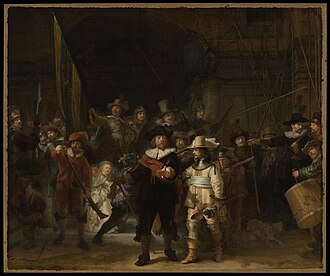 The Night Watch - Rembrandt van Rijn (1642)
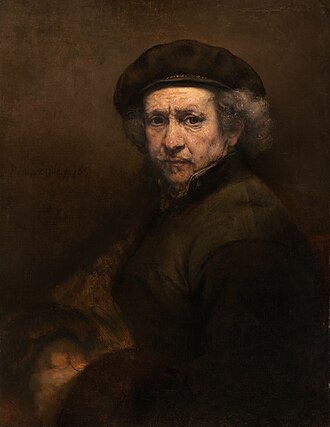 Self-Portrait - Rembrandt van Rijn (1659)
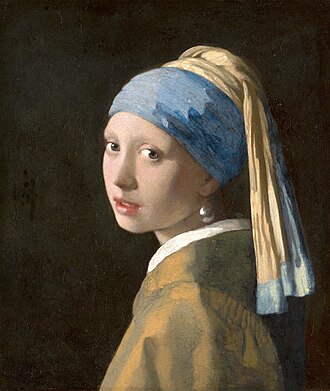 Girl with a Pearl Earring - Johannes Vermeer (1665)
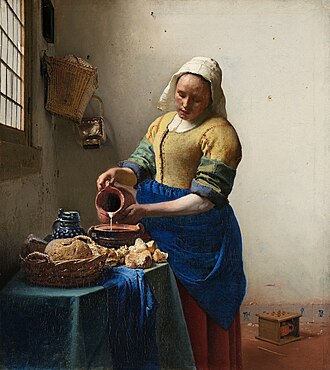 The Milkmaid - Johannes Vermeer (c. 1658)