The Garden of Love
Peter Paul Rubens · 1632
.jpg)
Elegant couples linger at the edge of a dreamlike garden while cupids flutter around them and a stone goddess sprays water. Rubens painted this celebration of love around the time of his second marriage, and it later hung in the Spanish king's bedroom.
The story behind the painting
Wikipedia dates the painting to around 1633, while Wikidata gives 1632. The work is believed to celebrate Rubens's marriage to Hélène Fourment, his second wife, who also posed for several of his portraits and for religious and mythological paintings. The first record of it comes in 1666, when it hung in the Royal Palace of Madrid, in the bedroom of the Spanish king. Early inventories did not call it The Garden of Love at all but The Garden Party. It is now in the Prado Museum in Madrid. The man at far left escorting a woman towards the group is believed to be Rubens himself, which led to an early reading of the picture as a self-portrait with friends.
What to look for
The canvas is large, about 199 by 286 cm. A crowd of finely dressed people in seventeenth century fashion lounge at the edge of an idyllic garden, arranged in depth like a full court scene. Cupids move among them, bringing mythology into a realistic setting. Look for the symbols of married love: the cupids, a pair of doves, flower crowns, music making and the peacock of Juno; the dogs stand for loyalty. Then find the two fountains. One shows the Three Graces, with an unsuspecting group below being sprayed. The other shows a full-figured goddess seated on a fish, water streaming from her breasts, known as the Nursing Venus.
Meaning and intent
The painting is an allegory and exaltation of love and marriage, as well as of merry company. The garden stands for Paradise and also for fertility. The Three Graces and the Venus fountains represent marital happiness, with their soft, full bodies emphasising fertility and physical beauty; the Nursing Venus symbolises childbearing and raising children. The article identifies the figure, because of the peacock, with Juno, goddess of marriage, so the sources combine Venus and Juno in one statue. Rubens builds his meaning from layers of allegory and symbols that his contemporaries would have recognised instantly, inside a scene full of movement and life.
Legacy
The Garden of Love has been called the high point of the courtly, outdoor merry company, a type of genre painting, and it anticipates the French fête champêtre, the elegant outdoor party scenes of the next century. Rubens's approach to the merry company was influenced by Adriaen Brouwer, a Flemish painter of intensely naturalistic merry company scenes, of whom only about 60 works are known, and whose atmospheric landscapes and loose brushstrokes left a mark on this picture. From a king's bedroom in the seventeenth century to the walls of the Prado today, it remains one of the most joyful statements of love in Baroque painting.
Did you know?
- Painted around 1633 according to Wikipedia, 1632 according to Wikidata.
- First recorded in 1666 in the king's bedroom in the Royal Palace of Madrid.
- Believed to celebrate Rubens's marriage to Hélène Fourment.
- In the Prado Museum, Madrid.
About the artist
Peter Paul Rubens (1577-1640)
woman · man · Museo del Prado · mythological painting · Baroque · gaze towards the viewer · lute
More by Peter Paul Rubens
.jpg) The Elevation of the Cross - Peter Paul Rubens (1609)
The Elevation of the Cross - Peter Paul Rubens (1609)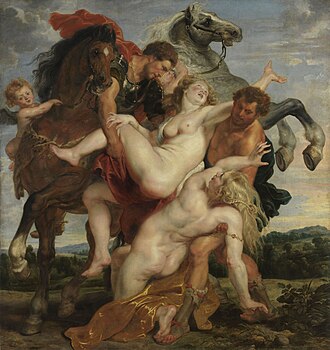 The Rape of the Daughters of Leucippus - Peter Paul Rubens (1618)
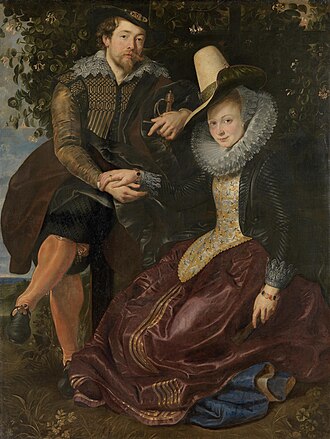 Rubens and Isabella Brant in the honeysuckle bower - Peter Paul Rubens (1600s)
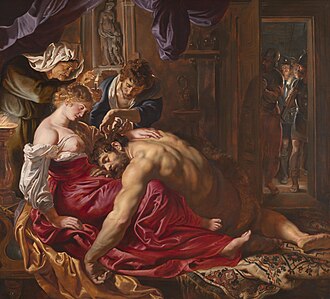 Samson and Delilah - Peter Paul Rubens (1600s)
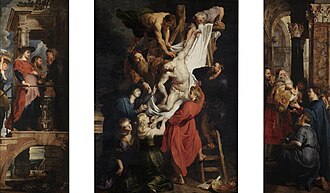 The Descent from the Cross - Peter Paul Rubens (1611)
 Head of Medusa - Peter Paul Rubens (1618)
 Helena Fourment in a Fur Robe - Peter Paul Rubens (1638)
 The Origin of the Milky Way - Peter Paul Rubens (1630s)
Paintings by related artists
 The Starry Night - Vincent van Gogh (1889)
.jpg) Café Terrace at Night - Vincent van Gogh (1888)
Café Terrace at Night - Vincent van Gogh (1888) Supper at Emmaus - Caravaggio (1601)
 The Calling of Saint Matthew - Caravaggio (1609)
 Las Meninas - Diego Velázquez (1656)
 The Surrender of Brea - Diego Velázquez (1635)
%20-%20Google%20Art%20Project.jpg) Charles I in Three Positions - Anthony van Dyck (1635)
Charles I in Three Positions - Anthony van Dyck (1635)%20with%20M.%20de%20St%20Antoine%20-%20Google%20Art%20Project.jpg) Charles I (1600-1649) with M. de St Antoine - Anthony van Dyck (1636)
Charles I (1600-1649) with M. de St Antoine - Anthony van Dyck (1636)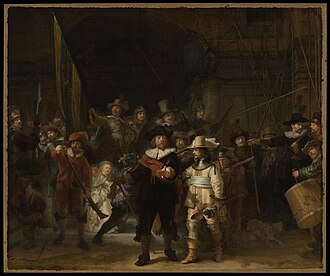 The Night Watch - Rembrandt van Rijn (1642)
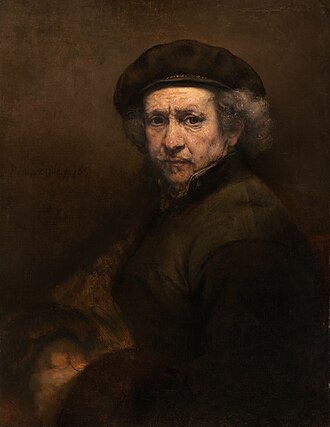 Self-Portrait - Rembrandt van Rijn (1659)
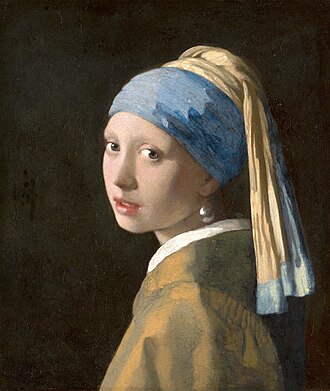 Girl with a Pearl Earring - Johannes Vermeer (1665)
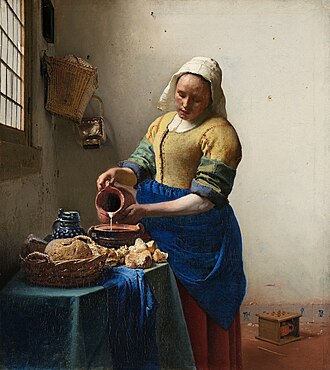 The Milkmaid - Johannes Vermeer (c. 1658)