The Crowning of the Virtuous Hero
Peter Paul Rubens · 1613
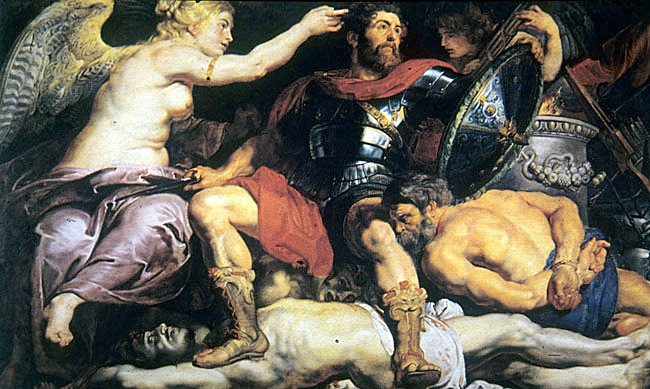
Victory sets a laurel crown on a Roman general as he tramples Discord with her snake hair. Rubens painted it for a guild of archers in Antwerp, and Napoleon later carried it off to Paris.
The story behind the painting
Peter Paul Rubens painted this work between 1613 and 1614, a date Wikidata gives as 1613. It is unsigned. The St George Guild of Archers in Antwerp commissioned it for their banqueting hall, a place where members gathered, so the picture was meant to speak to a civic company rather than a church or a prince. Its large horizontal format, about 160 by 263 cm, suits such a hall, where it would have been seen above a feasting company of guild members.
What to look for
An ancient Roman general is crowned by Nike with the laurels of victory. Under his feet lie a bound barbarian and a personification of Discord, recognisable by the snakes in her hair. To his right a genius of Harmony offers him a bound bundle of arrows, a symbol of peace. The figure on the right is also meant as the guardian of religion, shown by the eternal fire on the altar beside it. Behind the altar, look for a red and white tricolour.
Meaning and intent
The painting is an allegory of virtue rewarded: the hero wins not only by force but by overcoming discord, accepting harmony and protecting religion. The red and white tricolour refers to the ruling house of Habsburg, and so affirms the guild's loyalty to that dynasty. For an archers' guild, the image joined military courage to civic peace and political allegiance in a single scene, a message its members would see whenever they met in their hall.
Legacy
William VIII, Landgrave of Hesse-Kassel, acquired it between 1730 and 1760 for his Dutch paintings at Schloss Bellevue in Kassel. After the Peace of Tilsit in 1807, Napoleon took it for the imperial coronation hall in Paris. Jacob Grimm, then a legation secretary, helped win its return in December 1815. It hung in the Neue Galerie from 1878 to 1943, was moved to safety from Allied bombing, and returned to Kassel in April 1974. It now hangs in the Gemaldegalerie Alte Meister at Schloss Wilhelmshohe.
Did you know?
- Painted 1613-1614 for the St George Guild of Archers, Antwerp.
- Unsigned.
- Taken by Napoleon in 1807, returned in 1815 with Jacob Grimm's help.
- Now at Schloss Wilhelmshohe, Kassel.
About the artist
Peter Paul Rubens (1577-1640)
allegory · Hessen Kassel Heritage · Gemäldegalerie Alte Meister
More by Peter Paul Rubens
 The Elevation of the Cross - Peter Paul Rubens (1609)
 The Rape of the Daughters of Leucippus - Peter Paul Rubens (1618)
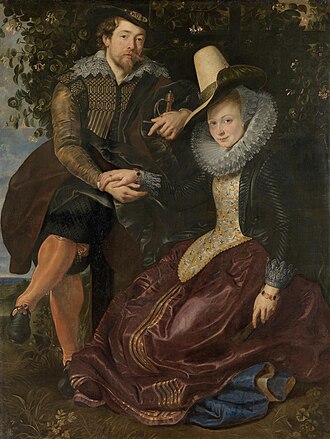 Rubens and Isabella Brant in the honeysuckle bower - Peter Paul Rubens (1600s)
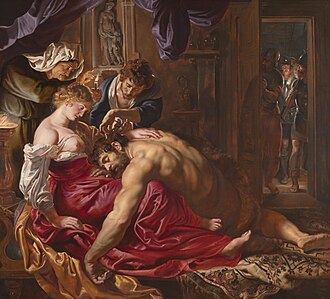 Samson and Delilah - Peter Paul Rubens (1600s)
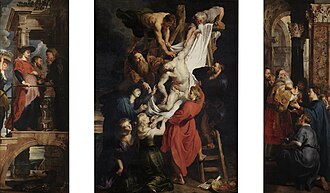 The Descent from the Cross - Peter Paul Rubens (1611)
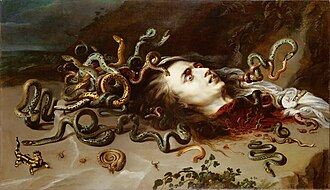 Head of Medusa - Peter Paul Rubens (1618)
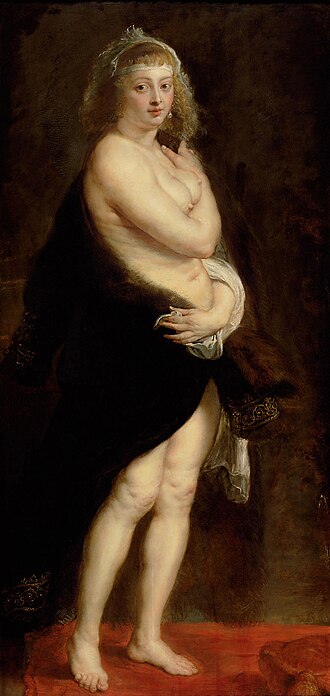 Helena Fourment in a Fur Robe - Peter Paul Rubens (1638)
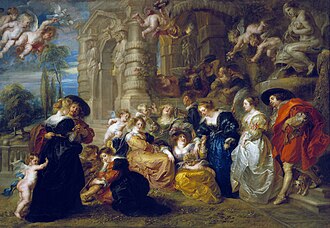 The Garden of Love - Peter Paul Rubens (1632)
Paintings by related artists
 The Starry Night - Vincent van Gogh (1889)
 Café Terrace at Night - Vincent van Gogh (1888)
 Supper at Emmaus - Caravaggio (1601)
 The Calling of Saint Matthew - Caravaggio (1609)
 Las Meninas - Diego Velázquez (1656)
 The Surrender of Brea - Diego Velázquez (1635)
 Saint Francis in Meditation - Francisco de Zurbarán (1639)
 The Immaculate Conception - Francisco de Zurbarán (1661)
 Charles I in Three Positions - Anthony van Dyck (1635)
 Charles I (1600-1649) with M. de St Antoine - Anthony van Dyck (1636)
 The Night Watch - Rembrandt van Rijn (1642)
 Self-Portrait - Rembrandt van Rijn (1659)