Atalanta and Meleager Hunting the Calydonian Boar
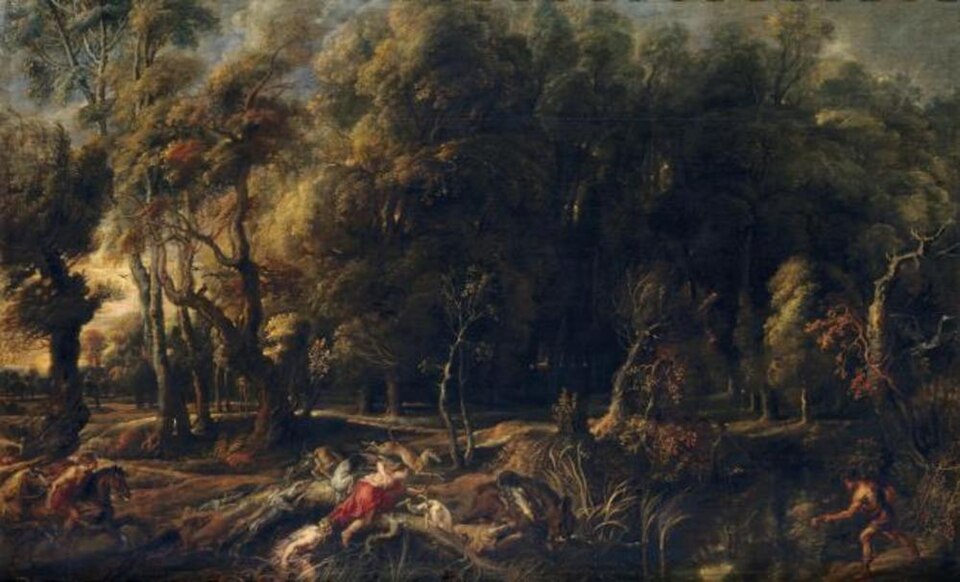
In a lush, dreamlike forest, Atalanta urges the hounds onto the giant boar she has just mortally wounded. Rubens kept this late hunting scene for himself until his death.
The story behind the painting
Rubens painted this work between 1635 and 1640, in the last stage of his career, and he follows Ovid's Metamorphoses closely. In the myth, the goddess Diana sends a gigantic boar to ravage the kingdom of Calydon. Meleager, son of the king, organises a hunt against it together with his beloved Atalanta and his cousins Castor and Pollux. Rubens kept the painting in his own possession until he died in 1640, a detail that suggests a picture he valued rather than one made to order for a client.
What to look for
Rubens set the figures low in the composition, in the foreground, so that the eye is guided to the place where Atalanta is setting the dogs on the boar after wounding it mortally. Her role is the heart of the scene. On the left are the cousins, on the right Meleager. Above and around them spreads the leafy landscape typical of Rubens's late work. Look at how much of the canvas, about 162 by 264 cm, belongs to the trees and light rather than to the hunters themselves.
Meaning and intent
Here Rubens sets aside the naturalism of other works and creates an idyllic, poetic setting. The hunt is a violent episode, yet the forest around it feels almost like a dream, so that myth and landscape share the stage. His inspiration came from reliefs on ancient sarcophagi and from drawings by Giulio Romano, which helps explain the frieze-like row of figures along the bottom. The painting shows an old master in his final years using a classical story as a reason to paint nature at its richest.
Legacy
After Rubens's death in 1640 the painting was acquired for the collection of Philip IV of Spain, and it is now shown in the Museo del Prado in Madrid. Rubens painted at least one other picture of the subject, The Hunt of Meleager and Atalanta in the Kunsthistorisches Museum in Vienna. The Prado also holds Nicolas Poussin's Hunt of Meleager of 1634 to 1639, and Jacob Jordaens had painted the story before Rubens at least twice, in 1618 in Antwerp and in 1620 to 1623 in a version now also at the Prado.
Did you know?
- Painted around 1635-1640, late in Rubens's career.
- Follows Ovid's account of the Calydonian boar hunt.
- Kept by Rubens until his death, then bought for Philip IV.
- Held in the Museo del Prado, Madrid.
About the artist
Peter Paul Rubens (1577-1640)
landscape painting · Museo del Prado · mythological painting
More by Peter Paul Rubens
 The Elevation of the Cross - Peter Paul Rubens (1609)
 The Rape of the Daughters of Leucippus - Peter Paul Rubens (1618)
 Rubens and Isabella Brant in the honeysuckle bower - Peter Paul Rubens (1600s)
 Samson and Delilah - Peter Paul Rubens (1600s)
 The Descent from the Cross - Peter Paul Rubens (1611)
 Head of Medusa - Peter Paul Rubens (1618)
 Helena Fourment in a Fur Robe - Peter Paul Rubens (1638)
 The Garden of Love - Peter Paul Rubens (1632)
Paintings by related artists
 The Starry Night - Vincent van Gogh (1889)
 Café Terrace at Night - Vincent van Gogh (1888)
 Supper at Emmaus - Caravaggio (1601)
 The Calling of Saint Matthew - Caravaggio (1609)
 Las Meninas - Diego Velázquez (1656)
 The Surrender of Brea - Diego Velázquez (1635)
 Saint Francis in Meditation - Francisco de Zurbarán (1639)
 The Immaculate Conception - Francisco de Zurbarán (1661)
 Charles I in Three Positions - Anthony van Dyck (1635)
 Charles I (1600-1649) with M. de St Antoine - Anthony van Dyck (1636)
 The Night Watch - Rembrandt van Rijn (1642)
 Self-Portrait - Rembrandt van Rijn (1659)