The Beacon Light
J. M. W. Turner · 1835
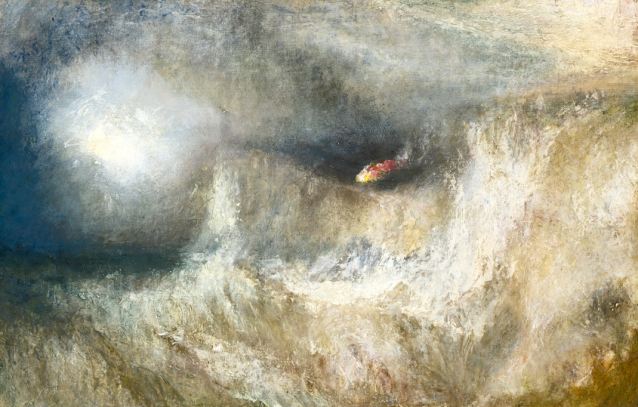
A coastal bluff by Turner, once doubted, hidden away and called a fake. Then a television investigation, scientific tests and an X-ray brought this Turner back into the light, and even moved it to a different coast.
The story behind the painting
The Beacon Light was said to be among the works Turner gave to his mistress, Mrs Booth. Her son by her first marriage, John Pound, later sold it at Christie's. In 1922 it was sold as a genuine Turner to the Welsh collectors Gwendoline and Margaret Davies. After Gwendoline's death it was one of seven Turners the sisters' collection gave to the National Museum of Wales. Butlin and Joll dated it to around 1835 to 1840, which fits the date of 1835 that Wikidata gives.
What to look for
The canvas, about 61.5 by 96 cm, shows a stretch of coastline with a bluff, a coast where shipping has long faced danger. For a long time it was thought to show the Needles on the Isle of Wight. An X-ray revealed that a lighthouse at the top of the bluff had been painted over, which helps explain the title. Look closely at the whole surface: scientific analysis later found that the same paint had been used across the whole picture.
Meaning and intent
Soon after the donation, some experts raised doubts about this painting and two other Turners from the Davies gift. Butlin and Joll suggested it was a fragment of a larger canvas that had certainly been worked on by a hand other than Turner's. The picture was taken off display, appearing again only in a 2007 exhibition. Its story is a reminder that a painting's reputation can change while the paint itself stays the same, and that the question of who held the brush can decide whether a work is seen at all.
Legacy
The painting was featured on the BBC programme Fake or Fortune? Scientific analysis showed that the paint matched Turner's known practice and was the same throughout. The evidence was put to Martin Butlin, co-author of the Turner catalogue raisonné, who accepted the work as genuine. Philip Mould and Bendor Grosvenor also established that the scene is in Kent, not the Isle of Wight, probably at St Margaret's at Cliffe, where the danger of the Goodwin Sands to shipping has long been known. It returned to display in September 2012.
豆知識
- Given to the National Museum of Wales by the Davies sisters' collection.
- Long doubted, it was accepted as genuine after Fake or Fortune?
- An X-ray found a painted over lighthouse on the bluff.
- The coast is now thought to be St Margaret's at Cliffe in Kent.
画家について
J. M. W. Turner (1775-1851)
同じ画家の作品: J. M. W. Turner
 戦艦テメレール号 - J. M. W. Turner (1839)
 雨、蒸気、速度 - グレート・ウェスタン鉄道 - J. M. W. Turner (1844)
 奴隷船 - J. M. W. Turner (1840)
 カルタゴを建設するディドー - J. M. W. Turner (1815)
 トラファルガーの海戦 - J. M. W. Turner (1820s)
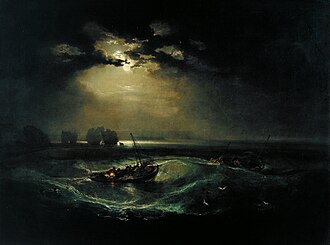 Fishermen at Sea - J. M. W. Turner (1796)
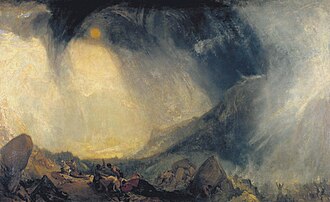 吹雪、アルプスを越えるハンニバルとその軍勢 - J. M. W. Turner (1812)
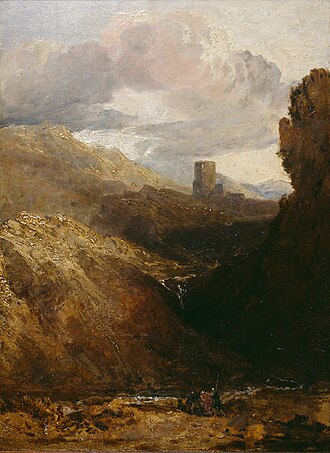 ドルバダーン城 - J. M. W. Turner (1800)
関連する画家の作品
 ウォルドグレイヴ家の貴婦人たち - Joshua Reynolds (1780)
 ジョージ K. H. クースメイカー大尉 - Joshua Reynolds (1782)
 印象・日の出 - Claude Monet (1872)
 睡蓮 - Claude Monet (1906)
 1808年5月3日 - Francisco Goya (1814)
 裸のマハ - Francisco Goya (1800)
 雲海の上の旅人 - Caspar David Friedrich (c. 1818)
 楡の木のある僧院 - Caspar David Friedrich (1800s)
 民衆を導く自由の女神 - Eugène Delacroix (1830)
 サルダナパールの死 - Eugène Delacroix (1827)
 青衣の少年 - Thomas Gainsborough (1770)
 アンドリューズ夫妻 - Thomas Gainsborough (1748)