雨、蒸気、速度 - グレート・ウェスタン鉄道
J. M. W. Turner · 1844
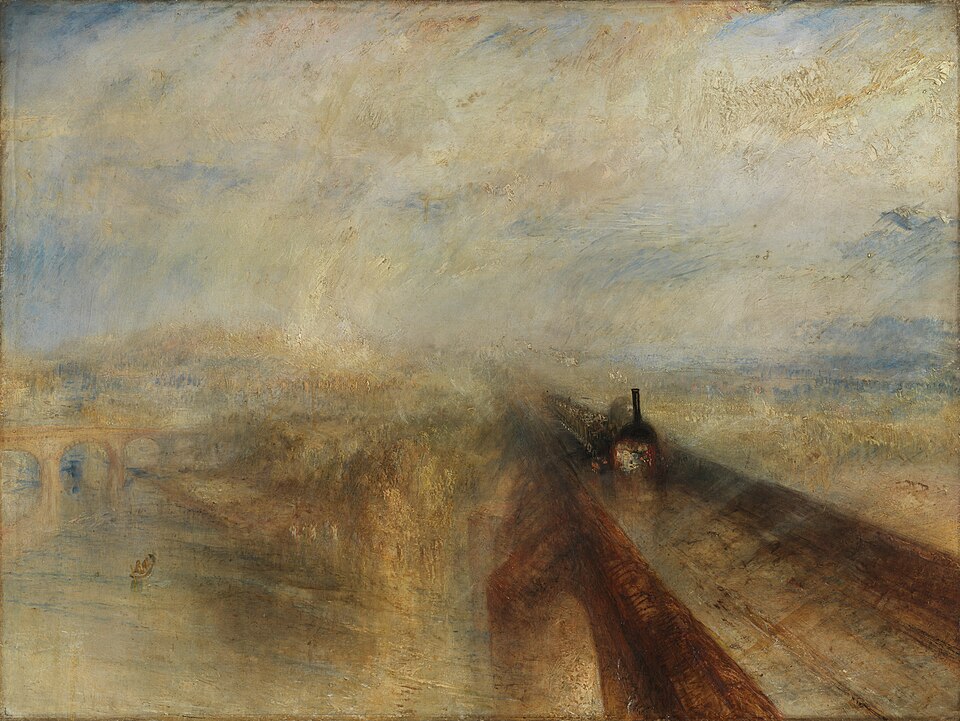
A dark train bursts out of golden rain and mist, rushing straight toward you across a bridge over the Thames. Turner made a still canvas feel like pure speed.
The story behind the painting
J. M. W. Turner first exhibited this oil painting at the Royal Academy in 1844, though it may have been painted earlier. It came near the end of the Industrial Revolution, when the railway had become one of the strongest symbols of a changing Britain. The Great Western Railway was one of several companies building this new way to travel. The scene is widely accepted as Maidenhead Railway Bridge, crossing the River Thames between Taplow and Maidenhead, looking east toward London. Isambard Kingdom Brunel designed the bridge, completed in 1839, and Turner had been exploring this stretch of country for over thirty years. Unlike most painters of his time, he treated industrial progress as a subject worthy of serious art.
What to look for
Start in the center, where a dark, rain-shrouded train comes toward you, framed by golden landscape on both sides. Notice how little of the bridge and engine is actually drawn: they melt into mist, rain and steam that blend into one shimmering color. Ahead of the engine, look for three white puffs of steam, the nearest one clearest, the others fading toward the horizon. In the lower left, a couple sits in a small boat on the river. Now search the bottom right, where a hare runs along the track. Turner built this atmosphere with short, broad brushstrokes, thick impasto laid on with a palette knife in the center and upper right, and smeary chunks of chrome yellow for the flickering sunlight.
Meaning and intent
The painting is often read as a celebration of travel and new technological power, where machines and natural forces meet. Together they create the emotional tension of the sublime, a feeling of being overwhelmed by something vast. Turner was not recording a factual view of the line, but making an allegory of nature and technology. The little hare has invited many readings. It may stand for speed itself, since Turner had used a chased hare in earlier works such as Apollo and Daphne of 1837. Others see it fleeing the machine, a hint that new technology could threaten nature. Some compare the picture to The Fighting Temeraire, as if the past gives way to a future racing toward us.
Legacy
Today the painting belongs to the National Gallery in London. It is celebrated as a work that gives a powerful impression of speed on a motionless canvas, a quality that set Turner apart from other artists. It also shows two sides of him at once: his commitment to the classical landscape tradition and his restless love of experiment and of the modern world. Wikidata links the work with Impressionism, a reminder of how much its dissolving forms and blazing light seem to look ahead. Small details keep it alive for every new viewer, from the waving passengers in the open carriages, a sign that railway travel was a popular entertainment, to the hare that may or may not escape.
豆知識
- First exhibited at the Royal Academy in 1844
- The bridge is widely accepted as Brunel's Maidenhead Railway Bridge, completed in 1839
- A hare runs along the track in the lower right
- Collection: National Gallery, London
風景画 · 印象派 · ナショナル・ギャラリー
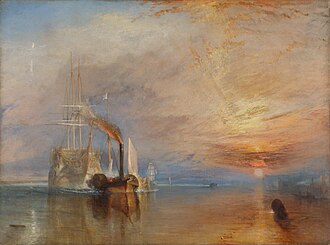 戦艦テメレール号
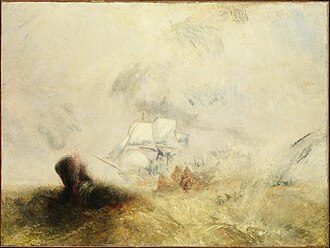 捕鯨船
捕鯨船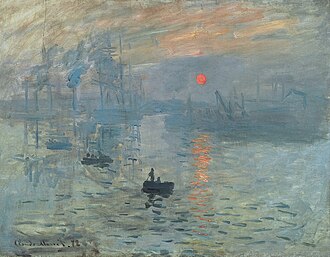 印象・日の出
 睡蓮
睡蓮 1808年5月3日
.jpg) 裸のマハ
裸のマハ 草上の昼食
草上の昼食 オランピア
オランピア