カルタゴを建設するディドー
J. M. W. Turner · 1815
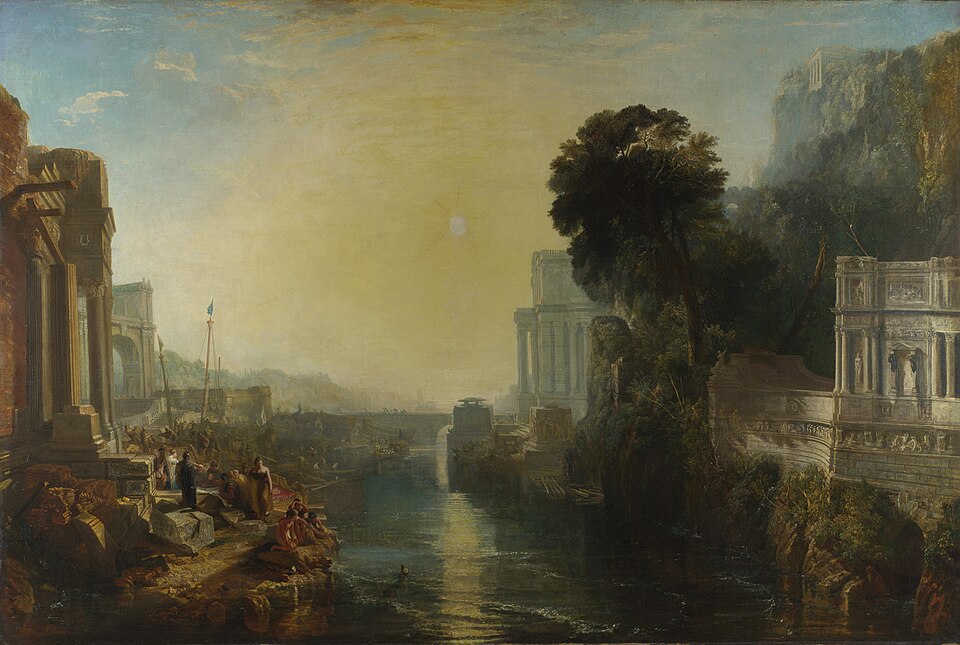
Turner once burst into tears in front of a painting by Claude, sure he could never equal it. Sixteen years later he painted this golden harbour at sunrise, called it his masterpiece, and refused to ever sell it.
The story behind the painting
In 1799 the collector John Julius Angerstein showed Turner his paintings. Standing before Claude's The Embarkation of the Queen of Sheba of 1648, Turner burst into tears, explaining that he would never be able to paint anything like it. For years he wanted to paint a seaport that could stand beside Claude's, and in 1815 he felt he had done it. He showed Dido building Carthage at the Royal Academy that year, next to the pastoral Crossing the Brook. Virgil's Aeneid was a lifelong source for him, and he made seven oils from it.
What to look for
Queen Dido, in blue and white on the left, stands with architects and masons planning her new city, which rises behind them. The cloaked, helmeted figure facing away is most likely the Trojan prince Aeneas. On the right is the tomb of Dido's husband Sychaeus, and from a dead tree a sapling grows. Children play with a toy boat in the water. Above a central vanishing point an intense yellow sunrise fills the sky. The left side is busy with life, while the right is still and ominous, and that tension gives the scene its drama.
Meaning and intent
Almost every detail looks forward. The sapling from the dead tree stands for the city's growth after Sychaeus's death; the sewer under the tomb hints at a city built to last; the children's toy boat foretells the Carthaginian navy that would dominate the Mediterranean. The sunrise is the dawn of a new empire. The scholar Moorby praised its mastery of perspective, its light, shade and reflections, and its moral contrast between life and death, the teeming city against the solemn tomb. Two years later Turner showed a companion piece, The Decline of the Carthaginian Empire.
Legacy
The painting was widely admired at the 1815 exhibition, but Turner never let it go. In his will of 1829 he asked to be buried rolled up in this canvas. He later changed his mind and left it to the National Gallery, on condition that it hang forever next to Claude's Seaport with the Embarkation of the Queen of Sheba, the picture that had once made him cry. When most of his works moved to Tate Britain in the early 20th century, this one stayed. It still hangs beside the Claude, as Turner wished.
豆知識
- Shown at the Royal Academy in 1815.
- Inspired by Claude's The Embarkation of the Queen of Sheba (1648).
- Turner once wanted to be buried rolled up in it.
- Hangs in the National Gallery, London, beside the Claude.
画家について
J. M. W. Turner (1775-1851)
同じ画家の作品: J. M. W. Turner
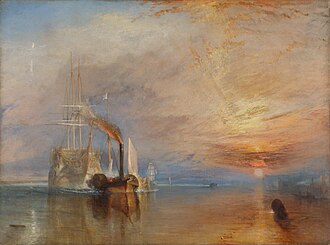 戦艦テメレール号 - J. M. W. Turner (1839)
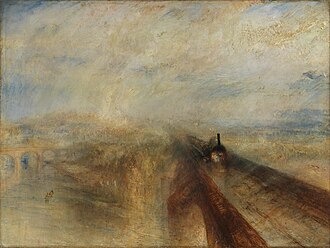 雨、蒸気、速度 - グレート・ウェスタン鉄道 - J. M. W. Turner (1844)
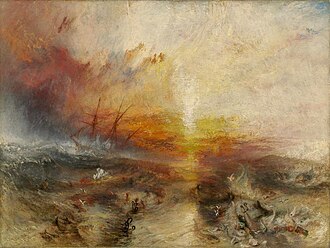 奴隷船 - J. M. W. Turner (1840)
.jpg) トラファルガーの海戦 - J. M. W. Turner (1820s)
トラファルガーの海戦 - J. M. W. Turner (1820s) Fishermen at Sea - J. M. W. Turner (1796)
 吹雪、アルプスを越えるハンニバルとその軍勢 - J. M. W. Turner (1812)
 Snow Storm: Steam-Boat off a Harbour's Mouth - J. M. W. Turner (1842)
 Sunrise with Sea Monsters - J. M. W. Turner (1845)
 印象・日の出
 睡蓮
睡蓮 雲海の上の旅人
 楡の木のある僧院
 1808年5月3日
.jpg) 裸のマハ
裸のマハ