Fishermen at Sea
J. M. W. Turner · 1796
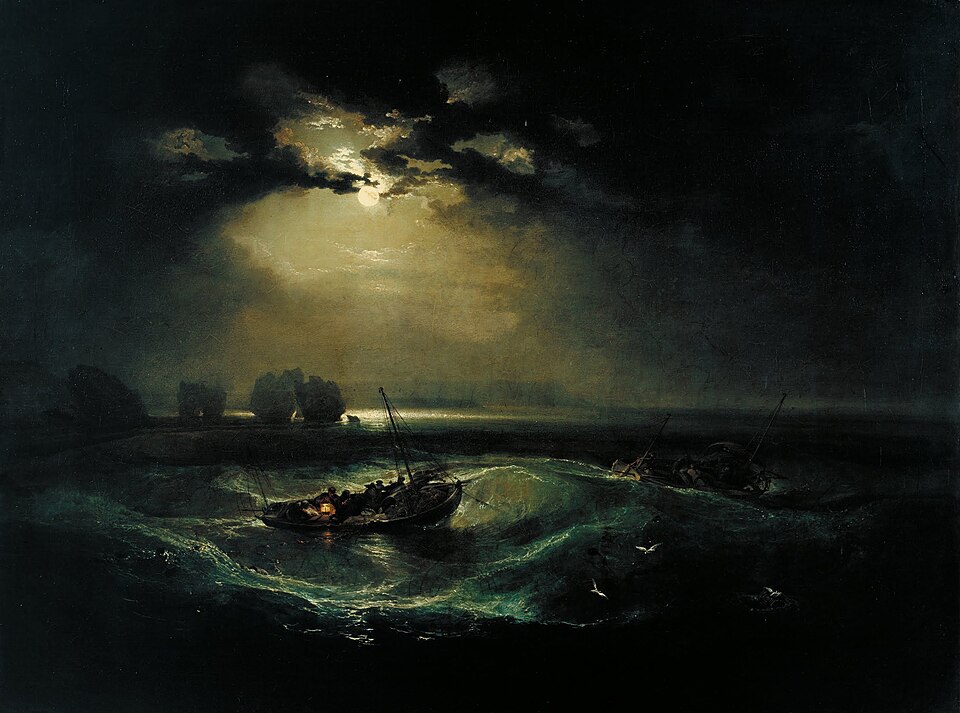
A small boat with a flickering lantern rides black waves under a cold moon. Turner, just twenty-one, showed this night sea at the Royal Academy, and it made his name as a painter in oils.
The story behind the painting
Turner entered the Royal Academy schools at fifteen and began mainly as a watercolourist in the early 1790s; his first public work, Lambeth Palace, was shown in 1790. Oil paintings carried more prestige, and he knew he needed them to win the recognition he wanted. Any earlier oil experiments were never shown and are lost. In 1795 he travelled to the Isle of Wight with a sketchbook, and those drawings may have fed this picture. He had just turned twenty-one when Fishermen at Sea was unveiled at the Royal Academy in 1796. It was long thought to be his first oil shown there.
What to look for
The canvas measures about 91 by 122 cm and shows fishermen on rough seas by moonlight near the Isle of Wight. Compare the two lights: the cold light of the moon through dark clouds, and the warm glow of the fishermen's lamp. The small boat looks fragile against the wide sea and the threatening rocks. The chalk cliffs on the left were traditionally identified as the Needles at the island's western tip, but some scholars think they are the cliffs at nearby Freshwater Bay instead. The handling of light shows the influence of Vernet, de Loutherbourg and the night scenes of Joseph Wright of Derby.
Meaning and intent
The painting sets the fragility of human life against the sublime power of nature. The boat and its little flame stand for the people; the clouded sky, the open sea and the rocks stand for the forces around them. The journalist Anthony Pasquin praised it as one of the greatest proofs of an original mind in that year's exhibition, writing that the boats were buoyant and swam well. Much later, the art historian Andrew Wilton called it a summary of all that eighteenth-century artists had said about the sea. It is a young painter's statement of what he could do.
Legacy
Contemporary critics praised the work, and it strengthened Turner's reputation both as an oil painter and as a painter of the sea. It passed to Sir Henry Charles Englefield, and after his death was sold at Christie's in 1823 as View of the Needles, then bought by his nephew Francis Cholmeley. It stayed with the Cholmeley family for nearly 150 years at Brandsby Hall, which is why it is also called the Cholmeley Sea Piece. Lent regularly to the Tate from 1931, it entered the Tate collection in 1972. Moonlight on water returned in many later Turner works.
豆知識
- Shown at the Royal Academy in 1796, when Turner was twenty-one.
- Long considered his first oil painting exhibited there.
- Also called the Cholmeley Sea Piece, after the family that owned it.
- In the Tate collection since 1972.
画家について
J. M. W. Turner (1775-1851)
同じ画家の作品: J. M. W. Turner
 戦艦テメレール号 - J. M. W. Turner (1839)
 雨、蒸気、速度 - グレート・ウェスタン鉄道 - J. M. W. Turner (1844)
 奴隷船 - J. M. W. Turner (1840)
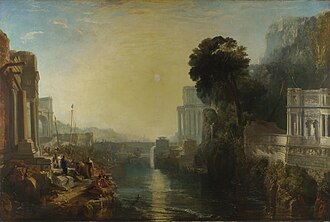 カルタゴを建設するディドー - J. M. W. Turner (1815)
.jpg) トラファルガーの海戦 - J. M. W. Turner (1820s)
トラファルガーの海戦 - J. M. W. Turner (1820s)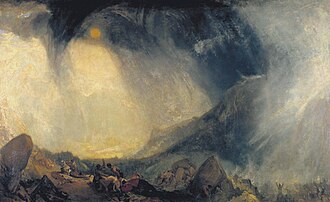 吹雪、アルプスを越えるハンニバルとその軍勢 - J. M. W. Turner (1812)
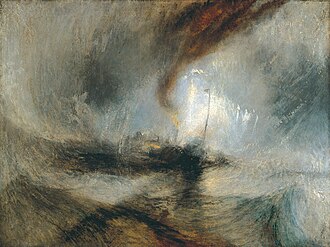 Snow Storm: Steam-Boat off a Harbour's Mouth - J. M. W. Turner (1842)
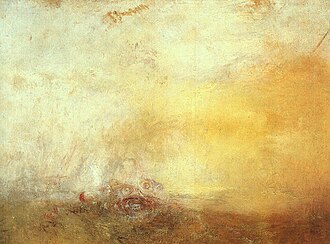 Sunrise with Sea Monsters - J. M. W. Turner (1845)
 印象・日の出
 睡蓮
睡蓮 雲海の上の旅人
 楡の木のある僧院
 1808年5月3日
.jpg) 裸のマハ
裸のマハ