シメオンの賛歌
Rembrandt van Rijn · 1631
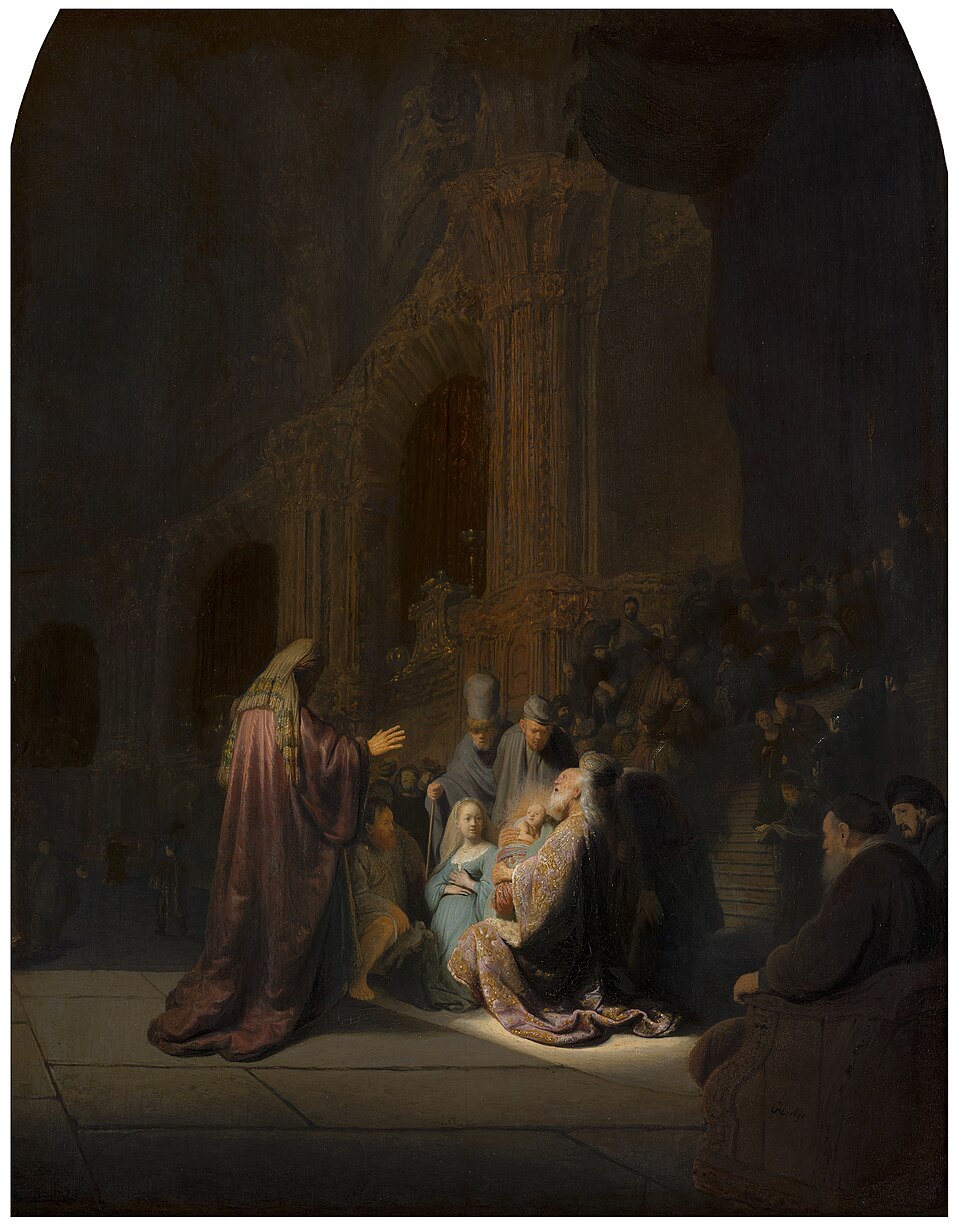
In a vast, shadowy temple an old man holds a newborn, and the light on his face seems to come from the child. Rembrandt painted it in Leiden in 1631, and the panel has travelled through palaces, a revolution and the Louvre since.
The story behind the painting
Rembrandt painted this oil on panel in 1631, while he was still living in Leiden. It shows an episode from the Gospel of Luke. Mary and Joseph have gone up to the temple in Jerusalem to present Jesus, their firstborn, as Jewish law required. Simeon, a just and devout old man, comes into the temple, takes the child in his arms and blesses God. It was not the only time Rembrandt turned to the scene: he had painted Simeon and Anna in the Temple in 1627 to 1628, and much later an unfinished Simeon in the Temple around 1669.
What to look for
The panel measures only 60.9 by 47.9 cm, yet the temple feels immense. It is drawn as a great Gothic interior, deep and mysterious, perhaps inspired by the Pieterskerk in Leiden. The composition favours diagonals, and the figures are elongated, typical of Rembrandt's style at that time. Find Simeon with the child: the light that falls on the old man seems to come from the baby himself. Around this bright pool, the vast building fades into darkness, so the small group feels like the only lit place in the world.
Meaning and intent
The story is about recognition. An old man who has waited his whole life holds a baby and knows him, and Rembrandt shows that moment through light. By making the child the source of brightness, he lets the picture say who this infant is without any words. The towering, dim architecture makes the people small and the moment quiet and intimate. Simeon's prayer of praise, which gives the work its name, becomes a scene of light found in darkness.
Legacy
In 1632 the panel was probably in the collection of Frederick Henry of Orange-Nassau, though the inventory cannot tell it apart from Rembrandt's earlier version. It passed to his widow Amalia of Solms-Braunfels, then to their daughter Albertine Agnes. In 1733 Philip van Dijk bought it at the sale of Adriaan Bout's collection. Under William V its upper corners were sawn off and an arched top added, so it could hang as a pair with a work by Gerard Dou. France seized it in 1795 for the Louvre, and it returned in 1815. It entered the Mauritshuis in 1822, and in 1983 and 1989 its original shape was restored.
豆知識
- Oil on panel, 60.9 by 47.9 cm, painted in Leiden in 1631.
- Shows Simeon blessing the infant Jesus in the temple (Luke 2).
- Taken to the Louvre in 1795, returned in 1815.
- In the Mauritshuis, The Hague, since 1822.
画家について
Rembrandt van Rijn (1606-1669)
宗教美術 · オランダ黄金時代の絵画 · マウリッツハイス美術館
同じ画家の作品: Rembrandt van Rijn
 夜警 - Rembrandt van Rijn (1642)
 自画像 - Rembrandt van Rijn (1659)
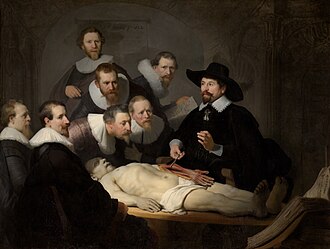 テュルプ博士の解剖学講義 - Rembrandt van Rijn (1632)
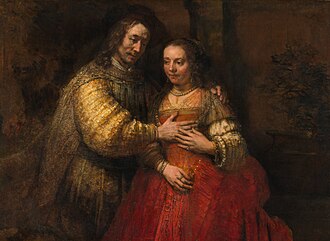 ユダヤの花嫁 - Rembrandt van Rijn (1660s)
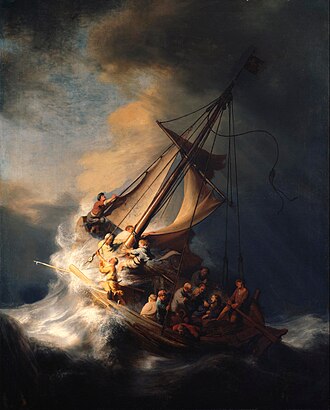 ガラリアの海の嵐 - Rembrandt van Rijn (1633)
 放蕩息子の帰還 - Rembrandt van Rijn (1668)
 ダナエ - Rembrandt van Rijn (1636)
 ベルシャザルの酒宴 - Rembrandt van Rijn (1636)
関連する画家の作品
 真珠の耳飾りの少女 - Johannes Vermeer (1665)
 牛乳を注ぐ女 - Johannes Vermeer (c. 1658)
 聖ニコラウスのお祭り - Jan Steen (1660s)
 牡蠣を食べる少女 - Jan Steen (1658)
 陽気な酒飲み - Frans Hals (1620s)
 微笑む騎士 - Frans Hals (1624)
 ウェイク・ベイ・ドゥールステーデの風車 - Jacob van Ruisdael (1670)
 The Jewish Cemetery - Jacob van Ruisdael (1650s)
 デルフトの家の中庭 - Pieter de Hooch (1658)
 リンゴの皮を剥く女性 - Pieter de Hooch (1663)