ダナエ
Rembrandt van Rijn · 1636
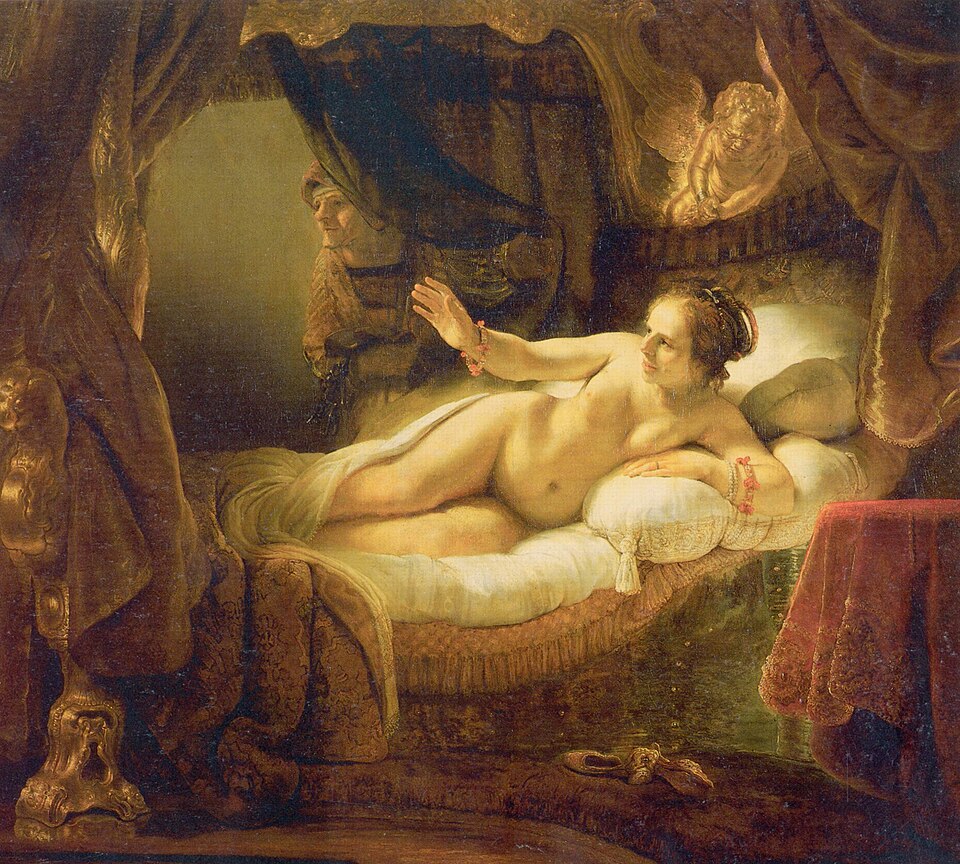
A woman rises from her pillows and lifts her hand toward an unseen visitor made of light. Rembrandt painted her, repainted her, and centuries later she survived acid and a knife.
The story behind the painting
Rembrandt van Rijn first completed Danaë in 1636, then returned to it and reworked it significantly, by 1643 at the latest. The subject comes from Greek mythology: Danaë, the mother of Perseus, whom Zeus visited and impregnated in the form of a shower of gold. Rembrandt's wife Saskia was the original model, but during the reworking he changed the face to that of Geertje Dircx, the woman who later became his companion. The canvas is life-sized and has since been considerably cut down. It may have been a picture Rembrandt cherished, and its sheer size may also have made it hard to sell.
What to look for
Danaë lies on a canopied bed, propped on pillows, her body turned toward the light and one arm outstretched as if greeting a presence we cannot see. That arm, along with her head and legs, was repositioned when Rembrandt reworked the picture, so what you see is the result of years of second thoughts. Look for the bracelet at her wrist, the long hair falling to her waist, and the heavy drapery of the bed. The scene glows with the warm, golden light that stands in for the god himself. A signature with a date ending in 6 is hard to read and may not be genuine.
Meaning and intent
Rembrandt does not need to show the god at all. Here the drama is carried by light and by the woman's response: she is presumably shown welcoming Zeus, who came to her as a shower of gold, and her open, outstretched gesture turns an ancient myth into a human moment of anticipation. The changes of face also give the painting a personal layer. It began with Saskia and ended with Geertje, so the canvas quietly records shifts in Rembrandt's own life across the years he worked on it. Life-sized and intimate, it is counted among his most magnificent paintings.
Legacy
Danaë once belonged to the collection of Pierre Crozat and has been in the Hermitage Museum in St Petersburg since the eighteenth century. On 15 June 1985 a visitor, later judged insane, threw sulphuric acid on it and cut it twice with a knife. The worst damage struck Danaë's face, hair, right arm and legs, and the central area dissolved into drips and spots. Restoration began that same day, with conservators rinsing the surface with water, and continued until 1997 in the Hermitage's restoration laboratory. Its survival and painstaking recovery make it one of the most remarkable conservation stories of modern times.
豆知識
- Rembrandt first finished it in 1636 and reworked it by 1643 at the latest.
- Saskia was the first model; the face was later changed to that of Geertje Dircx.
- It was attacked with acid and a knife in 1985 and restored over twelve years.
- It has been in the Hermitage, St Petersburg, since the eighteenth century.
画家について
Rembrandt van Rijn (1606-1669)
女性 · オランダ黄金時代の絵画 · 神話画 · ロングヘア · ヌード · 裸 · エルミタージュ美術館 · 枕
同じ画家の作品: Rembrandt van Rijn
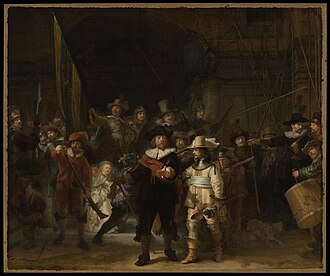 夜警 - Rembrandt van Rijn (1642)
 自画像 - Rembrandt van Rijn (1659)
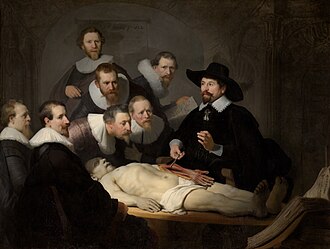 テュルプ博士の解剖学講義 - Rembrandt van Rijn (1632)
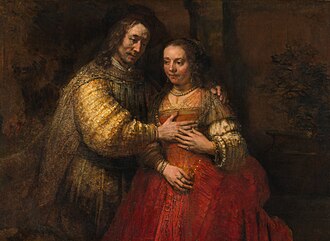 ユダヤの花嫁 - Rembrandt van Rijn (1660s)
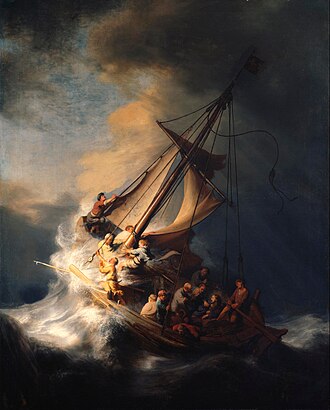 ガラリアの海の嵐 - Rembrandt van Rijn (1633)
 放蕩息子の帰還 - Rembrandt van Rijn (1668)
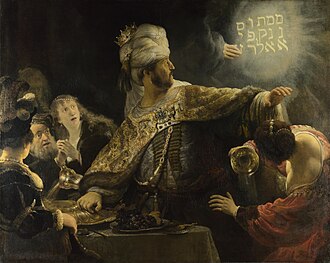 ベルシャザルの酒宴 - Rembrandt van Rijn (1636)
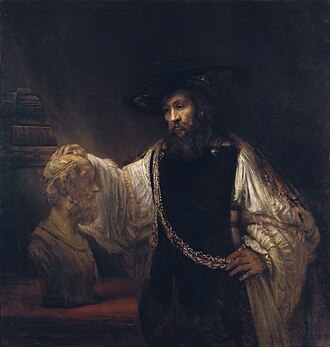 ホメロスの胸像を見つめるアリストテレス - Rembrandt van Rijn (1653)
 真珠の耳飾りの少女
 牛乳を注ぐ女
 エマオの晩餐
 聖マタイの召命
 ラス・メニーナス
 ブレダの開城