Regulus
J. M. W. Turner · 1828
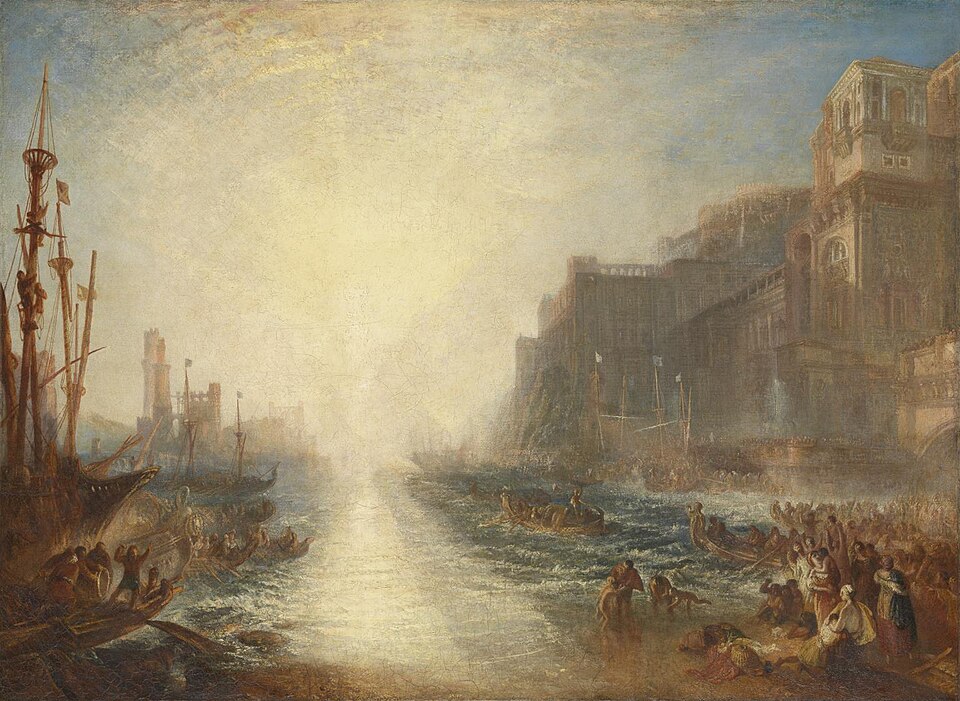
A blazing white sun swallows a harbour of ships and palaces, so bright it almost hurts. Turner painted Regulus, the Roman general said to have been blinded by the sun, and then drove white paint into its heart in front of a crowd.
The story behind the painting
Marcus Atilius Regulus was a Roman consul captured by Carthage in 255 BC. He likely died of natural causes, but legends say he was sent to Rome to negotiate a prisoner exchange, urged the Romans to refuse, and returned to Carthage knowing he would die. In many accounts his eyelids were removed and he was forced to stare at the sun. Turner had written Regulus Return in his copy of Oliver Goldsmith's Roman History. He painted the picture during his visit to Rome in 1828, reportedly to stop the gabbling of his peers, and showed it there in December with rope nailed round the edges because frames were hard to find.
What to look for
A harbour, in Rome or Carthage, is framed by ships and buildings around the water, and everything is dominated by a large white sun in the centre. The canvas is about 89.5 by 123.8 cm. Look at the sky in the upper left: a large tear there was stitched, relined and a quarter of the canvas repainted, and another tear runs through the middle of the sun. The artist John Gilbert later described Turner driving flake white into the centre with hog bristle brushes along ruled lines for the rays, until the sun seemed to bulge. Analysis in 2012 called many of those details into question.
Meaning and intent
Exactly what the picture shows is still debated. Some scholars think it shows Regulus leaving Carthage for Rome, others his return. Others ask whether Regulus is a figure in the scene at all, whether we see through his eyes as he is blinded, or whether the painting holds his whole life at once. Painters such as Salvator Rosa and Benjamin West had shown Regulus as a brave patriotic hero, and Turner himself praised his patriotism in an 1811 poem. Here, though, the hero almost disappears into the glare.
Legacy
In Rome about a thousand visitors came, many disliking Turner's lavish paint and its closeness to Claude. Back in England the picture was not shown for years, then reworked on the varnishing day of the British Institution in 1837. The source gives both 1837 and 1839 for that session. It became controversial, criticised even by Turner's champion John Ruskin, yet it inspired two derivative paintings and two engravings. In 1863 a man displeased with Turner stabbed it, and it has suffered flaking paint. It is now at Tate Britain in London.
豆知識
- Begun in Rome in 1828 and overpainted in London.
- Regulus was said to have been blinded by being forced to stare at the sun.
- Stabbed in 1863 by a man displeased with Turner.
- Now at Tate Britain, London.
画家について
J. M. W. Turner (1775-1851)
ナショナル・ギャラリー · テート・ギャラリー · 都市風景 · 港湾
同じ画家の作品: J. M. W. Turner
 戦艦テメレール号 - J. M. W. Turner (1839)
 雨、蒸気、速度 - グレート・ウェスタン鉄道 - J. M. W. Turner (1844)
 奴隷船 - J. M. W. Turner (1840)
 カルタゴを建設するディドー - J. M. W. Turner (1815)
 トラファルガーの海戦 - J. M. W. Turner (1820s)
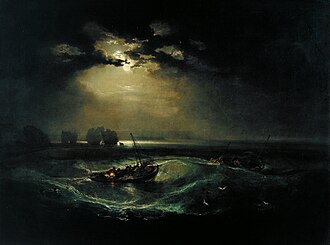 Fishermen at Sea - J. M. W. Turner (1796)
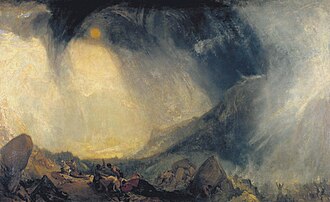 吹雪、アルプスを越えるハンニバルとその軍勢 - J. M. W. Turner (1812)
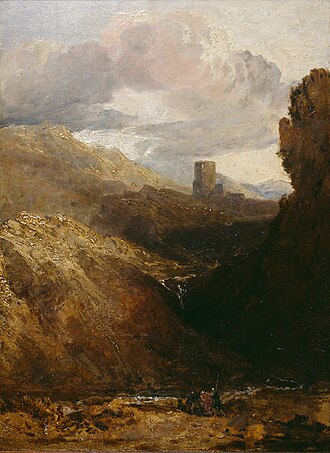 ドルバダーン城 - J. M. W. Turner (1800)
関連する画家の作品
 ウォルドグレイヴ家の貴婦人たち - Joshua Reynolds (1780)
 ジョージ K. H. クースメイカー大尉 - Joshua Reynolds (1782)
 印象・日の出 - Claude Monet (1872)
 睡蓮 - Claude Monet (1906)
 1808年5月3日 - Francisco Goya (1814)
 裸のマハ - Francisco Goya (1800)
 雲海の上の旅人 - Caspar David Friedrich (c. 1818)
 楡の木のある僧院 - Caspar David Friedrich (1800s)
 民衆を導く自由の女神 - Eugène Delacroix (1830)
 サルダナパールの死 - Eugène Delacroix (1827)
 青衣の少年 - Thomas Gainsborough (1770)
 アンドリューズ夫妻 - Thomas Gainsborough (1748)