Portrait of Samuel Johnson
ジョシュア・レノルズ · 1770s
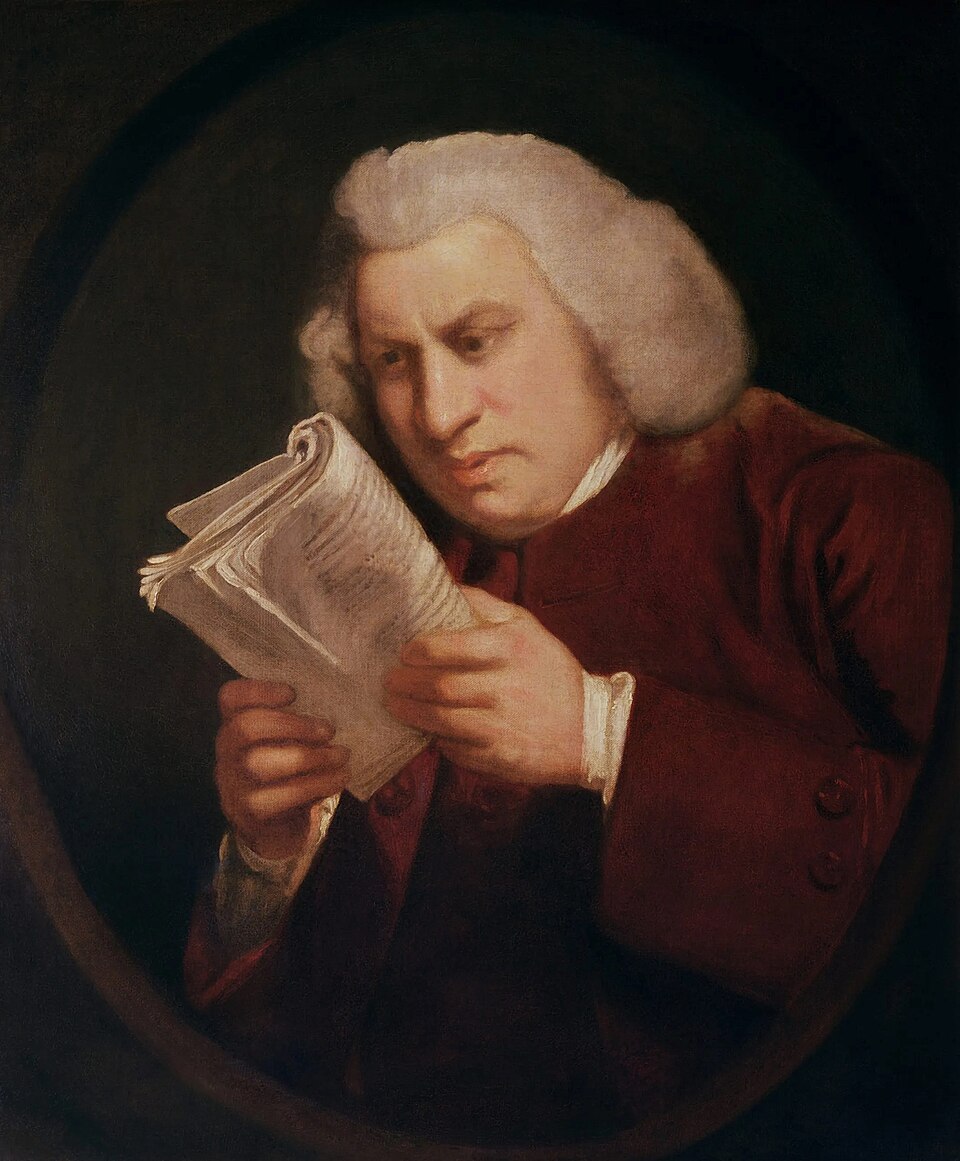
The great lexicographer squints at a book held almost against his face. His friend Reynolds painted him that way, and Johnson protested: he would not be Blinking Sam. Two centuries later the picture became a meme.
The story behind the painting
Samuel Johnson, author of A Dictionary of the English Language, and the portrait painter Joshua Reynolds were close friends; together with Edmund Burke and Oliver Goldsmith they founded the Literary Club. Reynolds painted Johnson four times. According to Reynolds's pupil James Northcote, this portrait was made in 1775, though it may have been begun earlier if it matches an entry in Reynolds's ledger of 12 May 1774. Johnson's sight had been badly damaged in childhood by an eye infection and by king's evil; accounts agree he was nearsighted, though some contemporaries described his vision as reasonably good.
What to look for
Inside a painted oval, Johnson wears his signature brown coat. He squints as he reads an unbound book or pamphlet, bent back on itself and held close to his face. Light falls on his face and on his hands, the two places where the whole story happens. There is no eye contact and no pose for the viewer: he is entirely absorbed. Hester Thrale described it as Johnson holding the page almost against his eye, as was his habit. The critic William Hazlitt saw in it an absorption of faculty and a look of purblind reflection characteristic of his mind.
Meaning and intent
Johnson disliked it. Thrale recorded that he would not be known to posterity only for his defects. When she pointed to Reynolds's own self-portrait, cupping his ear because he was deaf, Johnson answered that Reynolds could paint himself deaf if he chose, but he would not be Blinking Sam. In his dictionary Johnson had defined to blink as to see obscurely. Northcote insisted Reynolds meant no offence. Kai Kin Yung suggests it began as a joke but turned the defect into an engaging study, and Robert Folkenflik links both pictures to a Dutch tradition of painting the senses.
Legacy
Loren and Frances Rothschild of Los Angeles, collectors of Johnson memorabilia, bought the portrait in 1987 and kept it over the fireplace in their home library. In 2006 they gave it to The Huntington in San Marino, California, where it is on display. Daniel Cook calls it the best-known portrait of Johnson. Since 2012 it has also lived online as a meme, usually paired with another Reynolds portrait of Johnson from 1772, used to express confusion or shock at something absurd. Wikidata dates the work to the 1770s.
豆知識
- Painted by Reynolds around 1775, perhaps begun in 1774.
- Johnson objected that he would not be Blinking Sam.
- Given to The Huntington in 2006.
- An Internet meme since 2012.
画家について
ジョシュア・レノルズ (1723-1792)
肖像 · 本 · ハンティントン・ライブラリー
同じ画家の作品: ジョシュア・レノルズ
 ウォルドグレイヴ家の貴婦人たち - Joshua Reynolds (1780)
 ジョージ K. H. クースメイカー大尉 - Joshua Reynolds (1782)
 コウバーン夫人と三人の息子たち - Joshua Reynolds (1773)
 エリザベス・デルメ夫人とその子供たち - Joshua Reynolds (1770s)
 エリザベス・カーの肖像 - Joshua Reynolds (1769)
 ジョン・バーゴインの肖像 - Joshua Reynolds (1766)
 Thaïs - Joshua Reynolds (1781)
 David Garrick Between Tragedy and Comedy - Joshua Reynolds (1761)
関連する画家の作品
 戦艦テメレール号 - J. M. W. Turner (1839)
 雨、蒸気、速度 - グレート・ウェスタン鉄道 - J. M. W. Turner (1844)
 指し降ろされた親指 - Jean-Léon Gérôme (1872)
 奴隷市場 - Jean-Léon Gérôme (1866)
 草上の昼食 - Édouard Manet (1863)
 オランピア - Édouard Manet (1863)
 世界の起源 - Gustave Courbet (1866)
 オルナンの埋葬 - Gustave Courbet (2020)
 カーネーション、リリー、リリー、ローズ - John Singer Sargent (1885-1886)
 マダムXの肖像 - John Singer Sargent (1884)
 民衆を導く自由の女神 - Eugène Delacroix (1830)
 サルダナパールの死 - Eugène Delacroix (1827)