コウバーン夫人と三人の息子たち
ジョシュア・レノルズ · 1773
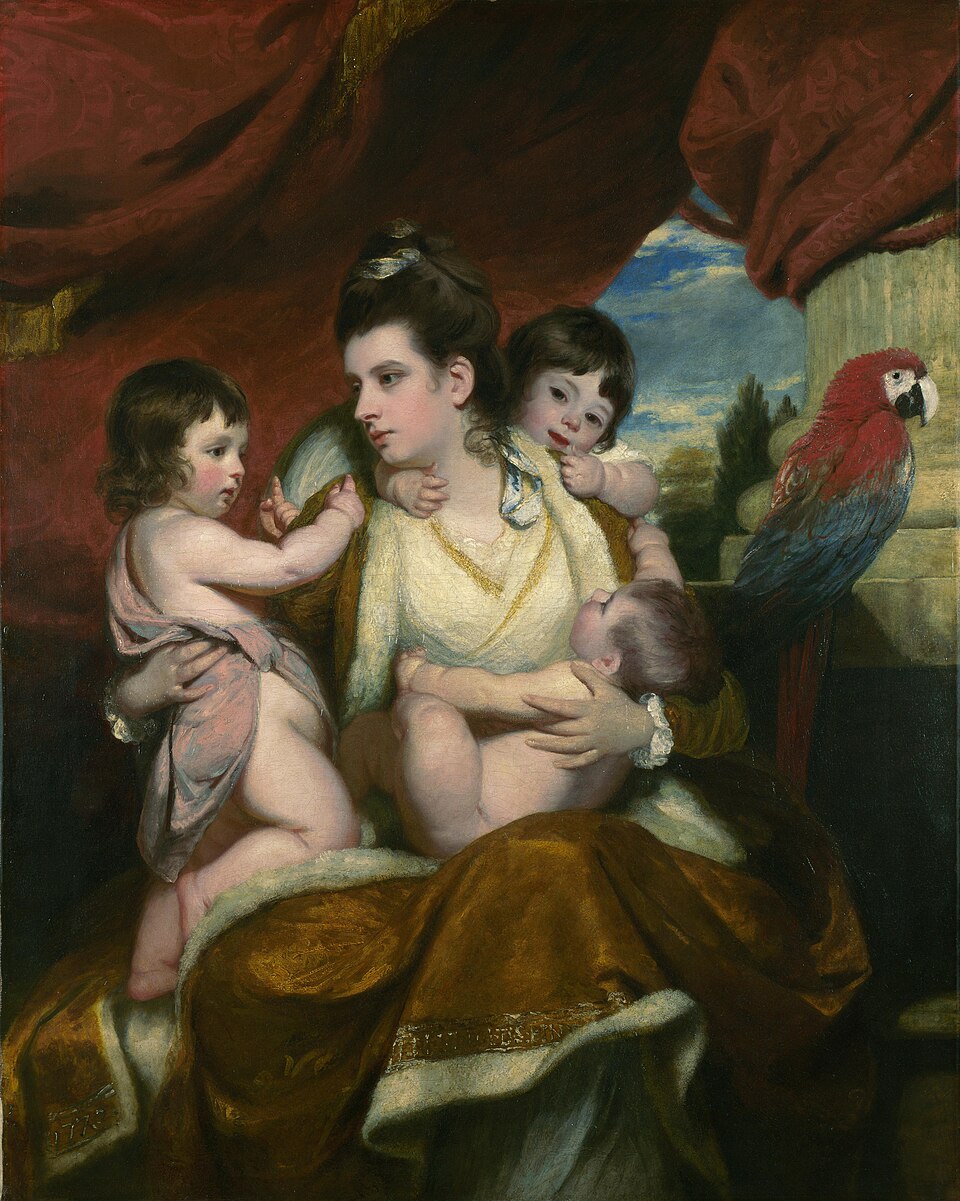
A young mother is wrapped in the climbing arms of three small boys, one of them peering out at us over her shoulder. Reynolds borrowed from Velazquez and van Dyck to turn a family likeness into a grand image of love.
The story behind the painting
Augusta Anne Ayscough, born in 1749, married Sir James Cockburn, 8th Baronet of Langton, and became Lady Cockburn in 1769. Within a few years she had three sons: James in 1771, George in 1772 and William in 1773. Reynolds began the portrait in 1773, the year Wikidata gives, but the canvas is dated 1775, the date Wikipedia uses. It is one of the few works Reynolds signed: his name and the year appear on Lady Cockburn's dress, a quiet mark of how much the picture mattered to him.
What to look for
The oil on canvas measures about 141.5 by 113 cm. In the Grand Manner fashion, Reynolds built it out of the old masters. The general composition follows Anthony van Dyck's Charity, in which a woman is surrounded by children. The child on the left takes his pose from the Cupid in Velazquez's Toilet of Venus. Look for the way the three boys cling to and lean across their mother, and then find the signature tucked into the folds of her gown.
Meaning and intent
By echoing an allegory of Charity, Reynolds lifted a private family portrait toward the dignity of history painting. Lady Cockburn becomes more than a fashionable sitter: she stands for motherly love itself, with her sons gathered around her like the children of a virtue. The quotation from Velazquez adds a playful, almost mythological note to a scene from an eighteenth-century Scottish household. Here grandeur and tenderness are held in the same embrace.
Legacy
The boys grew into notable lives. James became the 9th baronet and Governor of Bermuda, George became an Admiral of the Fleet and 10th Baronet, and William became Dean of York. Two more sons, Alexander and Francis, came later. The painting passed to George and then to his daughter, Mrs Hamilton, wife of Sir James Hamilton. It was bequeathed to the National Gallery in London in 1906, where it still hangs. Lady Cockburn herself lived until 1837.
豆知識
- Begun in 1773; signed and dated 1775 on the sitter's dress.
- Composition modelled on van Dyck's Charity.
- One child's pose borrowed from Velazquez's Toilet of Venus.
- Bequeathed to the National Gallery, London, in 1906.
画家について
ジョシュア・レノルズ (1723-1792)
同じ画家の作品: ジョシュア・レノルズ
 ウォルドグレイヴ家の貴婦人たち - Joshua Reynolds (1780)
 ジョージ K. H. クースメイカー大尉 - Joshua Reynolds (1782)
 エリザベス・デルメ夫人とその子供たち - Joshua Reynolds (1770s)
 エリザベス・カーの肖像 - Joshua Reynolds (1769)
 ジョン・バーゴインの肖像 - Joshua Reynolds (1766)
 Thaïs - Joshua Reynolds (1781)
 David Garrick Between Tragedy and Comedy - Joshua Reynolds (1761)
 Lady Worsley - Joshua Reynolds (1779)
関連する画家の作品
 戦艦テメレール号 - J. M. W. Turner (1839)
 雨、蒸気、速度 - グレート・ウェスタン鉄道 - J. M. W. Turner (1844)
 指し降ろされた親指 - Jean-Léon Gérôme (1872)
 奴隷市場 - Jean-Léon Gérôme (1866)
 草上の昼食 - Édouard Manet (1863)
 オランピア - Édouard Manet (1863)
 世界の起源 - Gustave Courbet (1866)
 オルナンの埋葬 - Gustave Courbet (2020)
 カーネーション、リリー、リリー、ローズ - John Singer Sargent (1885-1886)
 マダムXの肖像 - John Singer Sargent (1884)
 民衆を導く自由の女神 - Eugène Delacroix (1830)
 サルダナパールの死 - Eugène Delacroix (1827)