ジョン・バーゴインの肖像
ジョシュア・レノルズ · 1766
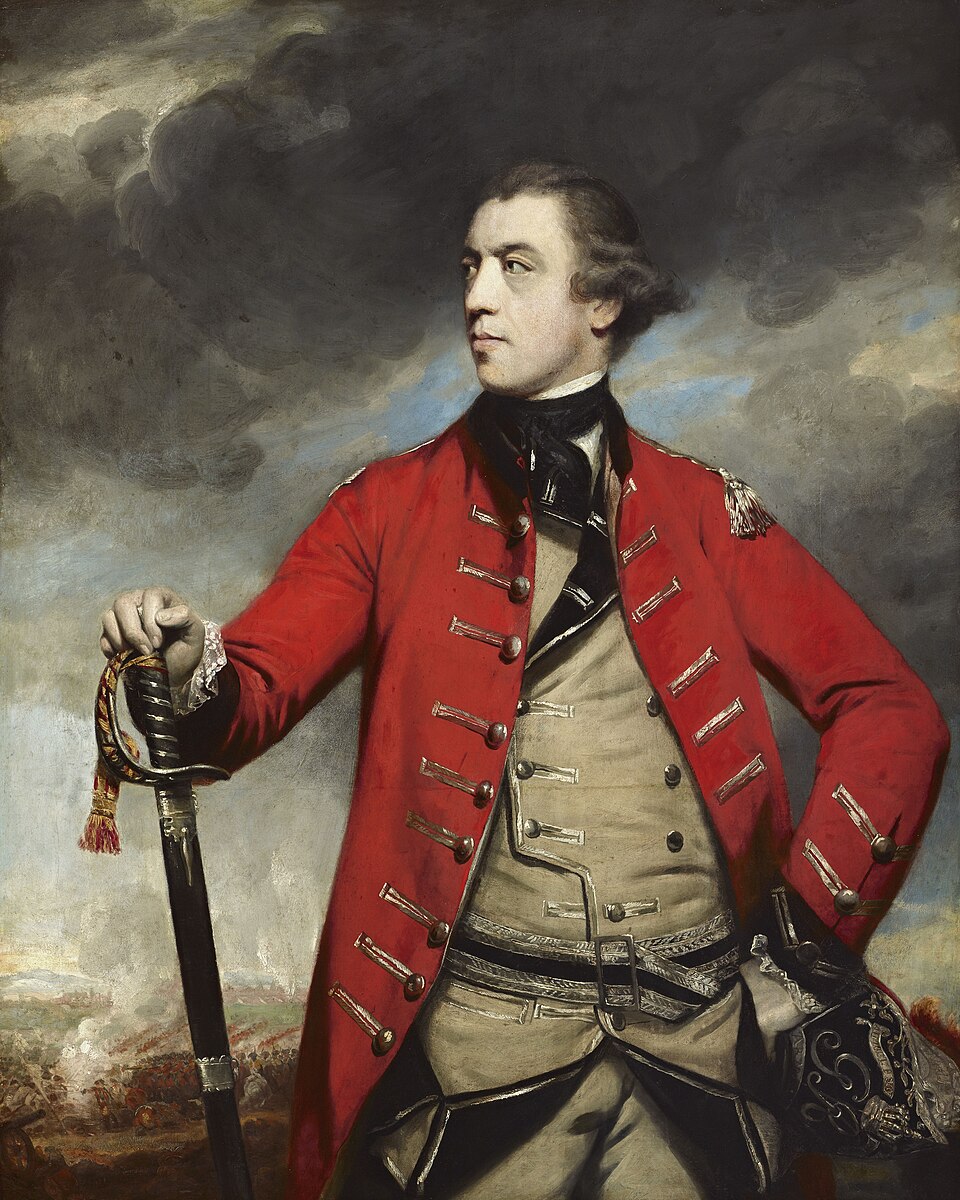
A cavalry officer stands against a stormy sky, sword at his side, a battle raging far behind him. Reynolds painted John Burgoyne in 1766, eleven years before the surrender at Saratoga made his name famous.
The story behind the painting
When Joshua Reynolds painted him in 1766, John Burgoyne had won distinction in the Seven Years' War, resisting the Spanish invasion of Portugal in 1762. Since 1761 he had been Member of Parliament for Midhurst. The portrait was commissioned by his former commander in Portugal, William, Count of Schaumburg-Lippe. Reynolds was already an established portrait painter in Britain. Two years later he would be a driving force behind the creation of the Royal Academy, serving as its first President until 1792.
What to look for
Burgoyne appears in military dress with his sword, wearing the uniform of the Sixteenth Light Dragoons, a branch of the light cavalry. His figure is silhouetted against a low horizon and a stormy sky, a feature common in romantic art. Look to the lower left of the background: a battle is taking place there, small and distant. The canvas measures about 127 by 101 cm, so the officer fills the picture with quiet confidence while the turmoil stays behind him.
Meaning and intent
The portrait shows a soldier at the height of his early success, honoured by the commander he had served. The stormy sky and the distant fight give him a heroic setting without showing him in action. Burgoyne was more than a soldier: in 1768 he won a hotly contested election in Preston and held that seat for the rest of his life, and he later wrote two plays, The Maid of the Oaks (1774) and The Heiress (1786), both staged in London's West End.
Legacy
Burgoyne is best remembered for what came after this picture. In 1777 he led a British army south from Canada to capture Albany in New York, but mislaid orders left him isolated at the Battle of Saratoga, and he surrendered to Horatio Gates, a former British officer serving with the Continental Army. Congress refused his terms and imprisoned his soldiers, while Burgoyne was paroled to go home and defend his conduct. The painting was acquired in 1943 by the Frick Collection in New York City, where it is today.
豆知識
- Painted by Joshua Reynolds in 1766.
- Commissioned by William, Count of Schaumburg-Lippe.
- Burgoyne wears the uniform of the Sixteenth Light Dragoons.
- In the Frick Collection, New York, since 1943.
画家について
ジョシュア・レノルズ (1723-1792)
同じ画家の作品: ジョシュア・レノルズ
 ウォルドグレイヴ家の貴婦人たち - Joshua Reynolds (1780)
 ジョージ K. H. クースメイカー大尉 - Joshua Reynolds (1782)
 コウバーン夫人と三人の息子たち - Joshua Reynolds (1773)
 エリザベス・デルメ夫人とその子供たち - Joshua Reynolds (1770s)
 エリザベス・カーの肖像 - Joshua Reynolds (1769)
 Thaïs - Joshua Reynolds (1781)
 David Garrick Between Tragedy and Comedy - Joshua Reynolds (1761)
 Lady Worsley - Joshua Reynolds (1779)
関連する画家の作品
 戦艦テメレール号 - J. M. W. Turner (1839)
 雨、蒸気、速度 - グレート・ウェスタン鉄道 - J. M. W. Turner (1844)
 指し降ろされた親指 - Jean-Léon Gérôme (1872)
 奴隷市場 - Jean-Léon Gérôme (1866)
 草上の昼食 - Édouard Manet (1863)
 オランピア - Édouard Manet (1863)
 世界の起源 - Gustave Courbet (1866)
 オルナンの埋葬 - Gustave Courbet (2020)
 カーネーション、リリー、リリー、ローズ - John Singer Sargent (1885-1886)
 マダムXの肖像 - John Singer Sargent (1884)
 民衆を導く自由の女神 - Eugène Delacroix (1830)
 サルダナパールの死 - Eugène Delacroix (1827)