Portrait of Maerten Soolmans
Rembrandt van Rijn · 1634
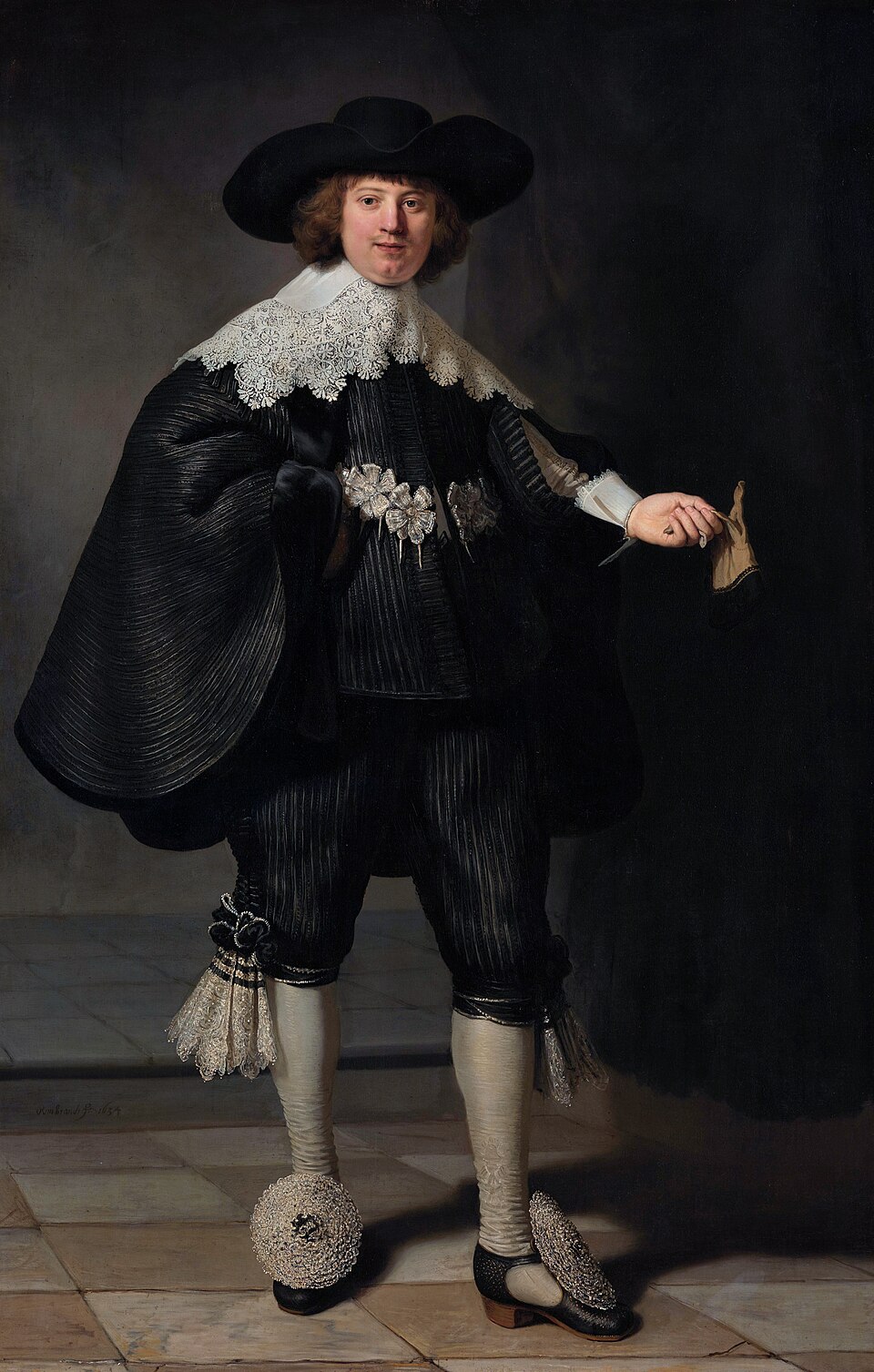
A young Amsterdam groom stands at full length, dressed in black with lace and rosettes. Rembrandt painted Maerten Soolmans in 1634, and today his portrait can never be separated from that of his wife: France and the Netherlands share them.
The story behind the painting
Rembrandt painted this oil portrait in 1634. Its sitter is Maerten Soolmans, born in 1613, the son of a refugee from Antwerp, who married Oopjen Coppit in June 1633. For a long time he was misidentified. When Hofstede de Groot catalogued the painting in 1915 with a precise description, he named the man as Maerten Daey, Oopjen's second husband. The confusion came from the fact that the portrait stayed for a long time in the Daey family. Maerten Soolmans himself died young, in 1641.
What to look for
The canvas is monumental, about 207 by 132.5 cm, a full-length figure close to life size. It was conceived together with the portrait of Oopjen Coppit, and the two are meant to be seen side by side, husband and wife answering each other across the space between the frames. The sources used here do not describe the costume in detail, so the best guide is the painting itself: look at how Rembrandt sets a young man of twenty or so before us at full height, with all the formality of a wedding pair.
Meaning and intent
These are marriage portraits, made a year after the wedding, and their meaning lies in being a pair. That is why their history matters so much. Around 1798 the two paintings left the Daey heirs and entered the van Winter family, then passed by inheritance to Anna Louisa van Winter, wife of Willem van Loon. When her heirs sold the collection in 1877, the Dutch government wanted to buy it but gave up. A consortium led by Baron Gustave de Rothschild bought sixty-eight paintings, the Soolmans pair among them, and both left for France.
Legacy
The pair stayed with the French Rothschilds for more than a century and were shown publicly only once in 150 years, in a 1956 exhibition by the Rijksmuseum and Museum Boijmans Van Beuningen. In 2014 the family decided to part with them; France wanted to keep them and the Netherlands wanted to undo the failure of 1877. The solution was a joint purchase, finalised on 1 February 2016: the Rijksmuseum owns Maerten, the Louvre owns Oopjen. The agreement says the two may never be separated, are shown together in turn in both museums, and cannot be lent elsewhere.
豆知識
- Painted by Rembrandt in 1634, about 207 by 132.5 cm.
- Long misidentified as Maerten Daey, Oopjen Coppit's second husband.
- Owned by the French Rothschilds for over a century.
- Since 2016 owned jointly in effect: never to be separated from Oopjen's portrait.
画家について
Rembrandt van Rijn (1606-1669)
肖像 · ルーヴル美術館絵画部門 · オランダ黄金時代の絵画 · アムステルダム国立美術館
同じ画家の作品: Rembrandt van Rijn
 夜警 - Rembrandt van Rijn (1642)
 自画像 - Rembrandt van Rijn (1659)
 テュルプ博士の解剖学講義 - Rembrandt van Rijn (1632)
 ユダヤの花嫁 - Rembrandt van Rijn (1660s)
 ガラリアの海の嵐 - Rembrandt van Rijn (1633)
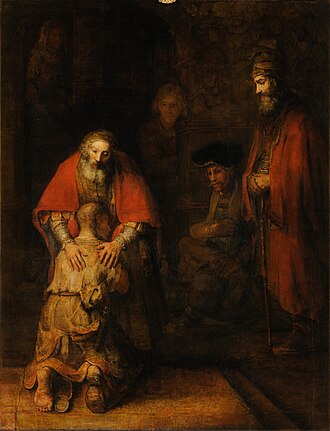 放蕩息子の帰還 - Rembrandt van Rijn (1668)
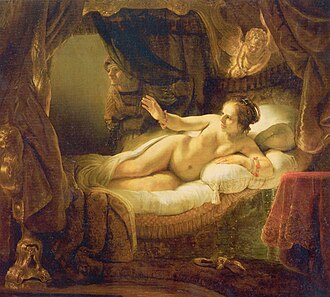 ダナエ - Rembrandt van Rijn (1636)
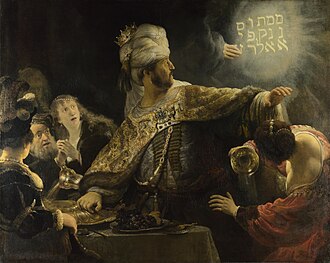 ベルシャザルの酒宴 - Rembrandt van Rijn (1636)
関連する画家の作品
 真珠の耳飾りの少女 - Johannes Vermeer (1665)
 牛乳を注ぐ女 - Johannes Vermeer (c. 1658)
 聖ニコラウスのお祭り - Jan Steen (1660s)
 牡蠣を食べる少女 - Jan Steen (1658)
 陽気な酒飲み - Frans Hals (1620s)
 微笑む騎士 - Frans Hals (1624)
 ウェイク・ベイ・ドゥールステーデの風車 - Jacob van Ruisdael (1670)
 The Jewish Cemetery - Jacob van Ruisdael (1650s)
 デルフトの家の中庭 - Pieter de Hooch (1658)
 リンゴの皮を剥く女性 - Pieter de Hooch (1663)