Norham Castle, Sunrise
J. M. W. Turner · 1845
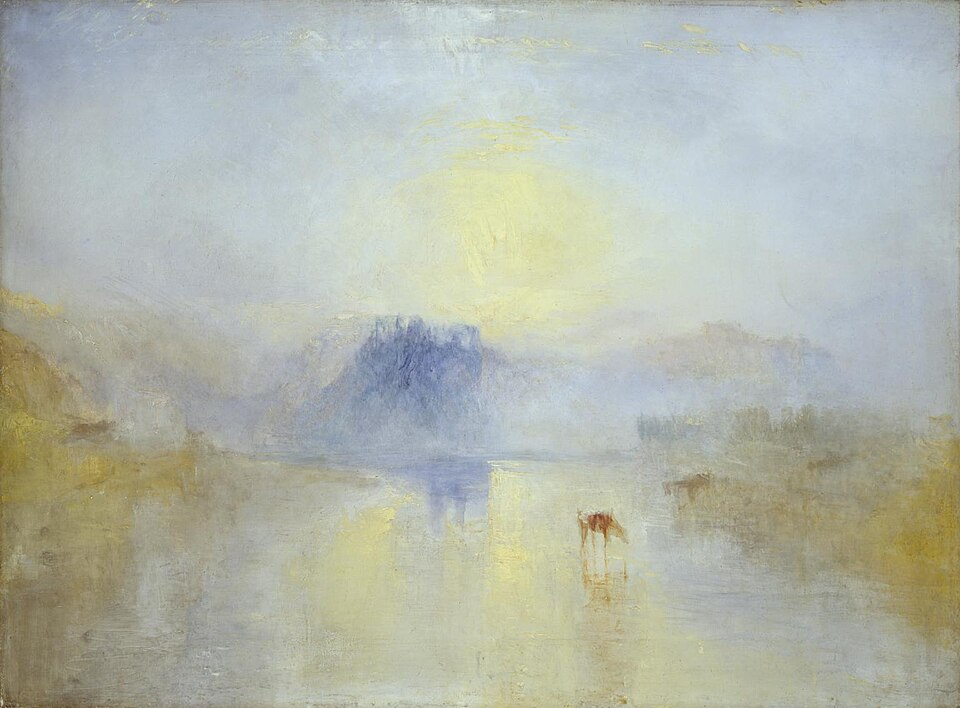
A castle above the River Tweed almost dissolves into the light of dawn. Turner first painted Norham as a young man, and late in life he came back to it again and again, saying this place had started him on the road to success.
The story behind the painting
Norham is a village in Northumberland, in the border country between England and Scotland. Its castle was a key stronghold above the River Tweed, the border itself, and was often attacked by the Scots. Turner visited the castle and the country around it in 1797. After that journey he made a watercolour, Norham Castle: Sunrise, which was shown at the Royal Academy of Arts in 1798 and was praised by critics. He went back to the ruins in 1801. Years later, on a visit in 1831, he told a companion that drawing and painting Norham Castle had set him on the path to becoming a successful artist.
What to look for
This oil on canvas, about 90.8 by 121.9 cm, was made around 1845 and is one of Turner's last paintings. It is known above all for its attention to dawn light and to the softened silhouette that such light gives. The castle on its height above the river is no longer drawn as a hard shape against the sky. Instead it seems to melt into the glow of early morning, and the outlines that would locate the stronghold give way to colour and haze. The work belongs to what is called Turner's Modernist period, near the end of his career.
Meaning and intent
The painting has deep roots in Turner's own work. In 1806 he began his Liber Studiorum, a collection of monochrome landscape prints. Norham Castle, Sunrise was among a series of unfinished coloured reworkings of those prints. Its direct source was plate number 57 of the Liber, Norham Castle on the Tweed, published in 1816. So the late canvas takes up a black and white image he had made decades earlier and gives it colour and light. For an artist who said this castle began his success, returning to it so late reads as a reflection on his work and his life.
Legacy
By the end of his career Turner had made six different versions of this subject, and he returned to Norham Castle several times. This version came to the nation in 1856 as part of the Turner Bequest, the group of works left by the artist, and went to the National Gallery of British Art, now Tate Britain. It remains in the Tate collection today. Wikidata lists both the National Gallery and Tate among its collections, reflecting that path from the bequest to the gallery that keeps it now.
豆知識
- Painted around 1845, one of Turner's last paintings.
- Based on plate 57 of his Liber Studiorum, published in 1816.
- Turner made six versions of the subject.
- Part of the Turner Bequest of 1856, now in Tate Britain.
画家について
J. M. W. Turner (1775-1851)
風景画 · ナショナル・ギャラリー · テート・ギャラリー
同じ画家の作品: J. M. W. Turner
 戦艦テメレール号 - J. M. W. Turner (1839)
 雨、蒸気、速度 - グレート・ウェスタン鉄道 - J. M. W. Turner (1844)
 奴隷船 - J. M. W. Turner (1840)
 カルタゴを建設するディドー - J. M. W. Turner (1815)
 トラファルガーの海戦 - J. M. W. Turner (1820s)
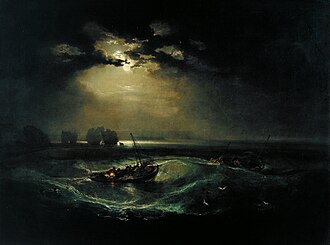 Fishermen at Sea - J. M. W. Turner (1796)
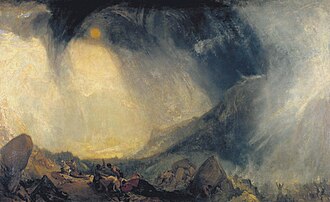 吹雪、アルプスを越えるハンニバルとその軍勢 - J. M. W. Turner (1812)
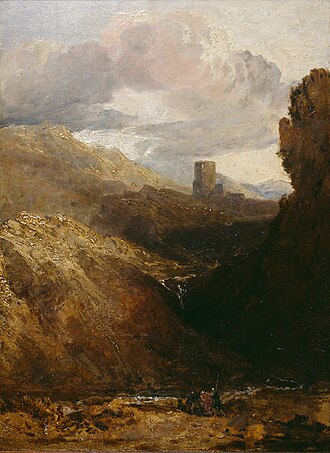 ドルバダーン城 - J. M. W. Turner (1800)
関連する画家の作品
 ウォルドグレイヴ家の貴婦人たち - Joshua Reynolds (1780)
 ジョージ K. H. クースメイカー大尉 - Joshua Reynolds (1782)
 印象・日の出 - Claude Monet (1872)
 睡蓮 - Claude Monet (1906)
 1808年5月3日 - Francisco Goya (1814)
 裸のマハ - Francisco Goya (1800)
 雲海の上の旅人 - Caspar David Friedrich (c. 1818)
 楡の木のある僧院 - Caspar David Friedrich (1800s)
 民衆を導く自由の女神 - Eugène Delacroix (1830)
 サルダナパールの死 - Eugène Delacroix (1827)
 青衣の少年 - Thomas Gainsborough (1770)
 アンドリューズ夫妻 - Thomas Gainsborough (1748)