Madonna del Rosario
アンソニー・ヴァン・ダイク · 1628
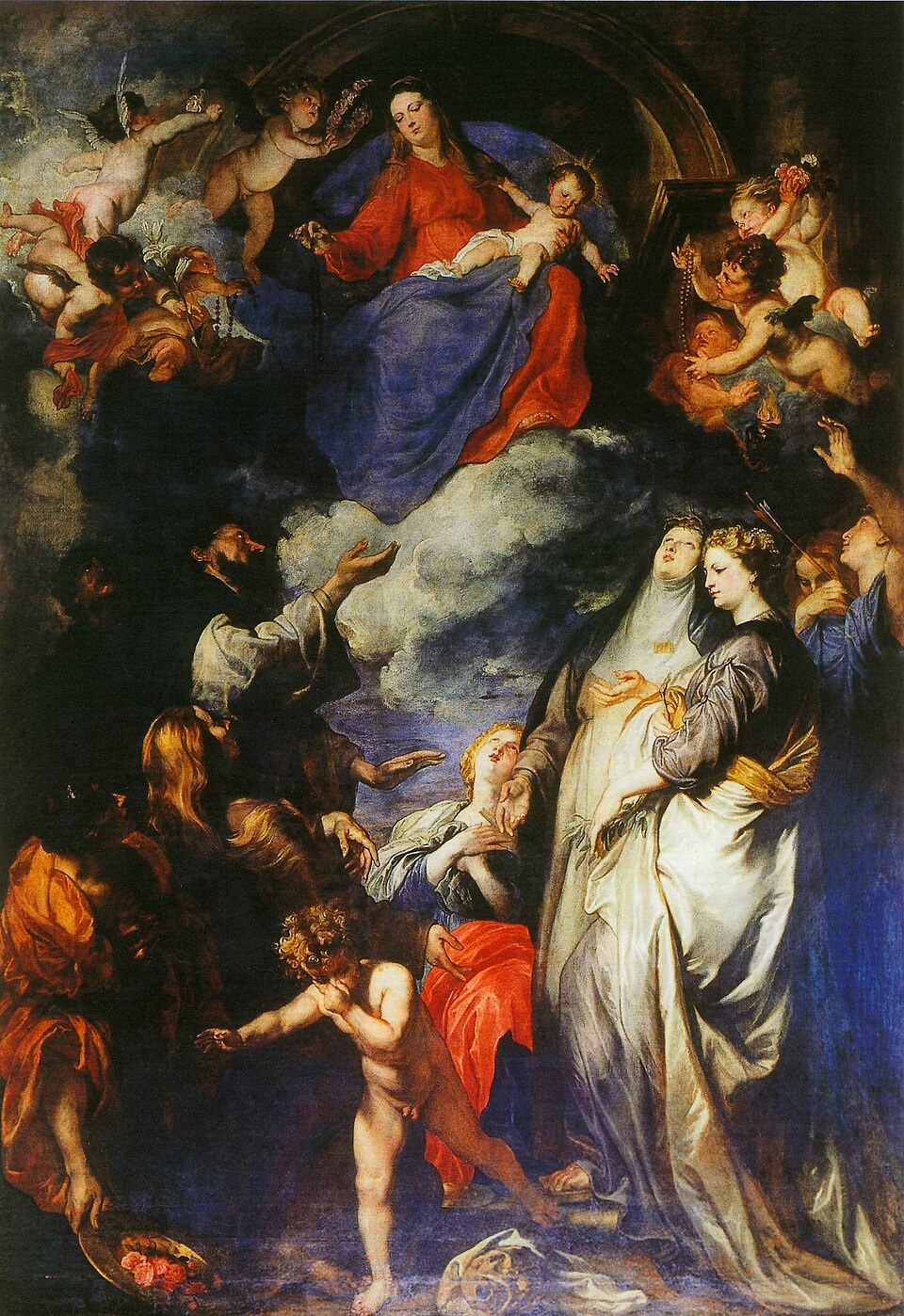
A city struck by plague, bones found in a mountain cave, and a young Flemish painter caught in the middle. Van Dyck's huge altarpiece in Palermo is a thank-you to the saint believed to have ended the epidemic.
The story behind the painting
From spring 1624 to autumn 1625 Anthony van Dyck stayed in Palermo at the invitation of the viceroy Emanuele Filiberto of Savoy. Soon after he arrived, plague struck the city. In summer 1624 relics were found in a cave on Monte Pellegrino, where the local saint Rosalia had lived as a hermit in the twelfth century. On the order of Archbishop Giovanni Doria they were carried in procession into Palermo, the plague later ceased, and Rosalia became the city's patron. In 1625 van Dyck was commissioned to paint an altarpiece for the Oratorio del Rosario di San Domenico. He painted it in Genoa and it was shipped to Palermo, probably in 1628, the date Wikidata gives.
What to look for
This is a large canvas, about 397 by 278 cm, striking for the brilliance of its reds and blues. It is built in two tiers, following the established image of the Virgin of the Rosary. Above, the Virgin and Child, surrounded by little angels, hand a rosary to Saint Dominic, who stands at the middle of the left side with his hand stretched out and links the two levels. Below, saints adore the Virgin. Rosalia is seen from three quarters behind, centre left, recognisable by her smock and her long Venetian blond hair. In front of her a naked boy runs away holding his nose and looking at a skull on the ground, a reminder of the stench of the streets during the plague.
Meaning and intent
The 1625 contract named the saints to be shown: three Dominicans, Dominic, Catherine of Siena and Vincent Ferrer, and five saints tied to Palermo and Sicily, Christina of Tyre, Nympha, Olivia, Agatha and Rosalia, the reason for the commission. The oratory already had a Virgin of the Rosary by Mario Minniti, but it did not include Rosalia, so the new painting also served as an ex voto, thanks for her intercession. Rivalry may have played a part: the Franciscans nearby owned a Nativity by Caravaggio. Van Dyck may also have recalled his master Rubens's first, rejected version of the Madonna della Vallicella, which he could have seen in Antwerp; his Saint Olivia echoes Rubens's Saint Domitilla.
Legacy
Only one preparatory study by van Dyck is known, kept in a museum in Hilversum. Once on public view, the altarpiece had a marked influence on local artists, above all Pietro Novelli, who worked on the decoration of the oratory. His ceiling fresco of the Coronation of the Virgin, from 1630, takes up the bright colours of the altarpiece, a break from his earlier, darker style. About sixty years later, the confraternity of the Oratorio del Rosario di Santa Cita ordered its own Madonna del Rosario from Carlo Maratta in 1695, which borrows features from van Dyck, including Rosalia seen from behind. The painting still stands where it was sent.
豆知識
- Commissioned in 1625 after the Palermo plague of 1624.
- Painted in Genoa and shipped to Palermo, probably in 1628.
- Saint Rosalia, the new patron of Palermo, appears seen from behind.
- Influenced Pietro Novelli and later Carlo Maratta.
画家について
アンソニー・ヴァン・ダイク (1599-1641)
同じ画家の作品: アンソニー・ヴァン・ダイク
 チャールズ1世の三面肖像画 - Anthony van Dyck (1635)
 馬上のチャールズ1世とサン・アントワーヌの領主の肖像 - Anthony van Dyck (1636)
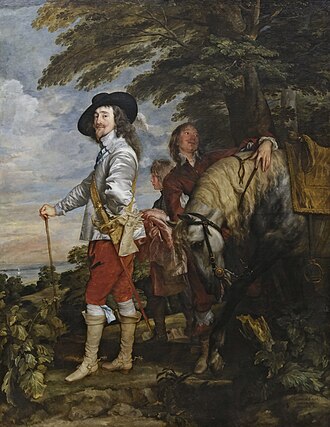 狩猟場のチャールズ1世 - Anthony van Dyck (1635)
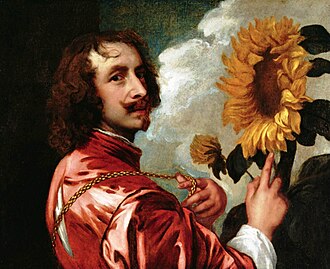 向日葵のある自画像 - Anthony van Dyck (1632)
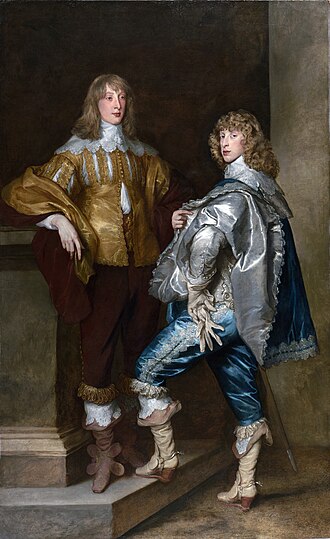 ジョン・ステュアート卿と弟バーナード・ステュアート卿の肖像 - Anthony van Dyck (1638)
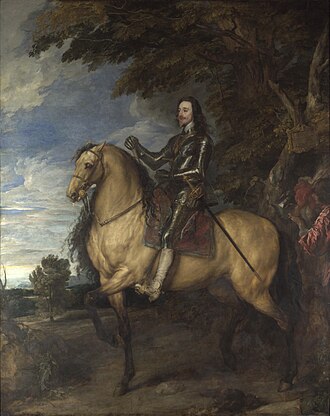 チャールズ1世騎馬像 - Anthony van Dyck (1637)
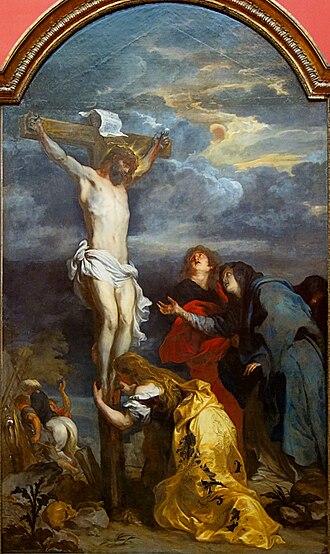 キリストの磔刑 - Anthony van Dyck
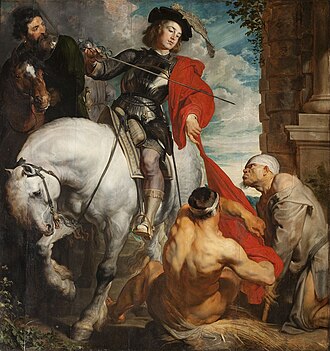 Saint Martin and the Beggar - Anthony van Dyck (1621)
関連する画家の作品
 エマオの晩餐 - Caravaggio (1601)
 聖マタイの召命 - Caravaggio (1609)
 ラス・メニーナス - Diego Velázquez (1656)
 ブレダの開城 - Diego Velázquez (1635)
 Saint Francis in Meditation - Francisco de Zurbarán (1639)
 The Immaculate Conception - Francisco de Zurbarán (1661)
 キリスト昇架 - Peter Paul Rubens (1609)
 レウキッポスの娘たちの略奪 - Peter Paul Rubens (1618)
 夜警 - Rembrandt van Rijn (1642)
 自画像 - Rembrandt van Rijn (1659)
 陽気な酒飲み - Frans Hals (1620s)
 微笑む騎士 - Frans Hals (1624)