キリスト昇架
ピーテル・パウル・ルーベンス · 1609
.jpg)
Nine straining men heave a cross upward, and on it Christ turns his face to heaven. Across three great panels, Rubens makes us feel the sheer weight of that moment.
The story behind the painting
Peter Paul Rubens painted this triptych in oil on panel in Antwerp, in 1610 and 1611 according to Wikipedia, while Wikidata gives 1609. It was made for the high altar of St. Walburga Church in Antwerp and was his first important religious commission after he returned home in late 1608 from a long stay in Italy. The altarpiece stood high above the altar, reached by stairs, so it could be seen from far across the large Gothic church. The work introduced large-scale Baroque painting to Flemish art and established Rubens as a leading painter in Flanders. Today it hangs in the Cathedral of Our Lady in Antwerp, its panels together spanning about 460 by 640 centimetres.
What to look for
Start with the central panel. Nine men, Roman soldiers, an old man in a turban and half-naked labourers with bulging muscles, haul, lift and push the cross on which Jesus is already nailed. One, a knight in a breastplate, may be a self-portrait of Rubens. Christ cuts diagonally across the panel, his hands clenched around the nails, his gaze turned upward. In the lower left corner an agitated dog pants. On the left wing, John and Mary watch in sorrow while a group of women and children react with horror. On the right wing, the two thieves are prepared for execution, and Roman officers on horseback give orders. Notice how one rocky landscape and darkening sky run across all three panels.
Meaning and intent
The crowd of straining men makes visible the immense weight of Christ, who in Catholic tradition carries the sins of the world. Rubens stresses willing sacrifice over horror: Christ's body has classical nobility, his face shows acceptance, his mouth is half open as if speaking to God. The darkening sky announces the eclipse described in the Gospel of Matthew. The work follows guidelines for religious images set by the Council of Trent and reflects the spirit of the Counter-Reformation. Rubens also contrasts Christ's plea for forgiveness with the vengeance of the ancient gods, basing figures on antique statues such as the Laocoön, whose father figure inspired Christ's expression.
Legacy
Rubens drew on what he had studied in Rome and Venice: the antique sculptures of the Laocoön, the Niobids and the Farnese Bull, and painters such as Michelangelo, Tintoretto and Caravaggio. From Tintoretto's Crucifixion in the Scuola di San Rocco he borrowed the arrangement of men pulling and pushing around a rising cross; from Caravaggio, the dramatic contrasts of light and dark. With angels once fluttering above the frame, the altarpiece has been called the first fully Baroque treatment of space in a northern European altarpiece. In the 1730s the original predellas were sold and their whereabouts are unknown, but the great triptych endures, and its oil sketches for the shutters are in the Dulwich Picture Gallery.
豆知識
- Painted 1610-1611 according to Wikipedia; Wikidata gives 1609.
- Made for the high altar of St. Walburga Church, Antwerp; now in the Cathedral of Our Lady.
- The knight in a cuirass may be a self-portrait of Rubens.
画家について
ピーテル・パウル・ルーベンス (1577-1640)
宗教美術 · 男性 · 聖母マリア · イエス・キリスト · バロック · イヌ · キリストの磔刑 · 死刑執行人
同じ画家の作品: ピーテル・パウル・ルーベンス
 レウキッポスの娘たちの略奪 - Peter Paul Rubens (1618)
 ルーベンスとイザベラ・ブラント - Peter Paul Rubens (1600s)
 サムソンとデリラ - Peter Paul Rubens (1600s)
 キリスト降架 - Peter Paul Rubens (1611)
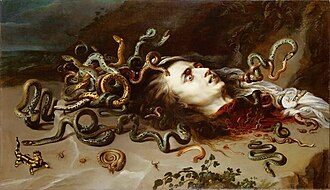 メドューサの頭部 - Peter Paul Rubens (1618)
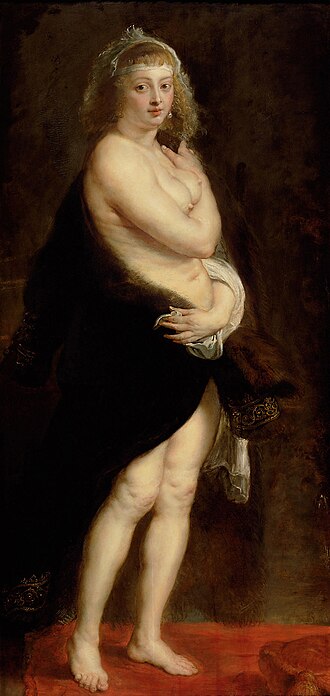 毛皮をまとったエレーヌ・フールマン - Peter Paul Rubens (1638)
.jpg) 愛の園 - Peter Paul Rubens (1632)
愛の園 - Peter Paul Rubens (1632) 天の川の誕生 - Peter Paul Rubens (1630s)
関連する画家の作品
 星月夜 - Vincent van Gogh (1889)
.jpg) 夜のカフェテラス - Vincent van Gogh (1888)
夜のカフェテラス - Vincent van Gogh (1888) エマオの晩餐 - Caravaggio (1601)
 聖マタイの召命 - Caravaggio (1609)
 ラス・メニーナス - Diego Velázquez (1656)
 ブレダの開城 - Diego Velázquez (1635)
%20-%20Google%20Art%20Project.jpg) チャールズ1世の三面肖像画 - Anthony van Dyck (1635)
チャールズ1世の三面肖像画 - Anthony van Dyck (1635)%20with%20M.%20de%20St%20Antoine%20-%20Google%20Art%20Project.jpg) 馬上のチャールズ1世とサン・アントワーヌの領主の肖像 - Anthony van Dyck (1636)
馬上のチャールズ1世とサン・アントワーヌの領主の肖像 - Anthony van Dyck (1636) 夜警 - Rembrandt van Rijn (1642)
 自画像 - Rembrandt van Rijn (1659)
 真珠の耳飾りの少女 - Johannes Vermeer (1665)
 牛乳を注ぐ女 - Johannes Vermeer (c. 1658)