キリストの磔刑
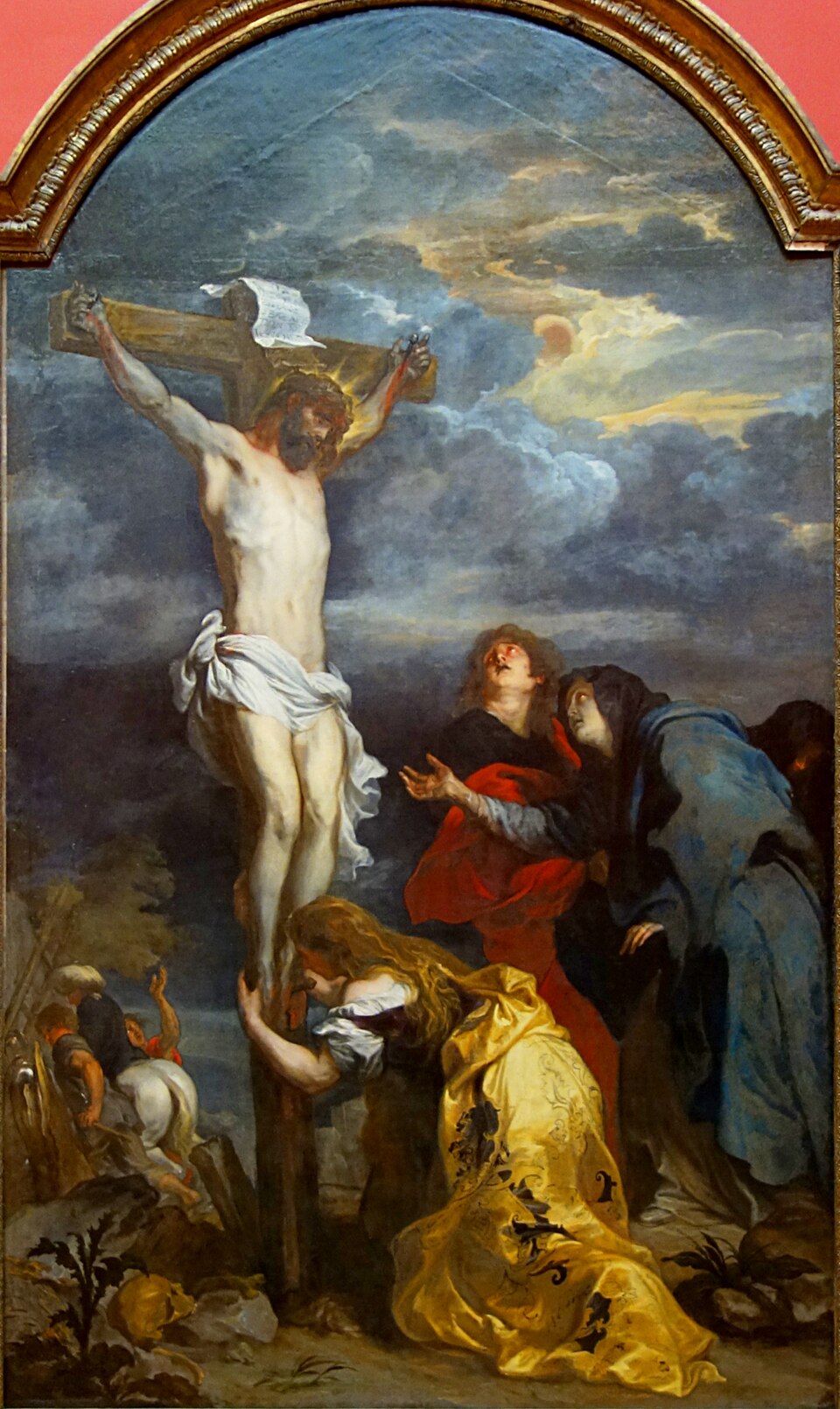
Van Dyck came back from Italy and painted the Crucifixion again, this time with the cross set at a slant and a storm-dark sky behind it. It has hung in Lille since the museum was founded.
The story behind the painting
Van Dyck painted this Crucifixion around 1630 as the high altarpiece for the convent of the Récollets in Lille, during his second Antwerp period, between his return from Italy in 1627 and his move to London in 1632. He had already treated the subject around 1617 to 1619, while still an assistant to Rubens, in a Crucifixion with the Virgin, Saint John and Mary Magdalene now in the Louvre. The new altarpiece let him return to a familiar theme with fresh experience.
What to look for
This second version is more original: the cross is not central but set at an oblique angle to give the scene depth. Look at the three mourners and their colours, golden yellow for Mary Magdalene, red for John, blue for the Virgin. A fourth shadowed figure at the far right is uncertain, perhaps one of the Three Marys. At the foot of the cross, lower left, Adam's skull lies under a thistle. The stormy sky and the Magdalene's hair show what Van Dyck learned from the Venetian masters in Italy.
Meaning and intent
The colours are symbolic: the Magdalene's yellow for eternal light, John's red for the Passion, the Virgin's blue for the mantle of humanity. Golgotha means the place of the skull, so Adam's skull recalls the Fall and Original Sin, and the thistle's spines echo Christ's crown of thorns. In the semicircle above the cross is a mystic delta, a symbol of the Holy Trinity. Every element at the foot of the cross thus points back to the story of sin and redemption that the altarpiece was meant to place before the friars.
Legacy
The painting was seized during the French Revolution, and in 1795 it became part of the founding collection of the Palais des Beaux-Arts de Lille, where it still hangs. The sources disagree on its size: Wikipedia gives a height of 2.51 m, while Wikidata lists 109 by 124 cm. The earlier version, painted while he worked with Rubens, was sold to Rubens in 1621 as the high altarpiece of the Jesuit church at the abbey of Saint-Winnoc in Bergues and is now in the Louvre, so both treatments survive in French museums.
豆知識
- Painted around 1630 for the Récollets convent in Lille.
- A second treatment of a subject Van Dyck painted around 1617 to 1619.
- Seized in the Revolution, in the Lille museum since 1795.
- Sources disagree on its size.
画家について
アンソニー・ヴァン・ダイク (1599-1641)
宗教美術 · 聖母マリア · イエス・キリスト · 空 · マグダラのマリア · 兵士 · リール美術館 · ヨハネ
同じ画家の作品: アンソニー・ヴァン・ダイク
%20-%20Google%20Art%20Project.jpg) チャールズ1世の三面肖像画 - Anthony van Dyck (1635)
チャールズ1世の三面肖像画 - Anthony van Dyck (1635)%20with%20M.%20de%20St%20Antoine%20-%20Google%20Art%20Project.jpg) 馬上のチャールズ1世とサン・アントワーヌの領主の肖像 - Anthony van Dyck (1636)
馬上のチャールズ1世とサン・アントワーヌの領主の肖像 - Anthony van Dyck (1636)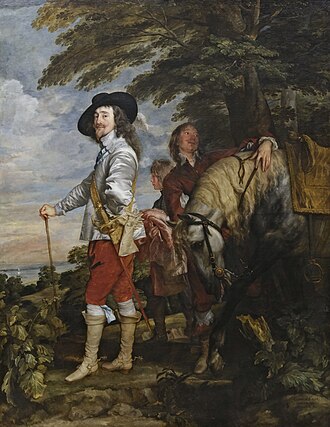 狩猟場のチャールズ1世 - Anthony van Dyck (1635)
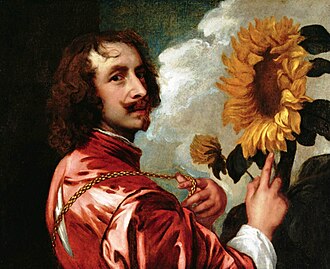 向日葵のある自画像 - Anthony van Dyck (1632)
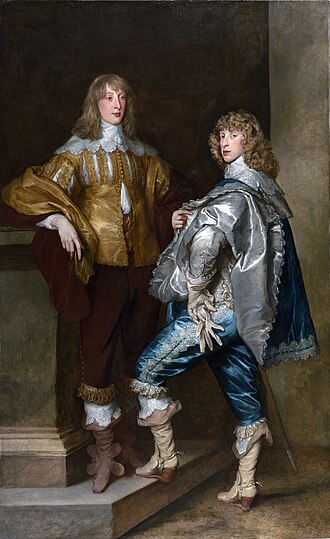 ジョン・ステュアート卿と弟バーナード・ステュアート卿の肖像 - Anthony van Dyck (1638)
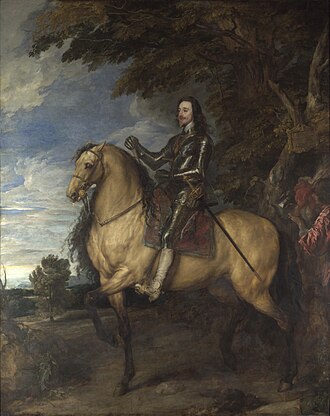 チャールズ1世騎馬像 - Anthony van Dyck (1637)
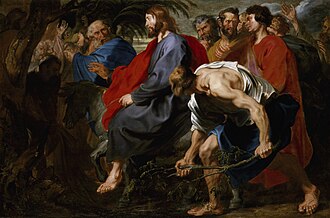 キリストのエルサレム入城 - Anthony van Dyck (1617)
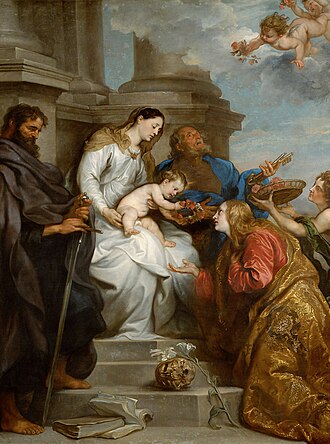 聖ロザリアの戴冠 - Anthony van Dyck (1629)
関連する画家の作品
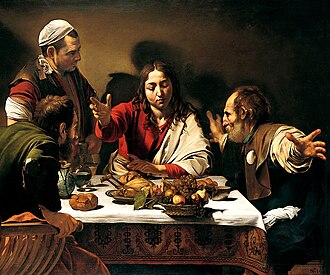 エマオの晩餐 - Caravaggio (1601)
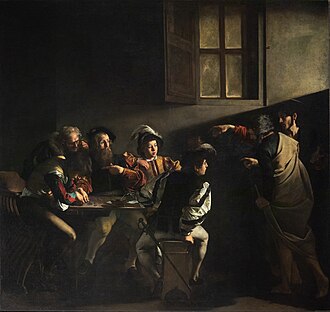 聖マタイの召命 - Caravaggio (1609)
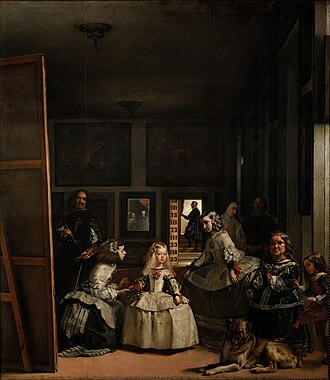 ラス・メニーナス - Diego Velázquez (1656)
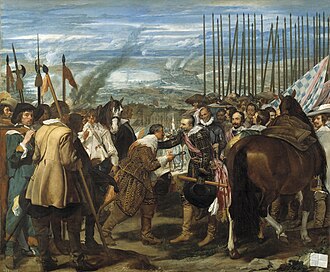 ブレダの開城 - Diego Velázquez (1635)
.jpg) キリスト昇架 - Peter Paul Rubens (1609)
キリスト昇架 - Peter Paul Rubens (1609)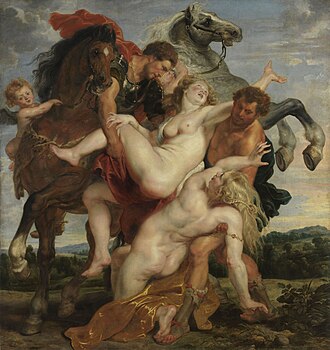 レウキッポスの娘たちの略奪 - Peter Paul Rubens (1618)
 夜警 - Rembrandt van Rijn (1642)
 自画像 - Rembrandt van Rijn (1659)
 真珠の耳飾りの少女 - Johannes Vermeer (1665)
 牛乳を注ぐ女 - Johannes Vermeer (c. 1658)