チャールズ1世騎馬像
アンソニー・ヴァン・ダイク · 1637
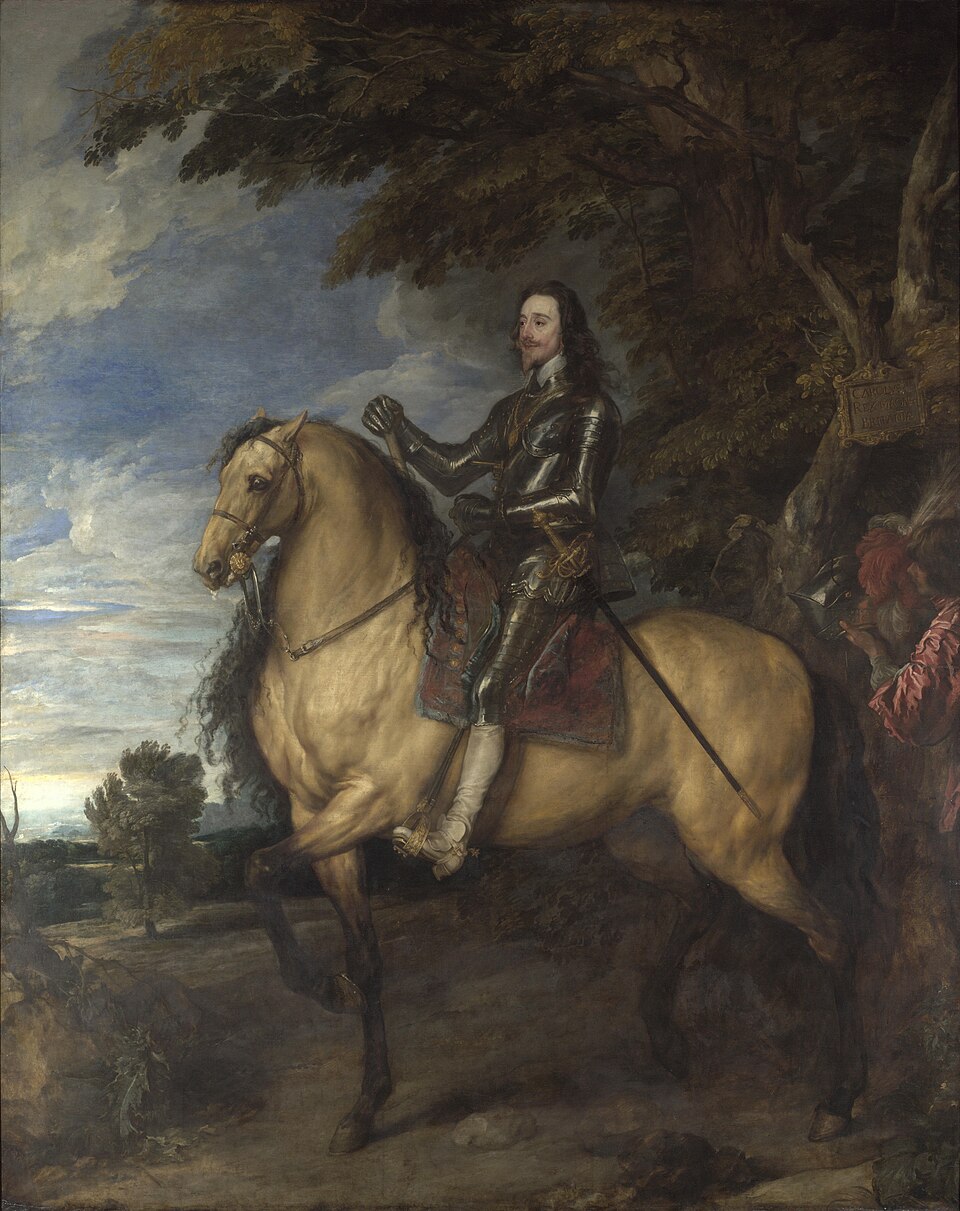
A king in armour rides out of a dark wood, gazing far away with a melancholy, distant look. Painted a few years before civil war tore his kingdoms apart, it is van Dyck's vision of Charles I as a philosopher king.
The story behind the painting
Charles I became King of England, Scotland and Ireland in 1625, and van Dyck became his Principal Painter in Ordinary in 1632. This portrait is thought to date from about 1637 to 1638, only a few years before the English Civil War broke out in 1642; Wikidata gives 1637. It was van Dyck's second equestrian portrait of the king, after Charles I with M. de St Antoine of around 1633, and he also painted the dismounted Charles I at the Hunt around 1635. The king was only 5 feet 4 inches tall, about 163 cm, and keenly conscious of it.
What to look for
Charles rides a heavily muscled dun horse with a peculiarly small head. He wears the same suit of tilt armour as in the earlier equestrian portrait, carries a baton of command, has a long sword at his side and wears the medallion of the Sovereign of the Order of the Garter. To the right a page offers a helmet. A tablet tied to a branch reads Carolus I Rex Magnae Britaniae, Charles I King of Great Britain. The canvas is huge, 3.67 metres high and 2.92 metres wide. Analysis at the National Gallery found smalt, ochres, vermilion, red lake and azurite in its subdued tones.
Meaning and intent
Charles appears as a heroic philosopher king, contemplatively surveying his domain; his melancholy, distant expression was seen as a sign of wisdom. The armour is itself a statement, since the last royal tilt had been held in 1616. So is the inscription: only 33 years after James I united the crowns and proclaimed himself King of Great Britain, nearly 70 years before the Acts of Union. The imperial tone echoes Titian's equestrian portrait of Emperor Charles V from 1548, and the composition may borrow from Durer's 1513 engraving Knight, Death and the Devil. Raising the king on horseback was also a way to increase his stature.
Legacy
The painting is listed in the first catalogue of the Royal Collection, compiled in 1637 to 1640, and hung at the end of a long gallery at Hampton Court Palace. After the king's execution the collection was dispersed, and in 1650 it was sold to Sir Balthazar Gerbier, the king's former agent in Antwerp. It passed to the Elector of Bavaria Maximilian II Emanuel in 1698, was taken from Munich as war booty by Emperor Joseph I, and given to John Churchill, 1st Duke of Marlborough, in 1706. It hung at Blenheim Palace until the National Gallery in London acquired it in 1895.
豆知識
- Painted about 1637-1638, a few years before the English Civil War.
- 3.67 metres high and 2.92 metres wide.
- Van Dyck's second equestrian portrait of Charles I.
- At Blenheim Palace until 1895; now in the National Gallery, London.
画家について
アンソニー・ヴァン・ダイク (1599-1641)
ナショナル・ギャラリー · バロック · ウマ · 馬術 · equestrian portrait · チャールズ1世
同じ画家の作品: アンソニー・ヴァン・ダイク
%20-%20Google%20Art%20Project.jpg) チャールズ1世の三面肖像画 - Anthony van Dyck (1635)
チャールズ1世の三面肖像画 - Anthony van Dyck (1635)%20with%20M.%20de%20St%20Antoine%20-%20Google%20Art%20Project.jpg) 馬上のチャールズ1世とサン・アントワーヌの領主の肖像 - Anthony van Dyck (1636)
馬上のチャールズ1世とサン・アントワーヌの領主の肖像 - Anthony van Dyck (1636)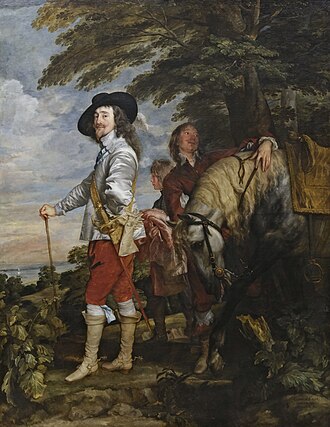 狩猟場のチャールズ1世 - Anthony van Dyck (1635)
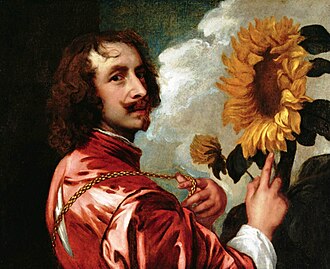 向日葵のある自画像 - Anthony van Dyck (1632)
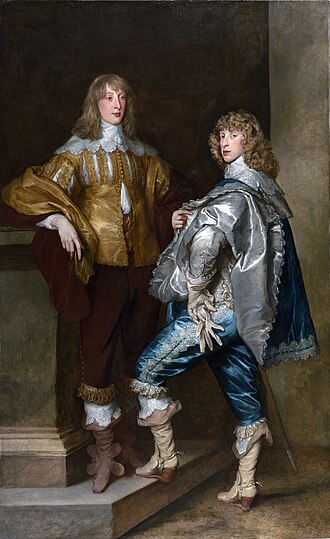 ジョン・ステュアート卿と弟バーナード・ステュアート卿の肖像 - Anthony van Dyck (1638)
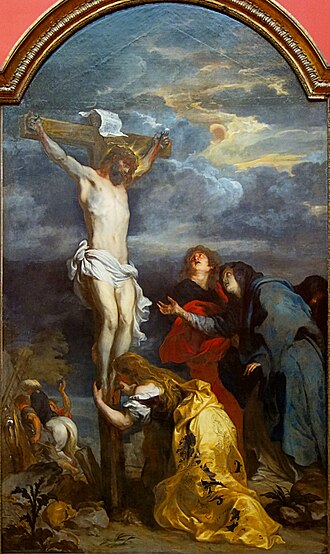 キリストの磔刑 - Anthony van Dyck
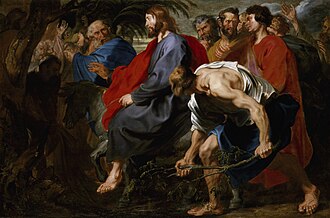 キリストのエルサレム入城 - Anthony van Dyck (1617)
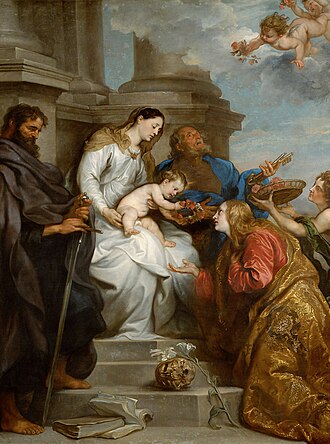 聖ロザリアの戴冠 - Anthony van Dyck (1629)
関連する画家の作品
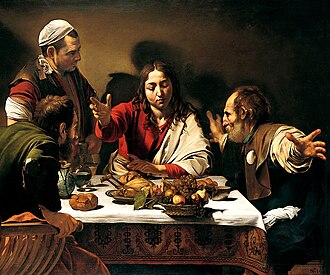 エマオの晩餐 - Caravaggio (1601)
 聖マタイの召命 - Caravaggio (1609)
 ラス・メニーナス - Diego Velázquez (1656)
 ブレダの開城 - Diego Velázquez (1635)
.jpg) キリスト昇架 - Peter Paul Rubens (1609)
キリスト昇架 - Peter Paul Rubens (1609) レウキッポスの娘たちの略奪 - Peter Paul Rubens (1618)
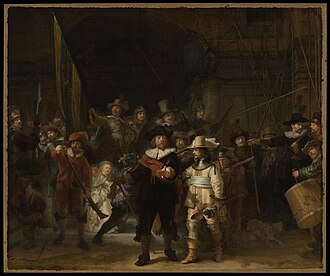 夜警 - Rembrandt van Rijn (1642)
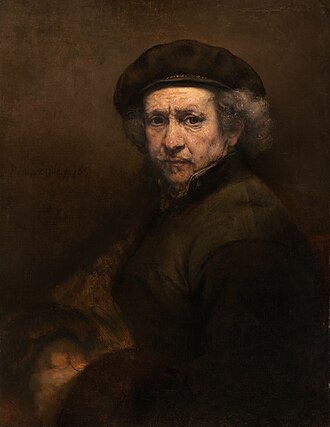 自画像 - Rembrandt van Rijn (1659)
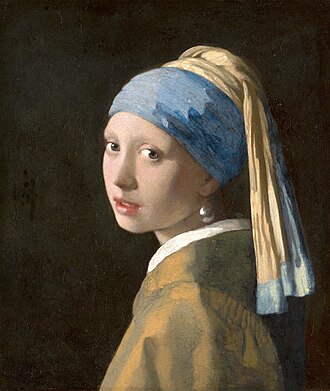 真珠の耳飾りの少女 - Johannes Vermeer (1665)
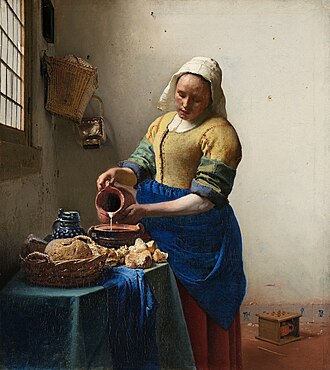 牛乳を注ぐ女 - Johannes Vermeer (c. 1658)