チャールズ1世の三面肖像画
アンソニー・ヴァン・ダイク · 1635
%20-%20Google%20Art%20Project.jpg)
One king, three faces: profile, full face and three-quarter view, side by side on one canvas. Van Dyck painted it so that a sculptor in Rome could carve Charles I without ever meeting him.
The story behind the painting
Van Dyck probably began this portrait of King Charles I of England in the latter part of 1635, and it is dated 1635 to 1636. It had a practical purpose. In 1636 it was sent to Rome as a reference for the Italian sculptor Gian Lorenzo Bernini, who was to carve a marble bust of the king. Pope Urban VIII sent the bust to Charles's queen, Henrietta Maria, hoping to encourage a reconciliation between the Roman Catholic Church and the Church of England. The sources give both 1637 and 1638 for the bust's arrival.
What to look for
The canvas, about 84 by 99 cm, shows the king from three viewpoints: left full profile, face on, and right three-quarter profile. Compare the three heads closely. The colours of the costumes and the patterns of the lace collars differ in each, as if the king had changed clothes between sittings, yet the blue riband of the Order of the Garter appears in all three. Seen together, the three views give what a sculptor needs: the line of the nose, the shape of the brow and beard, the turn of the head in space.
Meaning and intent
The idea of a triple view is thought to come from Lorenzo Lotto's Triple Portrait of a Goldsmith, painted around 1530 and then in the Royal Collection. Van Dyck turned it into a working tool and a royal image at once. The bust it served was admired for its workmanship and its likeness to the king, and Charles rewarded Bernini with a valuable diamond ring. Henrietta Maria commissioned a companion bust of herself, but the English Civil War intervened and it was never made.
Legacy
The bust itself was sold after the Civil War, recovered for the Royal Collection at the Restoration, then destroyed in the Whitehall Palace fire of January 1698. The painting survived in Rome with Bernini and his heirs until about 1802, when the dealer William Buchanan bought it and brought it back to England. It was shown at the British Gallery in 1821 and acquired for the Royal Collection in 1822. It may have influenced Philippe de Champaigne's triple portrait of Cardinal Richelieu, and many copies were made, including one now in the Victoria and Albert Museum.
豆知識
- Painted in 1635-1636 and sent to Rome as a model for Bernini.
- Bernini's bust of Charles I burned in the Whitehall fire of 1698.
- The painting stayed with Bernini's heirs until about 1802.
- Acquired for the Royal Collection in 1822.
画家について
アンソニー・ヴァン・ダイク (1599-1641)
肖像 · ロイヤル・コレクション · チャールズ1世
同じ画家の作品: アンソニー・ヴァン・ダイク
%20with%20M.%20de%20St%20Antoine%20-%20Google%20Art%20Project.jpg) 馬上のチャールズ1世とサン・アントワーヌの領主の肖像 - Anthony van Dyck (1636)
馬上のチャールズ1世とサン・アントワーヌの領主の肖像 - Anthony van Dyck (1636)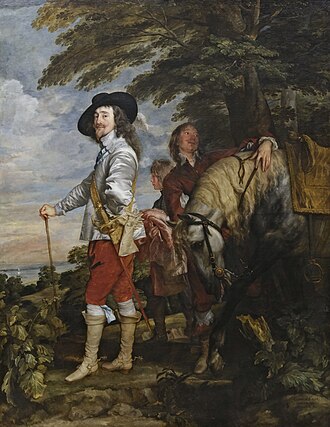 狩猟場のチャールズ1世 - Anthony van Dyck (1635)
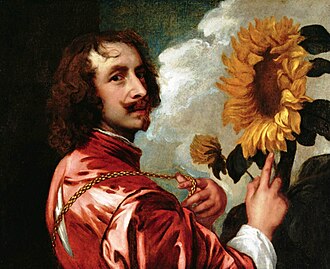 向日葵のある自画像 - Anthony van Dyck (1632)
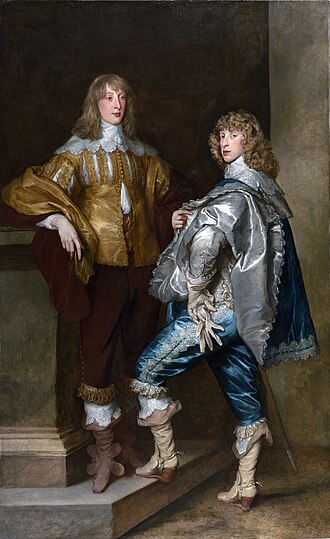 ジョン・ステュアート卿と弟バーナード・ステュアート卿の肖像 - Anthony van Dyck (1638)
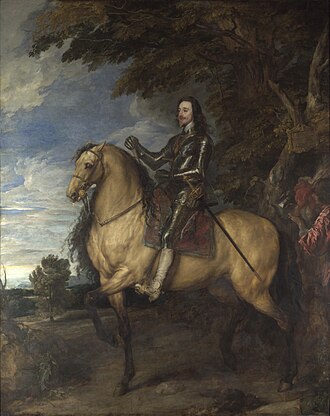 チャールズ1世騎馬像 - Anthony van Dyck (1637)
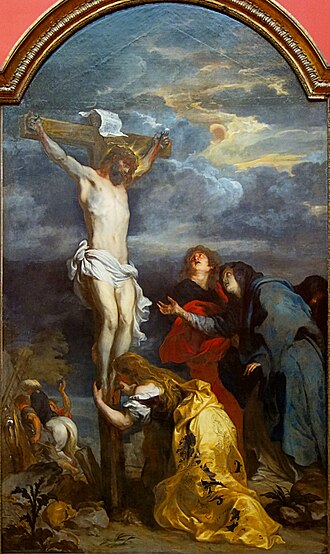 キリストの磔刑 - Anthony van Dyck
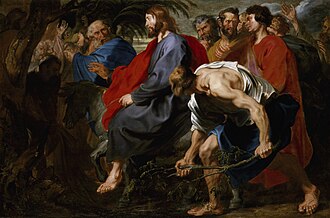 キリストのエルサレム入城 - Anthony van Dyck (1617)
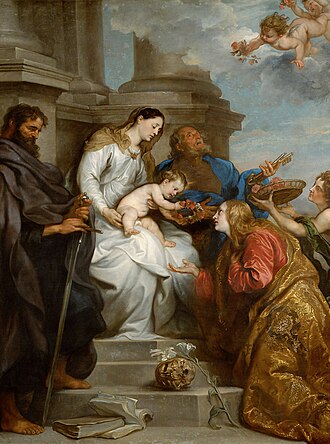 聖ロザリアの戴冠 - Anthony van Dyck (1629)
関連する画家の作品
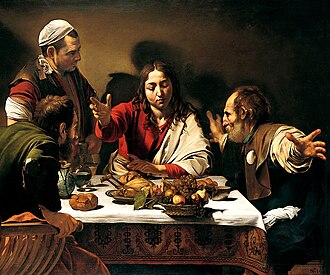 エマオの晩餐 - Caravaggio (1601)
 聖マタイの召命 - Caravaggio (1609)
 ラス・メニーナス - Diego Velázquez (1656)
 ブレダの開城 - Diego Velázquez (1635)
.jpg) キリスト昇架 - Peter Paul Rubens (1609)
キリスト昇架 - Peter Paul Rubens (1609) レウキッポスの娘たちの略奪 - Peter Paul Rubens (1618)
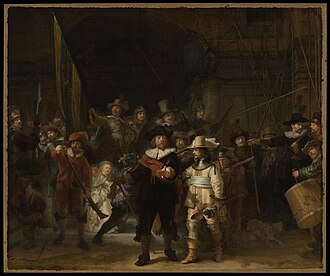 夜警 - Rembrandt van Rijn (1642)
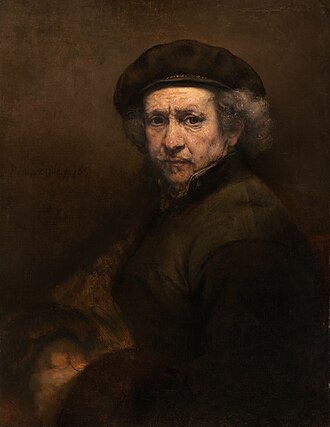 自画像 - Rembrandt van Rijn (1659)
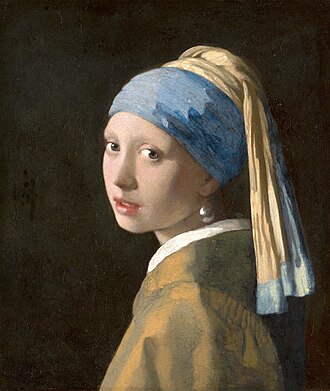 真珠の耳飾りの少女 - Johannes Vermeer (1665)
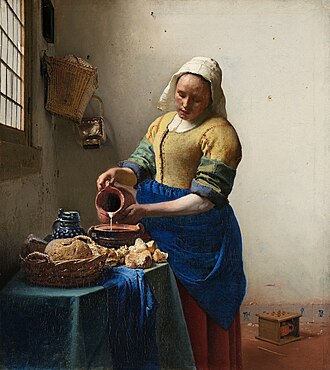 牛乳を注ぐ女 - Johannes Vermeer (c. 1658)