Lady Worsley
ジョシュア・レノルズ · 1779
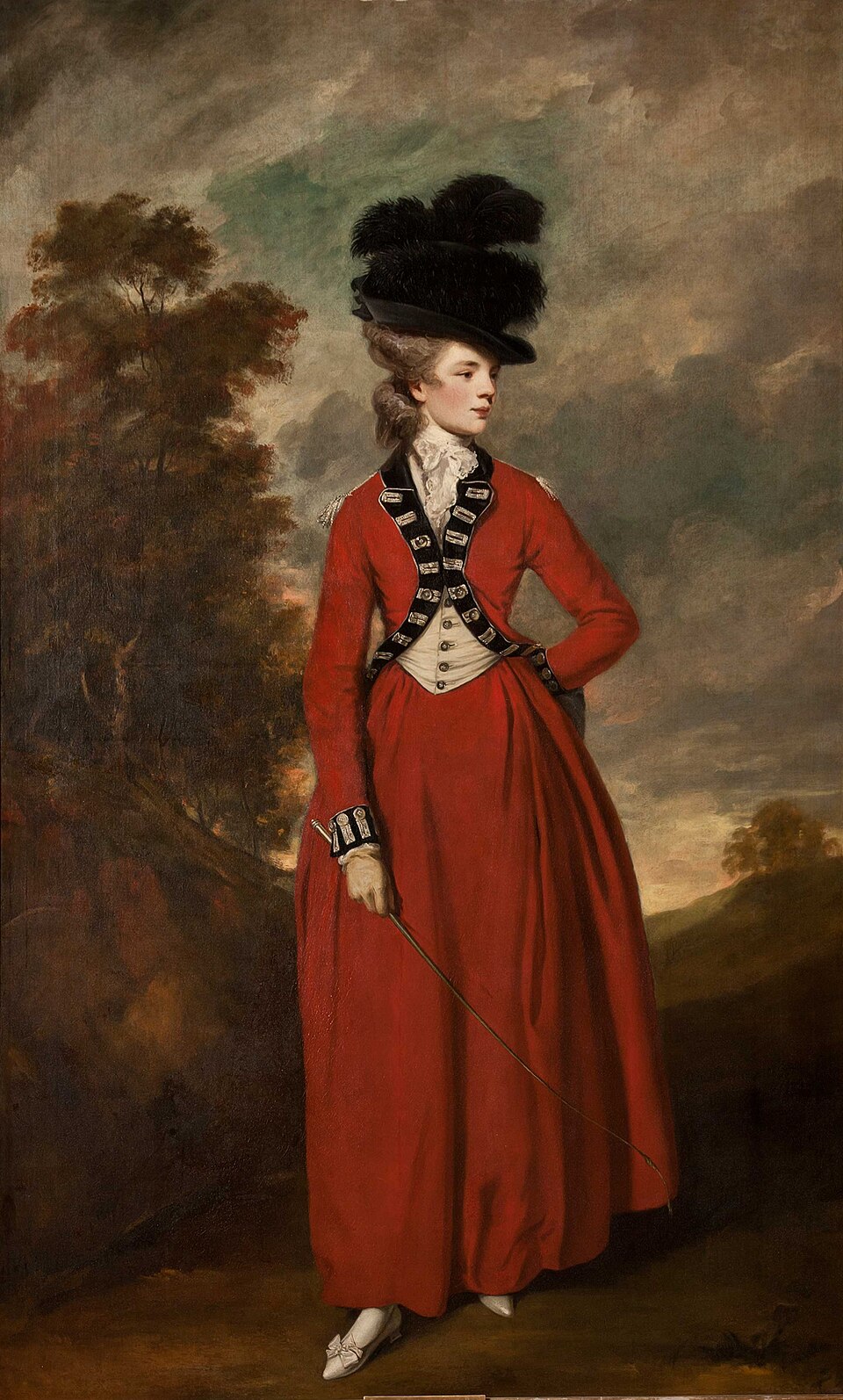
She stands full length in a red riding habit cut like a military uniform, a riding crop in her hand. Reynolds caught Seymour, Lady Worsley, in a moment of patriotic fervour, only a few years before her name filled the scandal sheets.
The story behind the painting
Seymour married Sir Richard Worsley, 7th Baronet, in 1775. In 1779 France and Spain had entered the American War of Independence, and a Franco-Spanish fleet threatened to invade England, the episode known as the Armada of 1779. Patriotic feeling ran high. Reynolds saw Lady Worsley in her riding costume at the Coxheath military camp near Maidstone in Kent, and painted her in it. The portrait was meant to complement an earlier 1775 portrait of Sir Richard in his own uniform.
What to look for
The canvas is tall, about 236 by 144 cm, and shows her full length. Her riding habit has been customised to resemble the uniform of the South Hampshire Militia, the regiment her husband commanded as colonel. In her right hand she holds a riding crop, an allusion to her skill on horseback. Look at how the cut of a soldier's coat is adapted to a woman's fashionable dress, joining elegance and martial pride in a single figure.
Meaning and intent
The painting turns a wife into a partner in her husband's public role. Dressed in his regiment's colours, she shares in the patriotic mood of a nation fearing invasion, and her crop speaks of confidence and command rather than ornament alone. Hung beside Sir Richard's portrait, it would have presented a united couple. History soon broke that image: in 1782 Lady Worsley ran off with her lover, whom her husband sued for criminal conversation, in one of the notorious scandals of the age.
Legacy
Reynolds, the first President of the Royal Academy, showed the work at the Royal Academy Exhibition of 1780 at Somerset House. For a long time it belonged to the collection of Harewood House in Yorkshire. It was later bought by the American businessman Stephen Schwarzman. The sale caused controversy: on 31 January 2025 the art historian Marcia Pointon, Professor Emerita at the University of Manchester, wrote to the Financial Times condemning it and asking for assurances that the painting would not leave Britain.
豆知識
- Painted in 1779, during the invasion scare called the Armada of 1779.
- Her habit imitates the South Hampshire Militia uniform.
- Shown at the Royal Academy Exhibition of 1780.
- Formerly at Harewood House; its sale stirred controversy in 2025.
画家について
ジョシュア・レノルズ (1723-1792)
同じ画家の作品: ジョシュア・レノルズ
 ウォルドグレイヴ家の貴婦人たち - Joshua Reynolds (1780)
 ジョージ K. H. クースメイカー大尉 - Joshua Reynolds (1782)
 コウバーン夫人と三人の息子たち - Joshua Reynolds (1773)
 エリザベス・デルメ夫人とその子供たち - Joshua Reynolds (1770s)
 エリザベス・カーの肖像 - Joshua Reynolds (1769)
 ジョン・バーゴインの肖像 - Joshua Reynolds (1766)
 Thaïs - Joshua Reynolds (1781)
 David Garrick Between Tragedy and Comedy - Joshua Reynolds (1761)
関連する画家の作品
 戦艦テメレール号 - J. M. W. Turner (1839)
 雨、蒸気、速度 - グレート・ウェスタン鉄道 - J. M. W. Turner (1844)
 指し降ろされた親指 - Jean-Léon Gérôme (1872)
 奴隷市場 - Jean-Léon Gérôme (1866)
 草上の昼食 - Édouard Manet (1863)
 オランピア - Édouard Manet (1863)
 世界の起源 - Gustave Courbet (1866)
 オルナンの埋葬 - Gustave Courbet (2020)
 カーネーション、リリー、リリー、ローズ - John Singer Sargent (1885-1886)
 マダムXの肖像 - John Singer Sargent (1884)
 民衆を導く自由の女神 - Eugène Delacroix (1830)
 サルダナパールの死 - Eugène Delacroix (1827)