フローラ
Rembrandt van Rijn · 1634
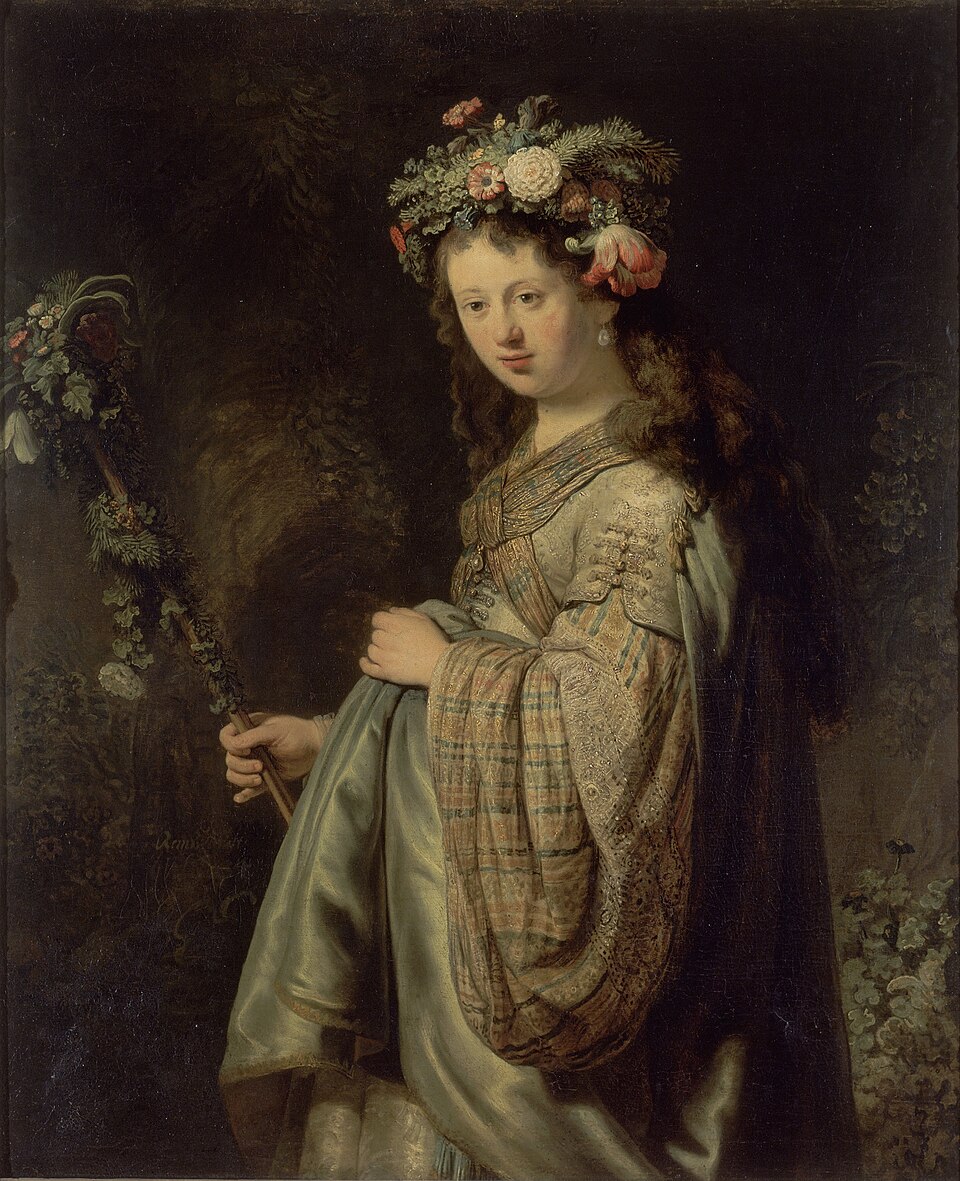
In the year of his marriage, Rembrandt crowned his young wife with flowers and turned her into the goddess of spring.
The story behind the painting
Rembrandt painted this Flora in Amsterdam in 1634, at a time when the young artist was enjoying early success. In June of that year he married Saskia van Uylenburgh, and he made several paintings of her in the guise of figures from ancient myth, in the spirit of his character portraits, or tronies. This one is thought to show Saskia as Flora, the Roman goddess of spring and flowers. Rembrandt's Floras may have drawn some inspiration from a Flora by Titian, then in the collection of Alfonso Lopez, the Spanish ambassador in Amsterdam. This is the Hermitage version, the first of several pictures Rembrandt would make on the theme.
What to look for
The canvas is life-size and quarter-length, about 125 by 101 centimetres. Saskia stands in a grotto, looking towards you. She is swathed in an extravagant, exotic costume of silk and satin with silver embroidery, with long hanging sleeves and a blue mantle. A large pearl hangs from her ear. Over her long hair sits a floral headdress; look for the multicoloured 'broken' tulip among the blooms. In her hand she carries a staff, also decorated with leaves and flowers. Below her right hand, find the signature and date: 'Rembrandt f (...) 34'.
Meaning and intent
Painting a beloved as a goddess was a way of honouring her and of stretching portraiture into myth. Here Saskia is not simply a bride in fine clothes but spring itself, wreathed and bearing a flowering staff, the newly married painter's homage set in a timeless grotto. Rembrandt returned to the idea again and again. He painted Saskia as Bellona in 1633 and as Minerva in 1635. A different Saskia as Flora of 1635 is in the National Gallery, London, now called Saskia van Uylenburgh in Arcadian Costume. After Saskia's death in 1642, a Flora of 1654 portrays Hendrickje Stoffels, though her features also resemble Saskia's.
Legacy
The painting's early history is unclear. In 1770 it was offered for sale in Amsterdam from the estate of Herman Aarentz, a bailiff and councillor in Deventer, and was 'bought in' by the auction house. It was later acquired by Catherine II, Empress of Russia, and entered the imperial collection at the Hermitage in St Petersburg before 1774. It has remained there ever since, apart from a few months in 2017 when it was loaned to the Hermitage branch in Amsterdam. In 1915 Cornelis Hofstede de Groot catalogued it and noted that it was sometimes wrongly called The Jewish Bride.
豆知識
- Painted in 1634, the year Rembrandt married Saskia (Wikipedia)
- About 125 × 101 cm; signed and dated 'Rembrandt f (...) 34' (Wikipedia)
- Acquired by Catherine II; in the Hermitage before 1774 (Wikipedia)
- A different Saskia as Flora (1635) is in the National Gallery, London (Wikipedia)
画家について
Rembrandt van Rijn (1606-1669)
女性 · オランダ黄金時代の絵画 · ロングヘア · ドレス · 直立姿勢 · エルミタージュ美術館 · portrait historié · イヤリング · フロラ · サスキア・ファン・オイレンブルフ
同じ画家の作品: Rembrandt van Rijn
 夜警 - Rembrandt van Rijn (1642)
 自画像 - Rembrandt van Rijn (1659)
 テュルプ博士の解剖学講義 - Rembrandt van Rijn (1632)
 ユダヤの花嫁 - Rembrandt van Rijn (1660s)
 ガラリアの海の嵐 - Rembrandt van Rijn (1633)
 放蕩息子の帰還 - Rembrandt van Rijn (1668)
 ダナエ - Rembrandt van Rijn (1636)
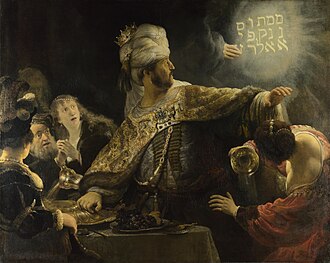 ベルシャザルの酒宴 - Rembrandt van Rijn (1636)
 真珠の耳飾りの少女
 牛乳を注ぐ女
 エマオの晩餐
 聖マタイの召命
 ラス・メニーナス
 ブレダの開城