Equestrian portrait of Francisco de Moncada
アンソニー・ヴァン・ダイク · 1630s
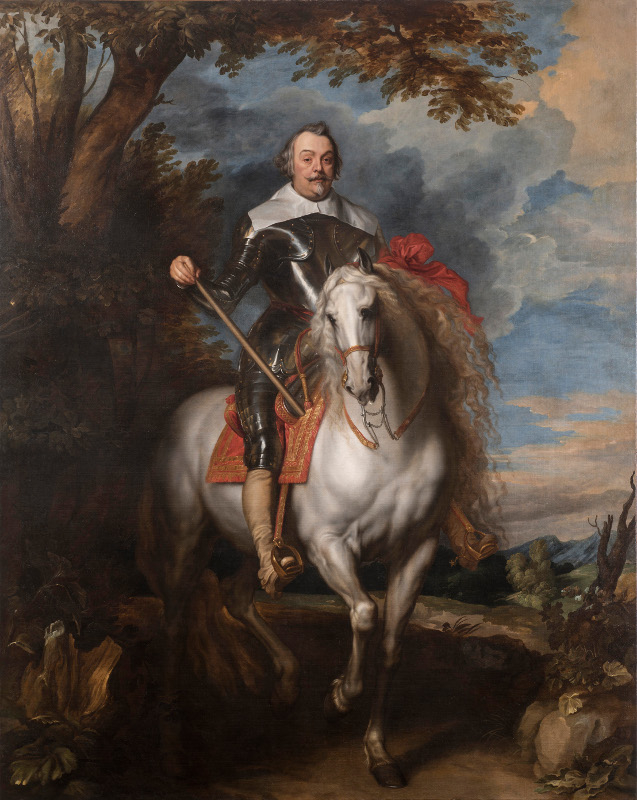
A nobleman in full armour rides calmly toward us, baton in hand, red sash stirring in the wind. Van Dyck painted not a victory but a quiet ride, and made it look like power.
The story behind the painting
The sitter is Francisco de Moncada, third Marquis of Aytona, born in Valencia in 1586 into an aristocratic family and trained in both letters and arms. He was a diplomat, writer and historian, soldier and governor: ambassador to Germany, envoy of the Infanta Isabel Clara Eugenia in Flanders, and governor general of the Netherlands. He died in the field at Goch in 1635 without returning to Spain. Van Dyck painted him in 1634; Wikidata dates the canvas only to the 1630s. The Louvre owns an identical version.
What to look for
Moncada faces us in full armour with a plain white collar spread over his shoulders. His right hand rests on the baton of command, while the hidden left hand holds the reins. Following the custom of Spanish captains, a red sash wraps his left arm and ripples as the horse trots. Light comes from the left, the dark background makes the figure stand out, and the foreshortened horse builds a convincing space. The canvas is about 305 by 240 cm.
Meaning and intent
His calm, unexpressive face suggests the serenity, prudence and control expected of a governor. The horse stands for nobility and military power, yet Van Dyck shows a peaceful ride rather than a victorious soldier. The scheme echoes Rubens's Equestrian Portrait of the Duke of Lerma, itself inspired by Titian's Charles V at Mühlberg, but Van Dyck leaves out the army Rubens painted in the background, stressing Moncada's peaceful stance. Moncada holds both moral authority and power.
Legacy
Where it was painted is unknown, but it is thought to have reached Valencia long ago. It belonged to Colonel Manuel Montesinos y Molina, and in 1941 his heirs ceded it to the Real Academia de Bellas Artes de San Carlos to be shown in the Museo de Bellas Artes de Valencia, where it hangs today. Through the Louvre's identical version, the same calm rider can be seen in two countries. The portrait also stands in a long line of equestrian images, from the ancient Marcus Aurelius to Donatello's Gattamelata, who also carries a baton with similar serenity.
豆知識
- Portrait of Francisco de Moncada, third Marquis of Aytona, governor of the Netherlands.
- Dated 1634 by Wikipedia, the 1630s by Wikidata.
- Composition recalls Rubens's portrait of the Duke of Lerma, without the army.
- In the Valencia museum since 1941.
画家について
アンソニー・ヴァン・ダイク (1599-1641)
肖像 · 男性 · ウマ · 馬術 · equestrian portrait · ピウス5世現代美術館
同じ画家の作品: アンソニー・ヴァン・ダイク
 チャールズ1世の三面肖像画 - Anthony van Dyck (1635)
 馬上のチャールズ1世とサン・アントワーヌの領主の肖像 - Anthony van Dyck (1636)
 狩猟場のチャールズ1世 - Anthony van Dyck (1635)
 向日葵のある自画像 - Anthony van Dyck (1632)
 ジョン・ステュアート卿と弟バーナード・ステュアート卿の肖像 - Anthony van Dyck (1638)
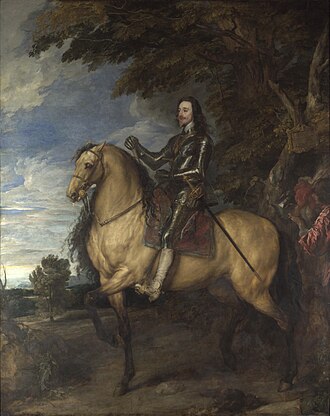 チャールズ1世騎馬像 - Anthony van Dyck (1637)
 キリストの磔刑 - Anthony van Dyck
 Saint Martin and the Beggar - Anthony van Dyck (1621)
関連する画家の作品
 エマオの晩餐 - Caravaggio (1601)
 聖マタイの召命 - Caravaggio (1609)
 ラス・メニーナス - Diego Velázquez (1656)
 ブレダの開城 - Diego Velázquez (1635)
 Saint Francis in Meditation - Francisco de Zurbarán (1639)
 The Immaculate Conception - Francisco de Zurbarán (1661)
 キリスト昇架 - Peter Paul Rubens (1609)
 レウキッポスの娘たちの略奪 - Peter Paul Rubens (1618)
 夜警 - Rembrandt van Rijn (1642)
 自画像 - Rembrandt van Rijn (1659)
 陽気な酒飲み - Frans Hals (1620s)
 微笑む騎士 - Frans Hals (1624)