ホメロスの胸像を見つめるアリストテレス
Rembrandt van Rijn · 1653
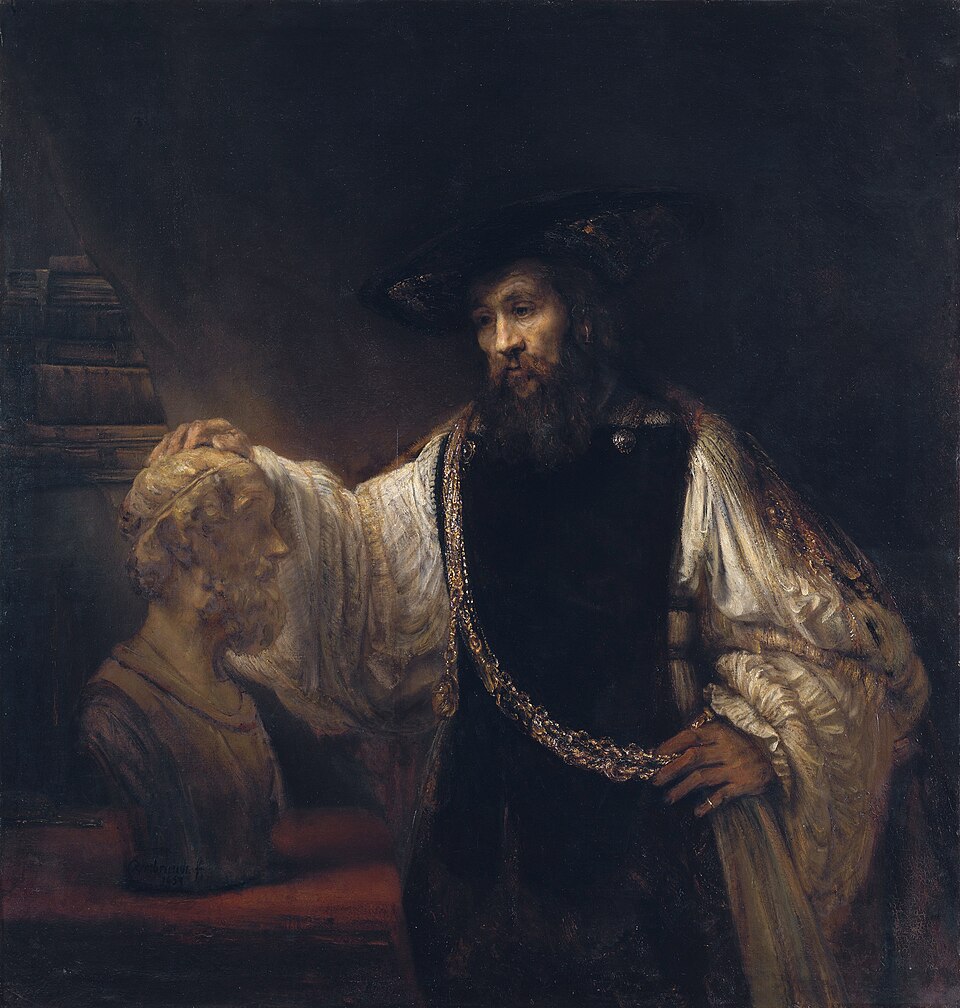
A philosopher in a golden chain rests his hand on the marble head of a blind poet, his own eyes lost in shadow. Rembrandt painted a man thinking, and nearly four centuries later we still wonder what he is thinking about.
The story behind the painting
In 1653 Rembrandt received an unusual commission from Don Antonio Ruffo, a Sicilian nobleman who did not ask for any particular subject. Ruffo had not seen what Rembrandt would make, yet he was already eager to hang it among the treasures of his collection. He planned companion pieces too, asking the Italian painter Guercino to supply one; Guercino chose a cosmographer, pairing Rembrandt's study of mankind with a study of the heavens, though that work later disappeared. About ten years after Aristotle, Rembrandt painted two more works for Ruffo: Homer Dictating his Verses and a now lost Alexander the Great. Because no subject was specified, the sitter's identity was long debated, with suggestions ranging from Virgil to the Dutch poet Hooft. In 1969 Julius Held argued convincingly that the man is Aristotle.
What to look for
The philosopher stands in a broad black hat and a voluminous robe whose sleeves glow with warm, creamy light. Across his chest hangs a heavy gold chain with a medallion, catching the light in thick touches of paint. His right hand rests on the white bust of Homer, while his left hangs lower, fingering the chain. Look at his eyes: shadows partly hide them, so we cannot read his feelings directly. Theodore Rousseau noted this in 1962, along with Rembrandt's varied brushstrokes and restrained colours, a palette mostly of blacks, golds and browns. The bust itself is cool and pale against the darkness, and the light seems to move between the two heads, the living thinker and the poet who lived long before him. Take time with the hands; they carry much of the story.
Meaning and intent
Julius Held read the painting as a meditation on values. Aristotle, world-weary, touches the bust of blind, humble Homer with his right hand, traditionally the favoured one, which is placed higher and painted in lighter tones than the left hand on the chain. The chain is understood as the gift of Alexander the Great, whom Aristotle tutored. So the picture weighs worldly success against lasting art: a famous, wealthy philosopher seeming to envy, or defer to, the poor poet whose verses outlived empires. Others see it as methodical science bowing to poetry, or as Rembrandt's reflection on the power of portraiture itself. Simon Schama even proposed that the figure is the painter Apelles. The ambiguity is part of the work's strength: it shows thought itself, which can never be fully seen from outside.
Legacy
After leaving Sicily, the painting passed through several collections. In 1815 it went to Sir Abraham Hume, who lent it to an exhibition at the British Institution in London; his descendants later sold it to Rodolphe Kann in Paris, and from there it passed to American collectors. In 1961 the Metropolitan Museum of Art in New York acquired it in a sale that drew worldwide attention and inspired the American artist Otis Kaye to paint his own critique of money in art, Heart of the Matter. During the renovation of the Met's Rembrandt galleries in 2013, the painting received its current title, Aristotle with a Bust of Homer. Today it remains one of the museum's most beloved works, a quiet image that invites every viewer to stand still and think.
豆知識
- The patron, Don Antonio Ruffo, did not specify any subject when he commissioned the painting.
- The sitter was once thought to be Virgil, Tasso, Ariosto or even the Dutch poet Hooft.
- Rembrandt later painted Homer Dictating his Verses for the same patron.
- The Metropolitan Museum gave the painting its current title in 2013.
画家について
Rembrandt van Rijn (1606-1669)
男性 · オランダ黄金時代の絵画 · メトロポリタン美術館 · 肖像 · portrait historié
同じ画家の作品: Rembrandt van Rijn
 夜警 - Rembrandt van Rijn (1642)
 自画像 - Rembrandt van Rijn (1659)
 テュルプ博士の解剖学講義 - Rembrandt van Rijn (1632)
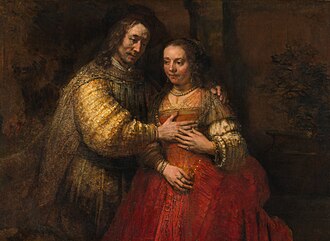 ユダヤの花嫁 - Rembrandt van Rijn (1660s)
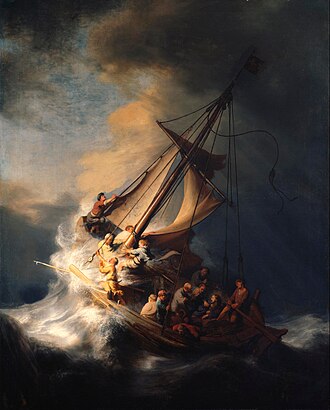 ガラリアの海の嵐 - Rembrandt van Rijn (1633)
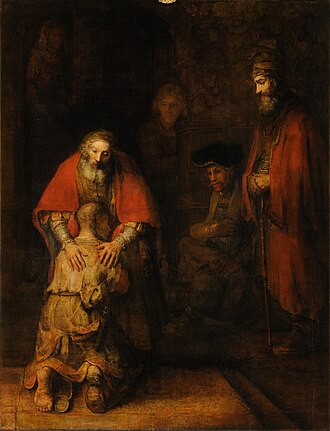 放蕩息子の帰還 - Rembrandt van Rijn (1668)
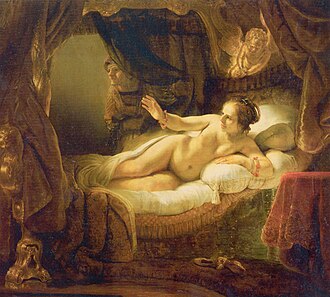 ダナエ - Rembrandt van Rijn (1636)
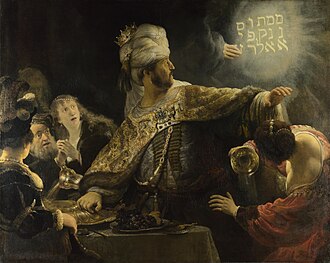 ベルシャザルの酒宴 - Rembrandt van Rijn (1636)
 真珠の耳飾りの少女
 牛乳を注ぐ女
 エマオの晩餐
 聖マタイの召命
 ラス・メニーナス
 ブレダの開城