Johannes Vermeer
1632-1675
Johannes Vermeer spent his whole life in Delft, painting quiet rooms washed in pearly light from a window on the left. Forgotten for two centuries after his death, the man once called the Sphinx of Delft is now counted among the greatest painters of the Dutch Golden Age.
Origins
Johannes Vermeer was baptised in the Reformed Church in Delft on 31 October 1632. His mother, Digna Baltens, came from Antwerp, and his father, Reijnier Janszoon, also born in Antwerp, had trained in Amsterdam as a silk weaver before settling in Delft. Reijnier began dealing in paintings, joined the Guild of Saint Luke as a master art dealer in 1631, and ran an inn, later a larger one on the market square named after the Flemish town Mechelen. Around 1640 he took the surname Vermeer. Johannes appears in official papers as Johannes van der Meer, but usually signed his paintings Johannes Vermeer. When his father died in October 1652, he took over the family art business.
Life and turning points
In April 1653 he married Catharina Bolnes, a Catholic. Her mother, Maria Thins, was wealthier and at first opposed the match, and Vermeer probably converted to Catholicism before the wedding; the painter Leonaert Bramer spoke up for him. The couple later lived in her spacious house on the Oude Langendijk, where Vermeer painted in a front room on the second floor for the rest of his life. Catharina bore 15 children. In December 1653 he joined the Guild of Saint Luke, and he was elected its head in 1662, 1663, 1670 and 1671. Where he trained is unknown; links to Carel Fabritius or Abraham Bloemaert remain speculation. The French invasion of 1672, the disaster year, ruined the art market. He died after a short illness on 15 December 1675, aged 43, leaving his wife in debt.
Style and technique
Vermeer worked slowly and with great care, probably producing about three paintings a year, and is renowned for his masterful use of light. His pictures are mostly domestic interiors with one or two figures lit by a window on the left, marked by balance, spatial order and a pearly light that lends everyday tasks a poetic timelessness. No other 17th century artist used the costly pigment ultramarine, made from lapis lazuli, so lavishly or so early in a career. He even laid it beneath other colours: in The Girl with the Wine Glass, blue underpaint makes the red dress look cool and crisp. Only about 20 pigments have been found in his work. No drawings have been firmly attributed to him, so his preparatory methods remain largely a mystery.
Stories and anecdotes
In 1663 the traveller Balthasar de Monconys came to see his work, but Vermeer had no paintings to show, so the visitors were sent to a baker, Hendrick van Buyten, who held a couple of them as collateral. In a petition after his death, Catharina wrote that during the war with France he could sell none of his art and, in a day and a half, went from being healthy to being dead. The microscopist Antonie van Leeuwenhoek was appointed trustee of the estate. Whether Vermeer used a camera obscura or mirrors has long been argued, by David Hockney, Philip Steadman and Tim Jenison among others. The theory remains disputed: there is no historical evidence of his interest in optics, and the inventory of his belongings lists no lens or camera obscura.
Legacy
In his lifetime Vermeer was a moderately successful genre painter, known in Delft and The Hague, and he earned his living mainly as an art dealer. A local patron bought much of his output, which kept him afloat but kept his fame from spreading. After his death he was barely mentioned in Arnold Houbraken's 1718 survey of Dutch painters, and was left out of later surveys for nearly two centuries, with some of his works credited to Metsu or Mieris. In the 19th century Gustav Friedrich Waagen and Theophile Thore-Burger rediscovered him; Thore-Burger attributed 66 works to him, though only 34 are universally accepted today. Since then his reputation has grown enormously, and his small, luminous rooms continue to hold viewers still.
Lo sapevi?
- Only three of his paintings are dated by the artist: The Procuress, The Astronomer and The Geographer.
- He painted just two cityscapes, View of Delft and The Little Street.
- In 1654 a gunpowder explosion known as the Delft Thunderclap destroyed a large part of the city.
- He never had pupils, though one scholar has suggested he taught his eldest daughter Maria to paint.
Dutch Golden Age painting · Baroque
Artisti collegati
Rembrandt van Rijn · Jan Steen · Frans Hals · Jacob van Ruisdael · Pieter de Hooch
Dipinti di Johannes Vermeer
 Girl with a Pearl Earring - Johannes Vermeer (1665)
 The Milkmaid - Johannes Vermeer (c. 1658)
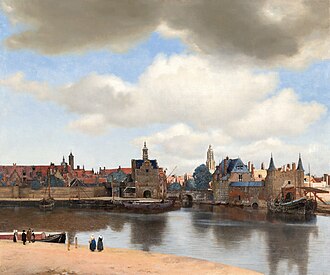 Veduta di Delft - Johannes Vermeer (1660s)
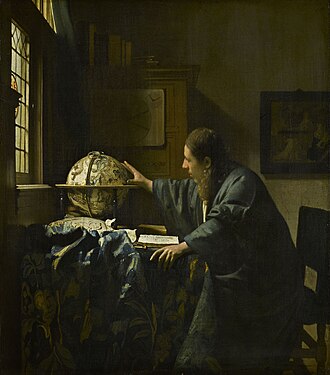 The Astronomer - Johannes Vermeer (1664)
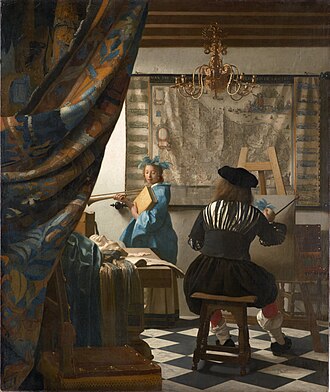 L'arte della pittura - Johannes Vermeer (1660s)
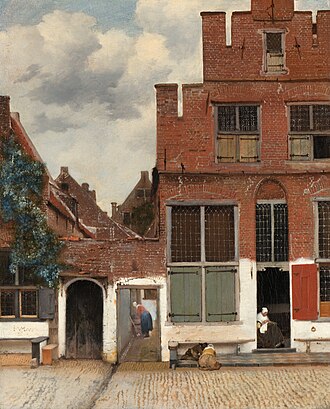 La stradina - Johannes Vermeer (1658)
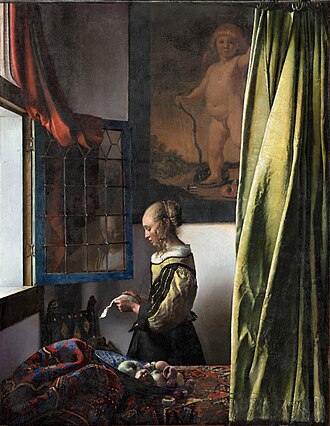 Girl Reading a Letter at an Open Window - Johannes Vermeer (1650s)
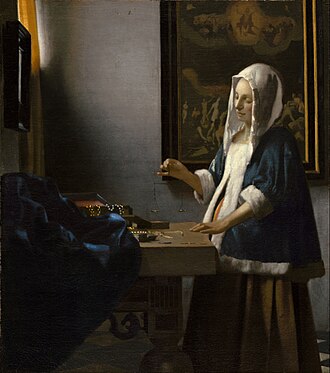 Donna con bilancia - Johannes Vermeer (1665)
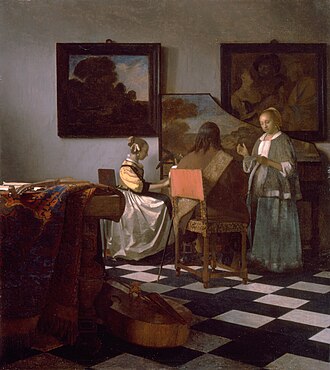 Il Concerto - Johannes Vermeer (1663)
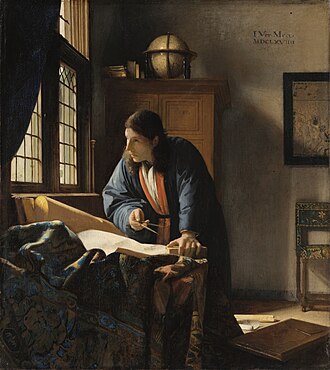 Il geografo - Johannes Vermeer (1668)
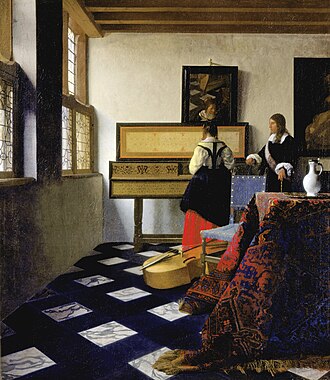 The Music Lesson - Johannes Vermeer (1662)
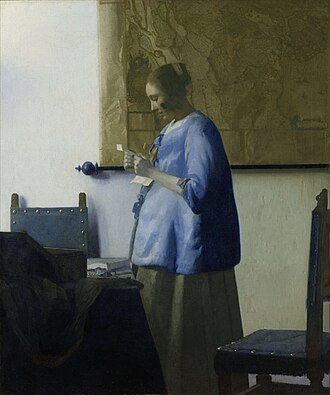 Donna in blu che legge una lettera - Johannes Vermeer (1664)
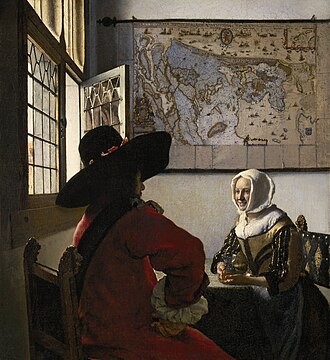 Officer and Laughing Girl - Johannes Vermeer (1658)
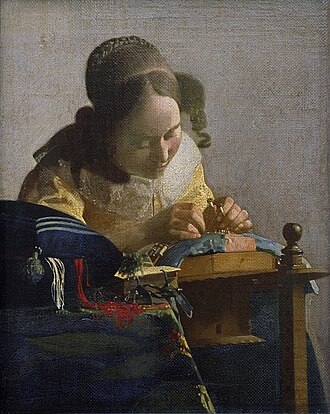 The Lacemaker - Johannes Vermeer (1669)
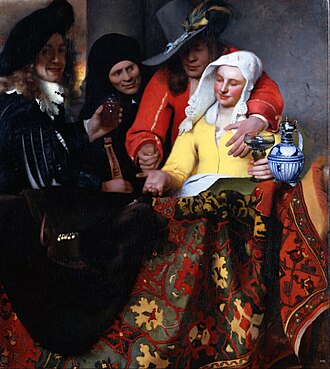 The Procuress - Johannes Vermeer (1656)
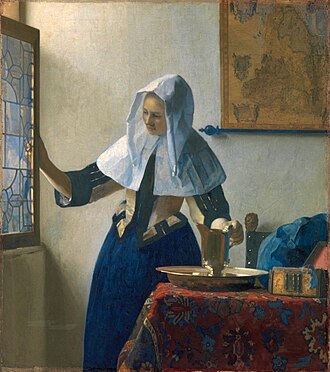 Woman with a Water Jug - Johannes Vermeer (1660)
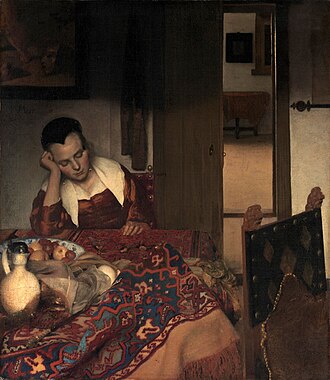 A Girl Asleep - Johannes Vermeer (1657)
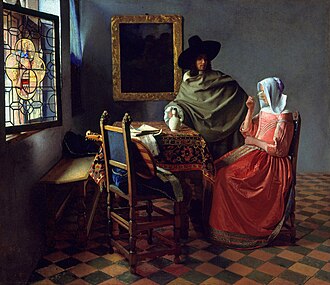 The Wine Glass - Johannes Vermeer (1650s)
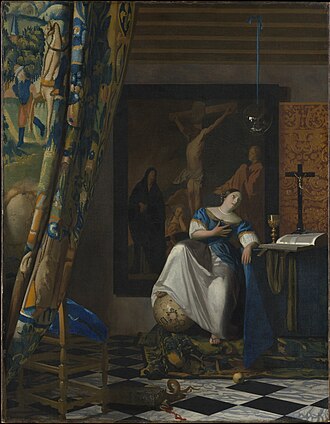 Allegory of the Catholic Faith - Johannes Vermeer (1670s)
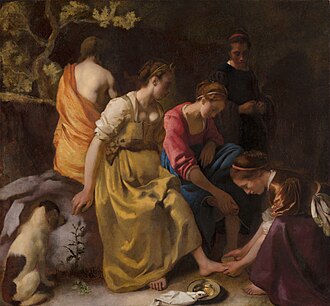 Diana and her Nymphs - Johannes Vermeer (1650s)
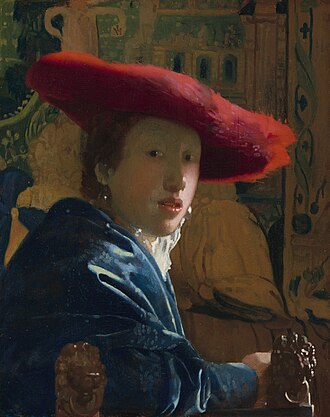 Girl with a Red Hat - Johannes Vermeer (1669)
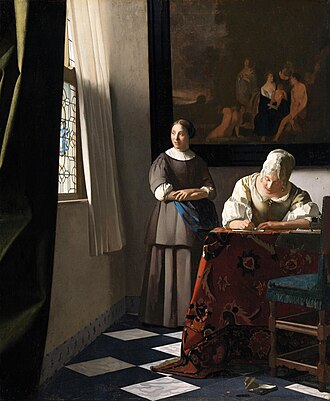 Lady Writing a Letter with her Maid - Johannes Vermeer (1670)
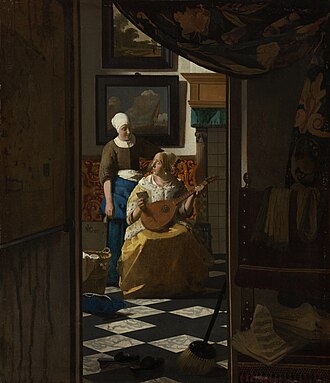 The Love Letter - Johannes Vermeer (1668)
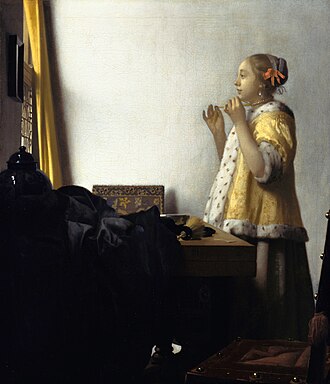 Woman with a Pearl Necklace - Johannes Vermeer (1664)
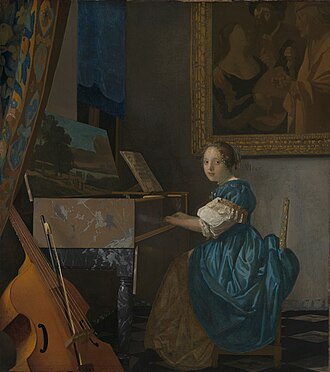 A Young Woman seated at a Virginal - Johannes Vermeer (1670s)
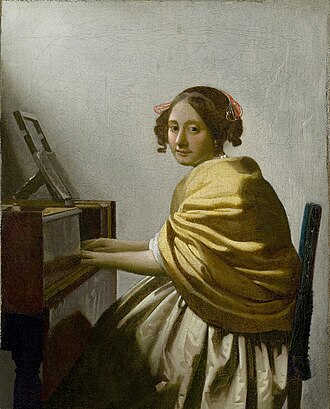 A Young Woman Seated at the Virginals - Johannes Vermeer (1670)
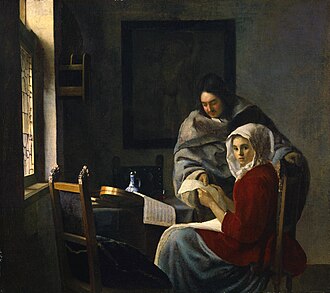 Girl Interrupted at her Music - Johannes Vermeer (1660)
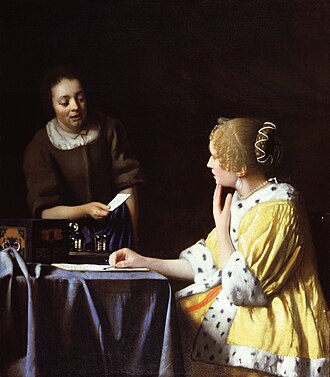 Mistress and Maid - Johannes Vermeer (1666)
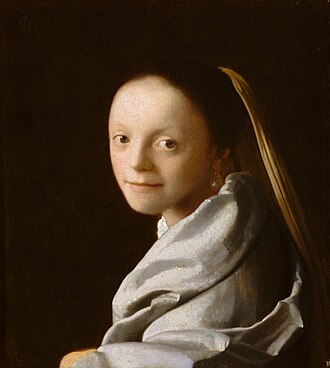 Portrait of a Young Woman - Johannes Vermeer (1665)
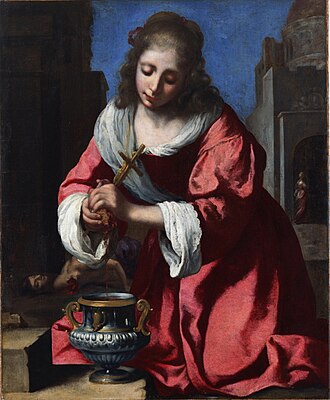 Saint Praxedis - Johannes Vermeer (1655)
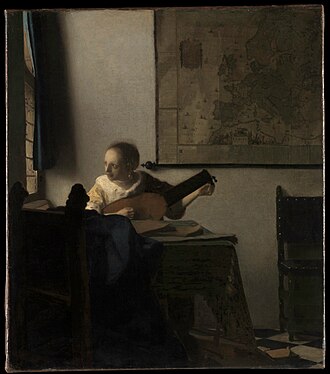 Woman with a Lute - Johannes Vermeer (1662)
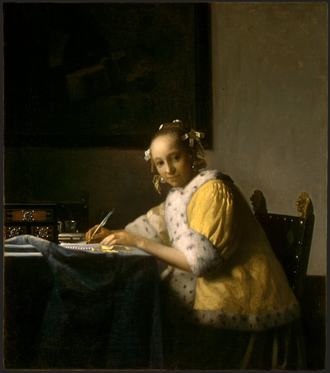 A Lady Writing a Letter - Johannes Vermeer (1660s)
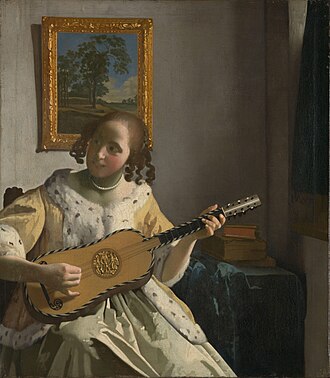 The Guitar Player - Johannes Vermeer (1672)