Girl Reading a Letter at an Open Window
Johannes Vermeer · 1650s
.jpg)
A young woman stands at an open window, lost in a letter, while light falls across her face. For centuries a hidden Cupid watched over her from the wall, and only recently has he been allowed to return.
The story behind the painting
Johannes Vermeer completed this painting in approximately 1657 to 1659, in the middle of the Dutch Golden Age. Its later life proved almost as dramatic as its subject is quiet. In 1742 Augustus III of Poland, Elector of Saxony, bought it for Dresden believing it was a Rembrandt. In 1826 it was credited instead to Pieter de Hooch. It was the French critic Théophile Thoré-Bürger who recognised it as one of the rare works of Vermeer; Wikipedia gives the restored attribution as 1860 in one passage and 1880 in another, so the exact year is uncertain. The painting survived the bombing of Dresden in World War II stored in a tunnel in Saxony, was taken by the Red Army, and came back to Dresden after the Soviets decided in 1955 to return the collection.
What to look for
Begin with the girl herself: fair-haired, seen in profile, standing at the open window and holding her letter. Now find the window glass, opened inward. In its lower right corner you can catch her reflection. A red drapery hangs over the top of the window, and in the right foreground a tasselled ochre curtain, partly drawn, hides a quarter of the room. Between you and her lies a table covered in red, with a bowl of fruit tipped forward and a peach cut in half to show its pit. Look closely at the brightest areas, the fruit and her blond hair, for tiny white globules of paint. And on the wall behind her, since the restoration, a painting of Cupid hangs once more.
Meaning and intent
For nearly three hundred years the wall behind the girl was bare. X-rays revealed an image beneath, and in 2017 conservator Christoph Schölzel found that the varnish over that area was applied after Vermeer died. Between 2018 and 2021 the Dresden collections removed the overpainting with scalpel and microscope. The returned Cupid, resembling a painting by Cesar van Everdingen from Vermeer's own collection, suggests the letter is a love letter. Writing before the restoration, Norbert Schneider read the open window as the woman's longing to reach beyond her home, and the fruit as a symbol of extramarital relations. Stephan Koja, director of the Old Masters Picture Gallery, sees instead a statement about the essence of true love.
Legacy
This canvas and Officer and Laughing Girl are the earliest known examples of the pointillé technique for which Vermeer became known, small dots of light that have fed speculation about his possible use of an optical device such as a camera obscura. It was also the last picture in which he placed a rug-covered table between the figure and the viewer. A 1968 study by Hermann Kühn found ordinary baroque pigments: azurite and lead-tin-yellow in the green curtain, vermilion and madder lake in the reds. The work has inspired others, including photographer Tom Hunter. Held in Dresden since 1742, it now hangs at the Gemäldegalerie there exactly as Vermeer painted it, Cupid and all.
Lo sapevi?
- Completed around 1657-1659; held in Dresden since 1742
- Once attributed to Rembrandt, then to Pieter de Hooch
- Restored 2018-2021 to reveal a painting of Cupid on the back wall
- 83 × 64.5 cm (Wikidata)
L'artista
Johannes Vermeer (1632-1675)
genre art · Dutch Golden Age painting · girl · Cupid · window · Staatliche Kunstsammlungen Dresden · letter
Altre opere di Johannes Vermeer
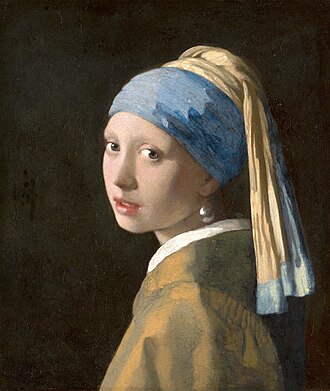 Girl with a Pearl Earring - Johannes Vermeer (1665)
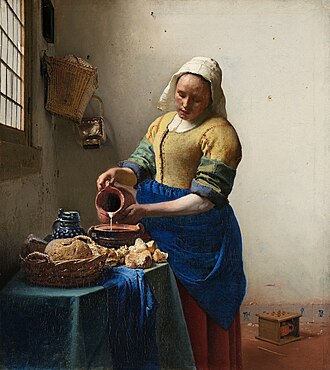 The Milkmaid - Johannes Vermeer (c. 1658)
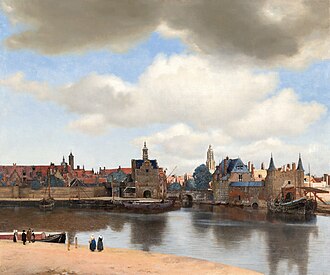 Veduta di Delft - Johannes Vermeer (1660s)
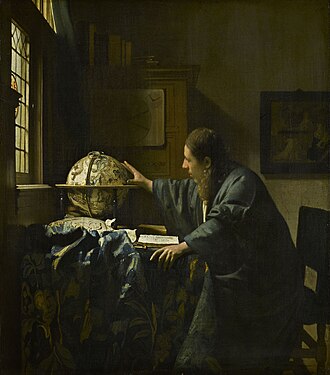 The Astronomer - Johannes Vermeer (1664)
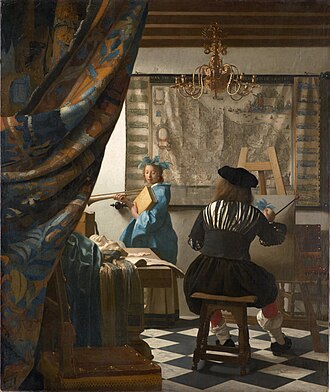 L'arte della pittura - Johannes Vermeer (1660s)
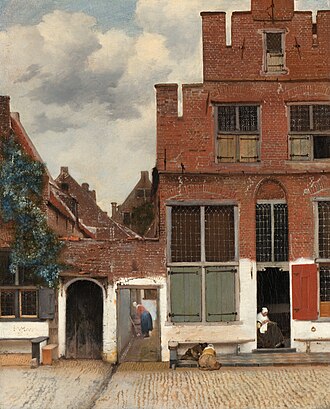 La stradina - Johannes Vermeer (1658)
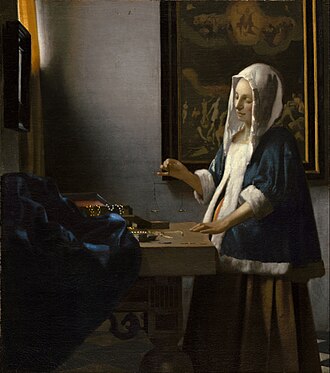 Donna con bilancia - Johannes Vermeer (1665)
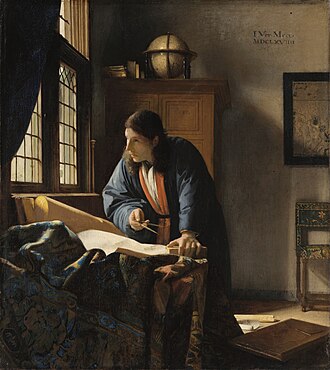 Il geografo - Johannes Vermeer (1668)
Dipinti di artisti collegati
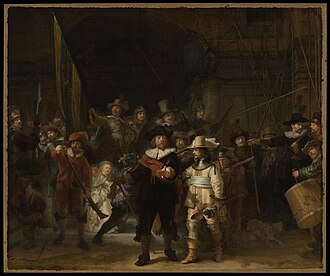 The Night Watch - Rembrandt van Rijn (1642)
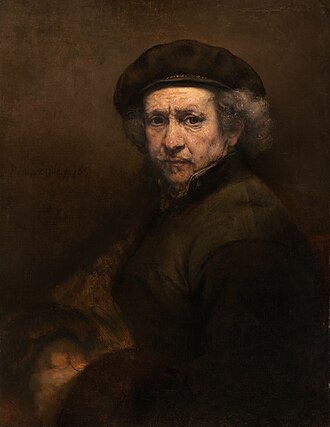 Self-Portrait - Rembrandt van Rijn (1659)
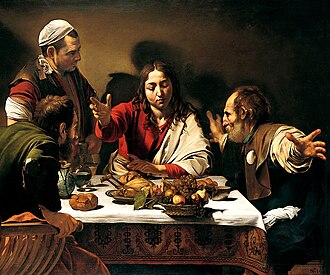 Supper at Emmaus - Caravaggio (1601)
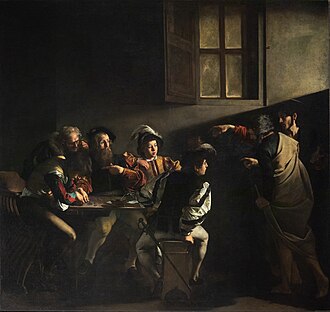 La vocazione di San Matteo - Caravaggio (1609)
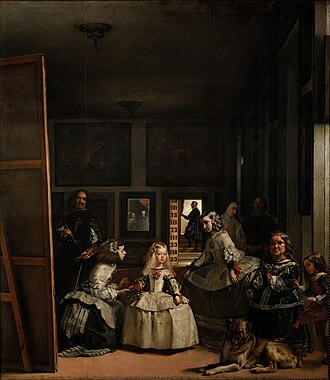 Las Meninas - Diego Velázquez (1656)
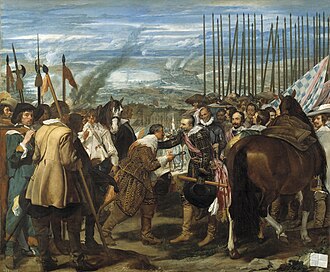 The Surrender of Brea - Diego Velázquez (1635)