Jacob van Ruisdael
1628-1682
Jacob van Ruisdael is generally seen as the greatest landscape painter of the Dutch Golden Age. Dunes, forests, waterfalls and vast skies filled with cloud made his name, and his windmill still ranks among the Rijksmuseum's best-loved pictures.
Origins
Jacob Isaackszoon van Ruisdael was born in Haarlem in 1628 or 1629 into a family of landscape painters. His grandfather, the furniture maker Jacob de Goyer, came from Blaricum, where a now lost castle bore the name Ruisdael; when de Goyer moved to Naarden, three of his sons took the name, probably to show their origin. Two of them became painters: Jacob's father Isaack and his well-known uncle Salomon van Ruysdael. Jacob always spelled his name with an i. It is not known whether his mother was Isaack's first wife, whose name is unknown, or his second, Maycken Cornelisdochter. His teacher is also unknown; there is no evidence he studied with his father or uncle, but Haarlem painters like Cornelis Vroom and Allart van Everdingen clearly influenced him.
Life and turning points
The earliest date on a Ruisdael painting and etching is 1646, and two years later he joined the Haarlem Guild of Saint Luke. Around 1657 he moved to Amsterdam, a prosperous city with a bigger market, and lived and worked there for the rest of his life. He travelled relatively little: to Blaricum, Egmond aan Zee and Rhenen in the 1640s, to Bentheim and Steinfurt in Germany with Nicolaes Berchem in 1650, and possibly to Germany again in 1661. He never married; his first biographer, Arnold Houbraken, said it was to serve his old father. He died in Amsterdam on 10 March 1682 and was buried in Saint Bavo's Church in Haarlem.
Style and technique
Ruisdael's early Haarlem work shows simple motifs and patient study of nature: dunes, woods and changing light. By using heavier paint than his predecessors, he gave foliage a rich, living quality, and his trees are the first whose types modern botanists can clearly recognise. After his German trip his landscapes became more heroic, with larger forms. He painted Bentheim Castle about a dozen times, raising its low hill into a wooded mountain, and was the first artist to make water mills a main subject. Later he added city panoramas and seascapes, often with the sky filling two-thirds of the canvas. Of the thirteen landscape themes one scholar identified in Dutch art, his work covers all but two.
Stories and anecdotes
Ruisdael painted more than 150 Scandinavian waterfall scenes, yet there is no record that he ever went to Scandinavia; they were based on earlier art, notably van Everdingen's, which they soon outstripped. Houbraken wrote that he studied medicine and practised surgery, and a crossed-out Jacobus Ruijsdael appears on a list of Amsterdam doctors, but many historians think this was a cousin, and the evidence is inconclusive. A myth that he died poor in a Haarlem almshouse was disproved: that was his cousin Jacob Salomonszoon. In fact he lived comfortably, and his paintings sold for about twice the average of the time.
Legacy
Ruisdael's work was in demand in his lifetime, and today the National Gallery in London, the Rijksmuseum and the Hermitage hold the largest collections. He shaped landscape painting worldwide, from the English Romantics to the Barbizon school in France and the Hudson River School in the United States. His Windmill at Wijk bij Duurstede of 1670, uniting low land, water and wide sky around a single windmill, ranks third in Rijksmuseum card sales after The Night Watch and View of Delft. His only registered pupil, Meindert Hobbema, became a fine landscapist too. In his skies and trees one still feels the weather moving over the Dutch land.
Lo sapevi?
- No likeness of Ruisdael is known to exist.
- All thirteen of his known etchings come from his early period.
- Seymour Slive's 2001 catalogue attributes 694 paintings to him.
- Figures in his later landscapes were often painted by other artists, including Hobbema and Adriaen van de Velde.
Artisti collegati
Rembrandt van Rijn · Johannes Vermeer · Jan Steen · Frans Hals · Pieter de Hooch
Dipinti di Jacob van Ruisdael
 The Windmill at Wijk bij Duurstede - Jacob van Ruisdael (1670)
 The Jewish Cemetery - Jacob van Ruisdael (1650s)
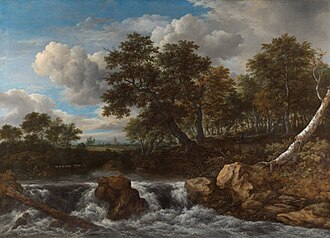 Landscape with Waterfall - Jacob van Ruisdael (1668)
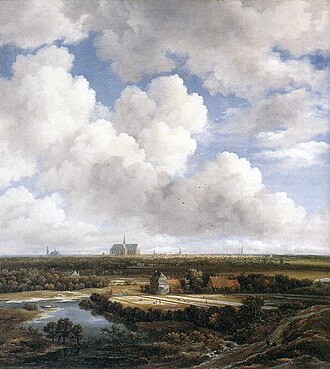 View of Haarlem with Bleaching Fields - Jacob van Ruisdael (1670)
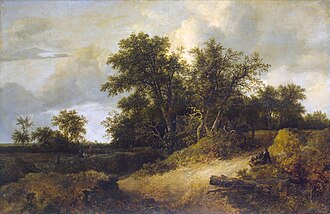 Peasant Cottage in a Landscape - Jacob van Ruisdael (1646)
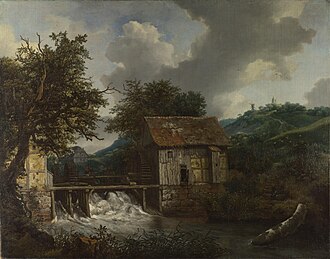 Two Watermills and an Open Sluice near Singraven - Jacob van Ruisdael (1650)
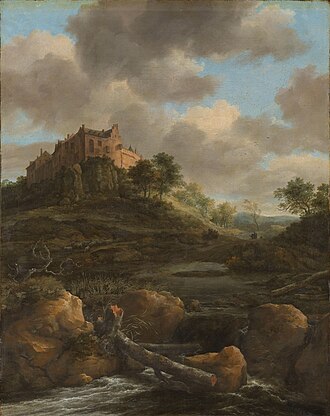 Bentheim Castle - Jacob van Ruisdael (1650s)
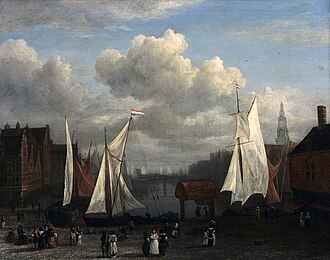 The Damrak in Amsterdam - Jacob van Ruisdael (1670)
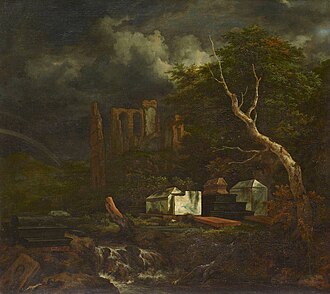 The Jewish Cemetery - Jacob van Ruisdael (1653)
View of Egmond aan Zee - Jacob van Ruisdael (1650)
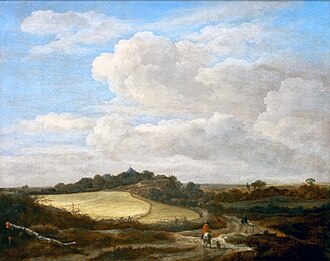 Hilly wheat field - Jacob van Ruisdael (1660)