Mistress and Maid
Johannes Vermeer · 1666
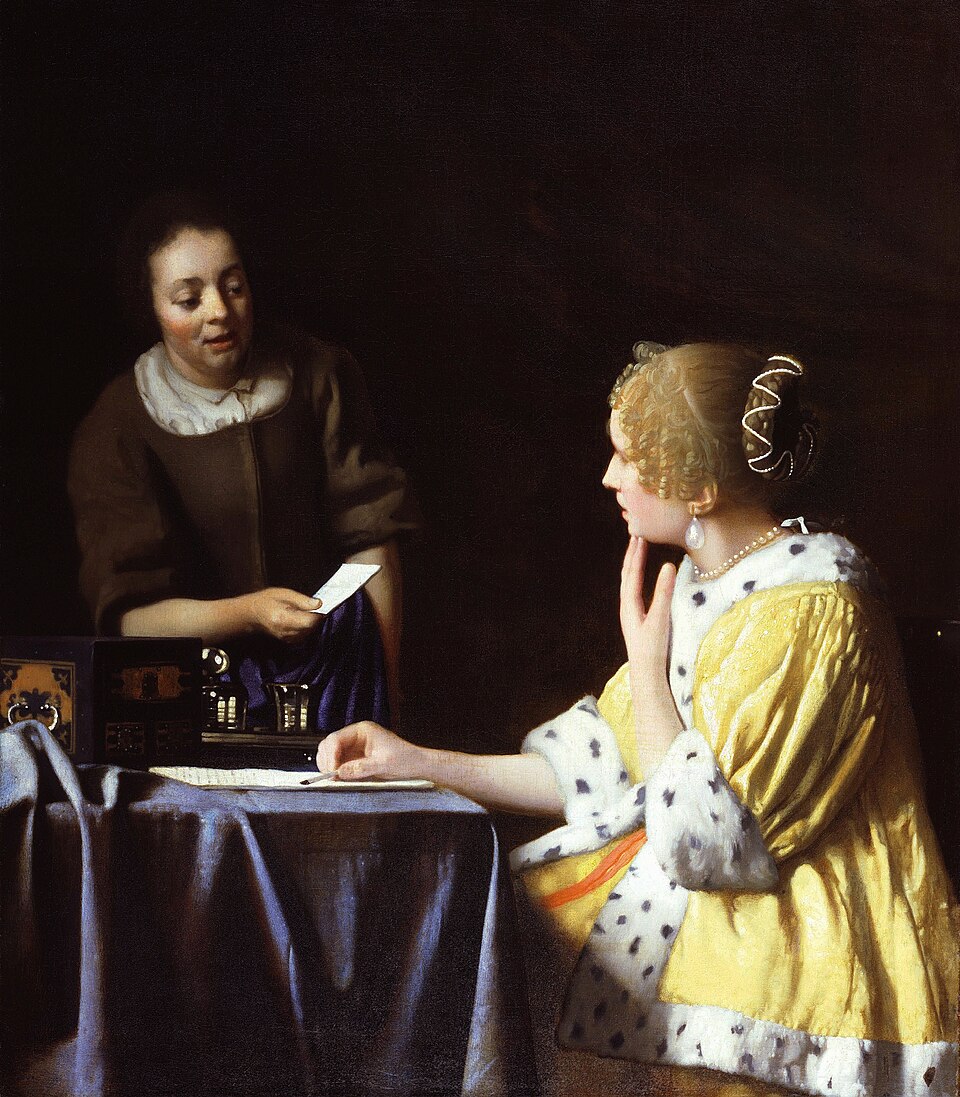
A letter arrives, and a lady lifts her fingertips to her chin, lips slightly parted, wondering. Her maid leans in from the dark. Vermeer leaves us, like them, waiting to learn what the letter says.
The story behind the painting
Vermeer painted Mistress and Maid around 1666 to 1667 in Delft, the city where he lived and worked all his life. Wikipedia gives c. 1667 and also 1666 to 1667, while Wikidata gives 1666. He worked slowly, two or three paintings a year, and only about 35 of his works are known today. Letters were a recurring theme of his paintings in the 1660s. In earlier works such as Woman in Blue Reading a Letter, a woman is alone with her letter; here a second figure, the maid, enters the scene, which was something new.
What to look for
The mistress sits at a table in a yellow, fur-trimmed jacket, with pearls at her ears and neck, signs of status at the time. The yellow is laid down in sweeping strokes of lead-tin yellow, with clearly defined shadows. Blue returns in the silk tablecloth and the maid's apron. Light comes from the left and falls on the mistress's face; her gaze is pensive, her fingertips raised to her chin as if asking a question. Behind them, Vermeer used a dark background, as he did in Girl with a Pearl Earring, so the two women stand out with nothing to distract us.
Meaning and intent
The painting shows an everyday moment, a letter handed over at a desk, but the gestures and expressions of the two women suggest anxiety about what it may contain. Vermeer gives no answer. We do not see the words, only the pause before reading or right after, and the two faces reacting. It is a typical Vermeer subject, a woman in a quiet domestic interior, with his favourite pairing of yellow and blue, but the dialogue between mistress and servant gives it a tension his single figures rarely have.
Legacy
Mistress and Maid is now in the Frick Collection in New York, which also holds Vermeer's Officer and Laughing Girl and Girl Interrupted at Her Music. Wikipedia notes that the painting is well preserved. Vermeer died in 1675 at the age of 43, in debt, partly because his slow pace kept him from wealth during his lifetime. Today his small body of work is treasured, and this canvas, with its unanswered letter, remains one of the clearest examples of his love of yellow, blue and women caught in a single private moment.
Lo sapevi?
- Painted around 1666 to 1667 in Delft.
- One of only about 35 known paintings by Vermeer.
- The maid is a new element in his letter paintings.
- In the Frick Collection, New York.
L'artista
Johannes Vermeer (1632-1675)
woman · genre art · Dutch Golden Age painting · The Frick Collection · domestic worker
Altre opere di Johannes Vermeer
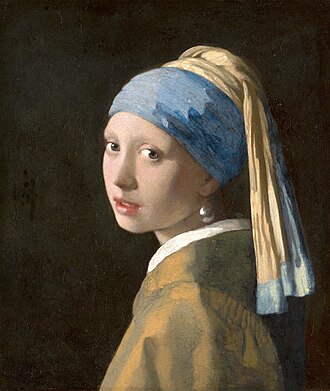 Girl with a Pearl Earring - Johannes Vermeer (1665)
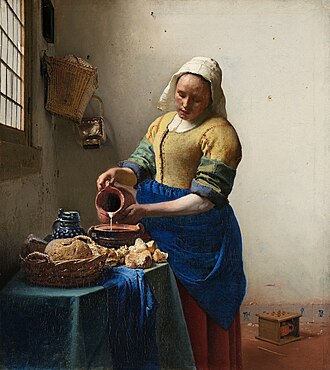 The Milkmaid - Johannes Vermeer (c. 1658)
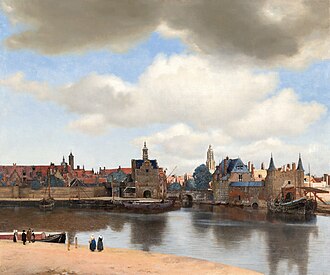 Veduta di Delft - Johannes Vermeer (1660s)
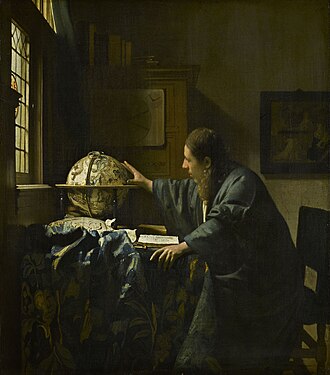 The Astronomer - Johannes Vermeer (1664)
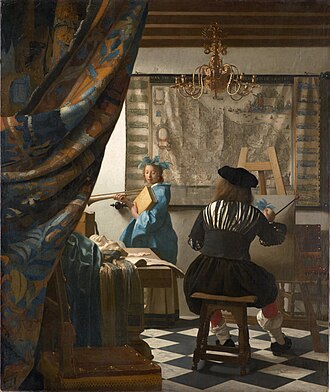 L'arte della pittura - Johannes Vermeer (1660s)
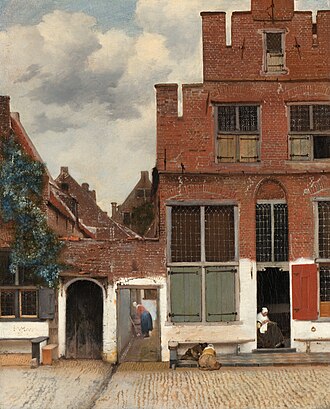 La stradina - Johannes Vermeer (1658)
.jpg) Girl Reading a Letter at an Open Window - Johannes Vermeer (1650s)
Girl Reading a Letter at an Open Window - Johannes Vermeer (1650s)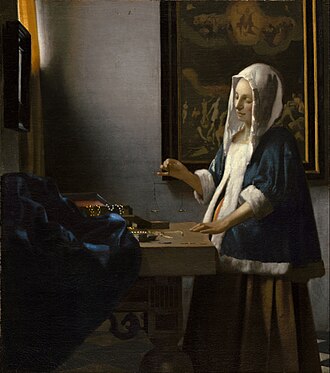 Donna con bilancia - Johannes Vermeer (1665)
Dipinti di artisti collegati
 The Night Watch - Rembrandt van Rijn (1642)
 Self-Portrait - Rembrandt van Rijn (1659)