L'arte della pittura
Johannes Vermeer · 1660s
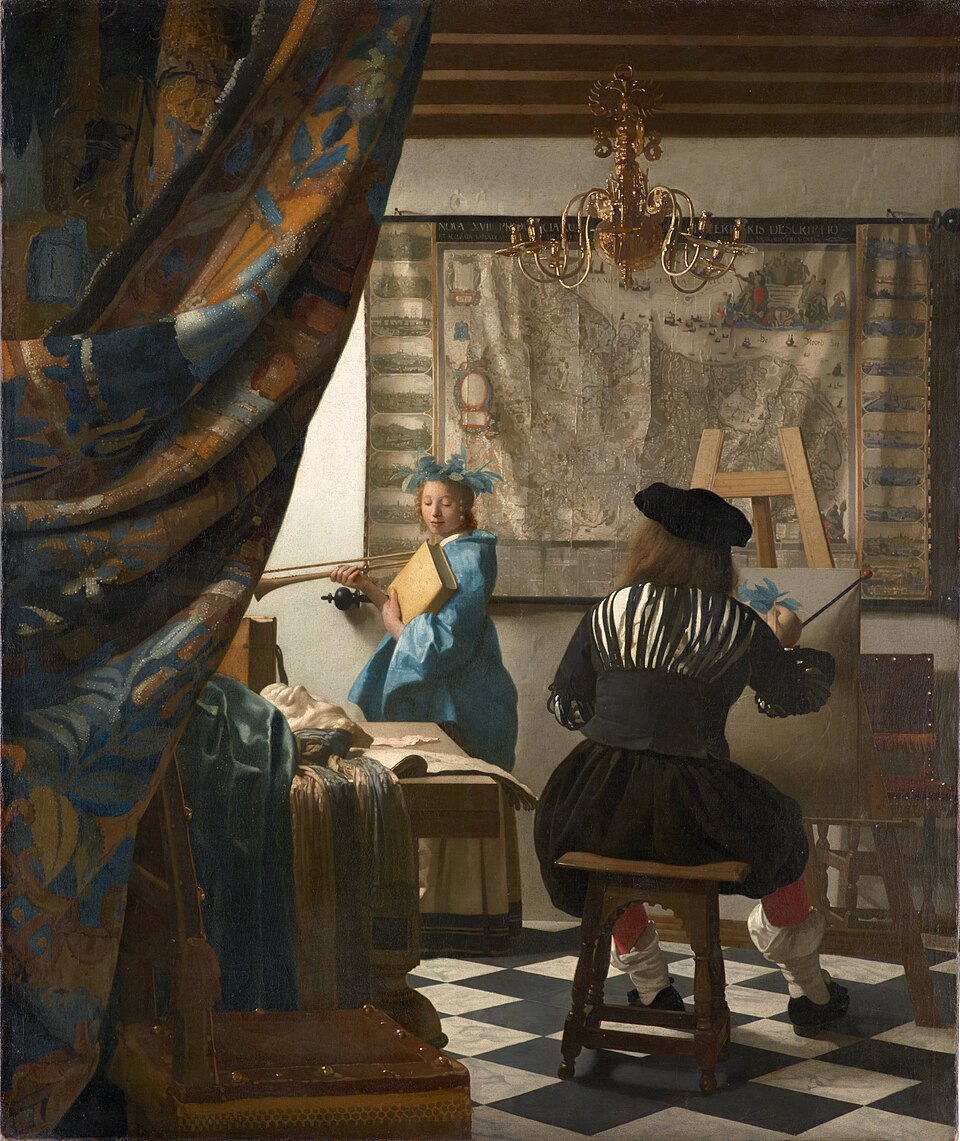
A heavy curtain is pulled aside, and we are let into a painter's studio at the very moment he begins. Vermeer kept this picture all his life and never sold it.
The story behind the painting
The Art of Painting, also called The Allegory of Painting or Painter in his Studio, is Johannes Vermeer's most complex work and, after Christ in the House of Martha and Mary and The Procuress, his largest. It is signed but undated; most experts place it around 1665 to 1668, though some suggest as late as 1670 to 1675. One clue to its purpose: in 1663 the traveller Balthasar de Monconys visited Vermeer, who had no painting to show him. The canvas was possibly made to keep an outstanding specimen of his art in the studio. Vermeer clearly prized it, for he never sold it during his lifetime. Svetlana Alpers called it a kind of summary and assessment of what had been done, and Walter Liedtke saw it as a virtuoso display staged in an imaginary version of his studio.
What to look for
A tapestry pulled back on the left and a chair in front act as repoussoirs, drawing us inward. Beyond them, a painter in an elegant black garment, slashed to show the shirt beneath, with short puffy breeches and orange stockings, sits at his easel, where the sketch of a crown has begun. By the window stands a woman in blue, eyes lowered. Behind her hangs a large map of the Seventeen Provinces, flanked by views of Dutch cities, published by Claes Janszoon Visscher in 1636 and remarkable for its play of light. Look up: the ceiling is visible, and a golden chandelier hangs above a marble tiled floor, both proof of Vermeer's command of perspective. On the table lie a plaster mask, cloth, a folio and leather, each catching or absorbing light in its own way.
Meaning and intent
Many art historians read the picture as an allegory of painting. The model, with her laurel wreath, trumpet and book, matches Cesare Ripa's description of Clio, the Muse of History, in his emblem book Iconologia, though Ripa says History should look back, not down as she does here. Another reading, drawing on Gerard de Lairesse, sees history and poetry as the painter's main resources: the woman as poetry, recalling the ancient saying that painting is silent poetry, and the map as history. Other objects carry hints too. The plaster mask may refer to the paragone, the debate over the rival merits of the arts, and the double-headed eagle that may adorn the chandelier, symbol of the Habsburgs, could stand for the former rulers of the Low Countries.
Legacy
Admiration for the painting is long-standing. In 1868 Théophile Thoré-Bürger, the critic known for rediscovering Vermeer, judged it his most interesting work. Albert Blankert wrote that no other painting so flawlessly integrates naturalistic technique, brightly illuminated space and a complex composition. In the twentieth century it was among the works earmarked for the planned Führermuseum. Today it is owned by the Austrian Republic and displayed in the Kunsthistorisches Museum in Vienna, where its 120 by 100 centimetre canvas draws visitors into that imagined studio. It matters because it is Vermeer thinking aloud about his own art: about light, illusion, fame and history, gathered in one quiet room where a painter, seen from behind, keeps his face hidden from us.
Lo sapevi?
- Vermeer never sold this painting during his lifetime.
- The wall map was published by Claes Janszoon Visscher in 1636.
- It is signed to the right of the model, but not dated.
- The painter, seen from behind, was long thought to be a self-portrait.
L'artista
Johannes Vermeer (1632-1675)
genre art · Dutch Golden Age painting · Kunsthistorisches Museum · painter
Altre opere di Johannes Vermeer
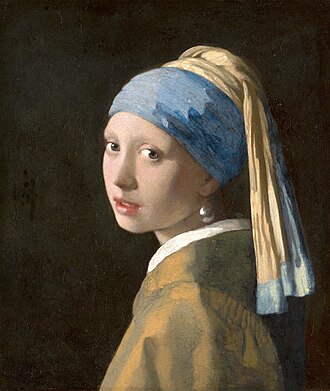 Girl with a Pearl Earring - Johannes Vermeer (1665)
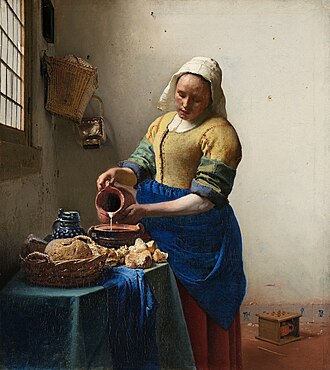 The Milkmaid - Johannes Vermeer (c. 1658)
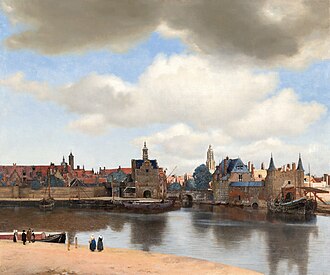 Veduta di Delft - Johannes Vermeer (1660s)
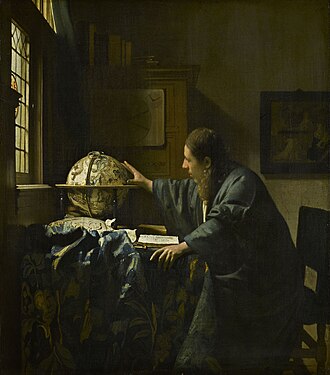 The Astronomer - Johannes Vermeer (1664)
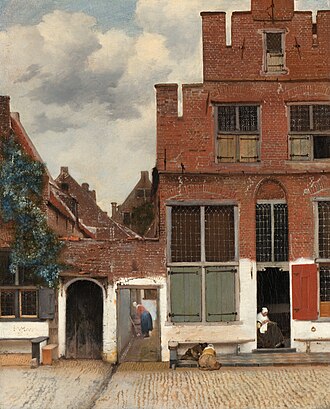 La stradina - Johannes Vermeer (1658)
.jpg) Girl Reading a Letter at an Open Window - Johannes Vermeer (1650s)
Girl Reading a Letter at an Open Window - Johannes Vermeer (1650s)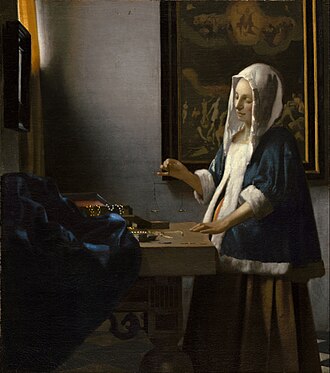 Donna con bilancia - Johannes Vermeer (1665)
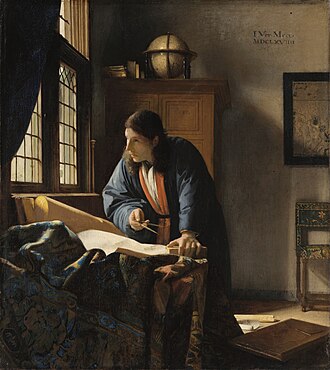 Il geografo - Johannes Vermeer (1668)
Dipinti di artisti collegati
 The Night Watch - Rembrandt van Rijn (1642)
 Self-Portrait - Rembrandt van Rijn (1659)
 Supper at Emmaus - Caravaggio (1601)
 La vocazione di San Matteo - Caravaggio (1609)
 Las Meninas - Diego Velázquez (1656)
 The Surrender of Brea - Diego Velázquez (1635)