La Crucifixion
Andrea Mantegna · 1450s
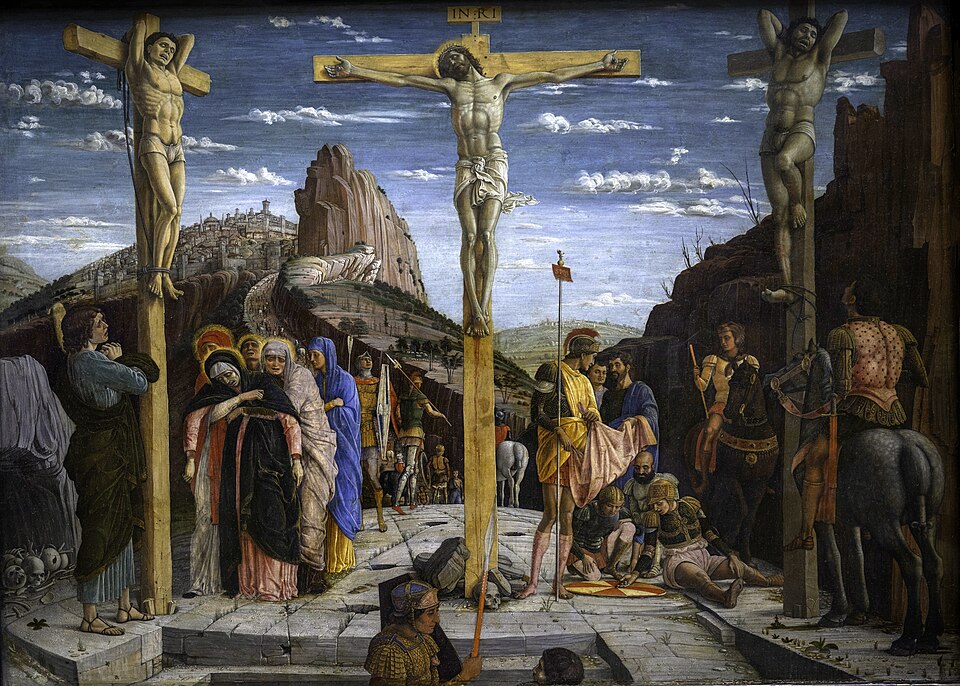
Soldiers in exact Roman armour stand at the foot of the cross, and the ground curves away as if the world itself were bending. This small panel was the heart of the base of Mantegna's great altarpiece for San Zeno in Verona.
The story behind the painting
Mantegna painted the Crucifixion between 1457 and 1459 as the central panel of the predella, the strip of small scenes at the base of a large altarpiece for the high altar of San Zeno in Verona. The altarpiece was commissioned by Gregorio Correr, abbot of the monastery. The Crucifixion sat exactly in the middle of that predella. Wikidata dates the panel simply to the 1450s, which agrees with this range. The panel is about 76 by 96 cm, small beside the altarpiece above it but full of detail.
What to look for
Mantegna wanted a steep effect of perspective, like the one he had already achieved in the Eremitani chapel at Padua. Look at the figures in the foreground, cut off by the frame: they push the scene back into depth. The lines of the ground curve inwards and seem to contract. Every detail of the landscape is rendered with great care, showing his feeling for nature. And look closely at the Roman soldiers: their equipment is drawn with an accuracy that was unusual for the time. Christ and Mary are among the figures Wikidata lists in the scene.
Meaning and intent
That care for Roman detail reveals Mantegna's attitude to antiquity. Florentine artists of the period tried to understand and match the beauty of ancient sculpture and architecture but cared little for historical exactness. Mantegna pursued it with the devotion of an archaeologist. His background helps explain this: from the fourteenth century the Veneto was the main Italian centre for the trade in antiquities, and Venetian towns had cabinets of antiquities long before Florence did. The Crucifixion is therefore both a devotional image and a piece of reconstructed history.
Legacy
The panel was brought to the Louvre in 1798 and put on display at once. In 1806 two other predella panels, the Mount of Olives and the Resurrection, were sent to the museum of Tours. In 1815 the central panel and wings of the altarpiece were taken back to Italy and shown in the city museum of Verona, and after 1918 they returned to San Zeno, where they remain, though they are not easy to see. The 1815 commission that reclaimed art taken from the Veneto left the predella panels in France, so the Crucifixion is still in the Louvre.
Le saviez-vous ?
- Central predella panel of the San Zeno altarpiece, 1457-1459.
- Commissioned by abbot Gregorio Correr.
- In the Louvre since 1798.
- The main altarpiece returned to San Zeno after 1918.
À propos de l'artiste
Andrea Mantegna (1431-1506)
art religieux · homme · Marie · département des peintures du musée du Louvre · Jésus-Christ · Première Renaissance
Autres œuvres de Andrea Mantegna
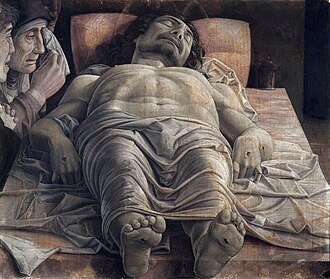 Lamentation sur le Christ mort - Andrea Mantegna (1483)
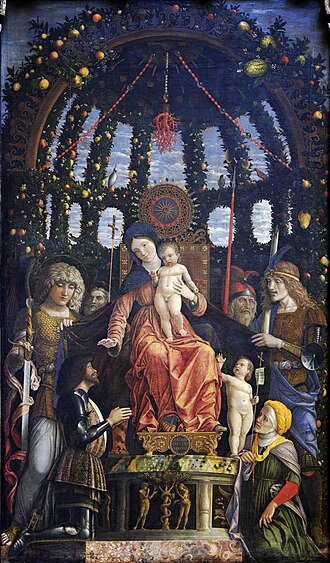 La Vierge de la Victoire - Andrea Mantegna
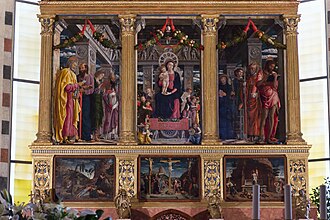 retable de San Zeno - Andrea Mantegna (1457)
 Adoration of the Shepherds - Andrea Mantegna (1450)
 La Madone de la carrière - Andrea Mantegna (1489)
 Le Parnasse - Andrea Mantegna
 L'Introduction du culte de Cybèle à Rome - Andrea Mantegna (1500s)
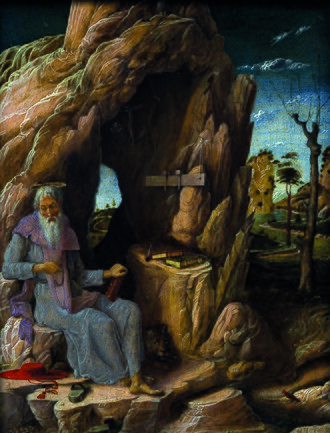 Saint Jérôme dans le désert - Andrea Mantegna
Œuvres d'artistes liés
 La Naissance de Vénus - Sandro Botticelli (c. 1485)
 Le Printemps - Sandro Botticelli (1480s)
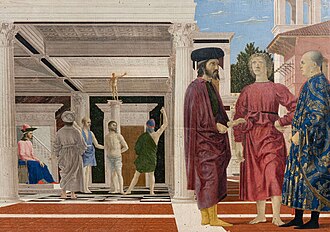 La Flagellation du Christ - Piero della Francesca (1450s)
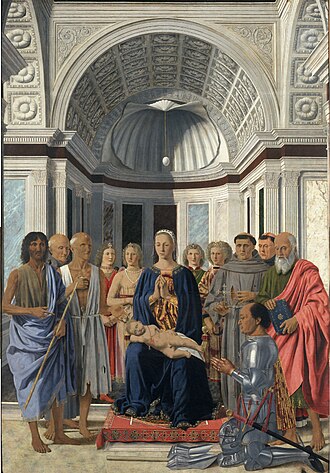 La Conversation sacrée - Piero della Francesca (1472)
 La Joconde - Leonardo da Vinci (1503-1519)
 La Dame à l'hermine - Leonardo da Vinci (1490)
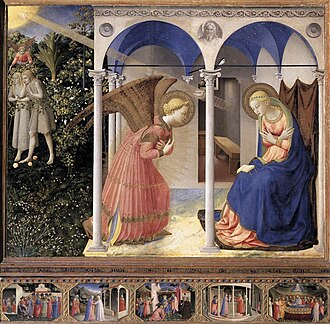 L'Annonciation - Fra Angelico (1425)
 Tondo Cook - Fra Angelico (1430)